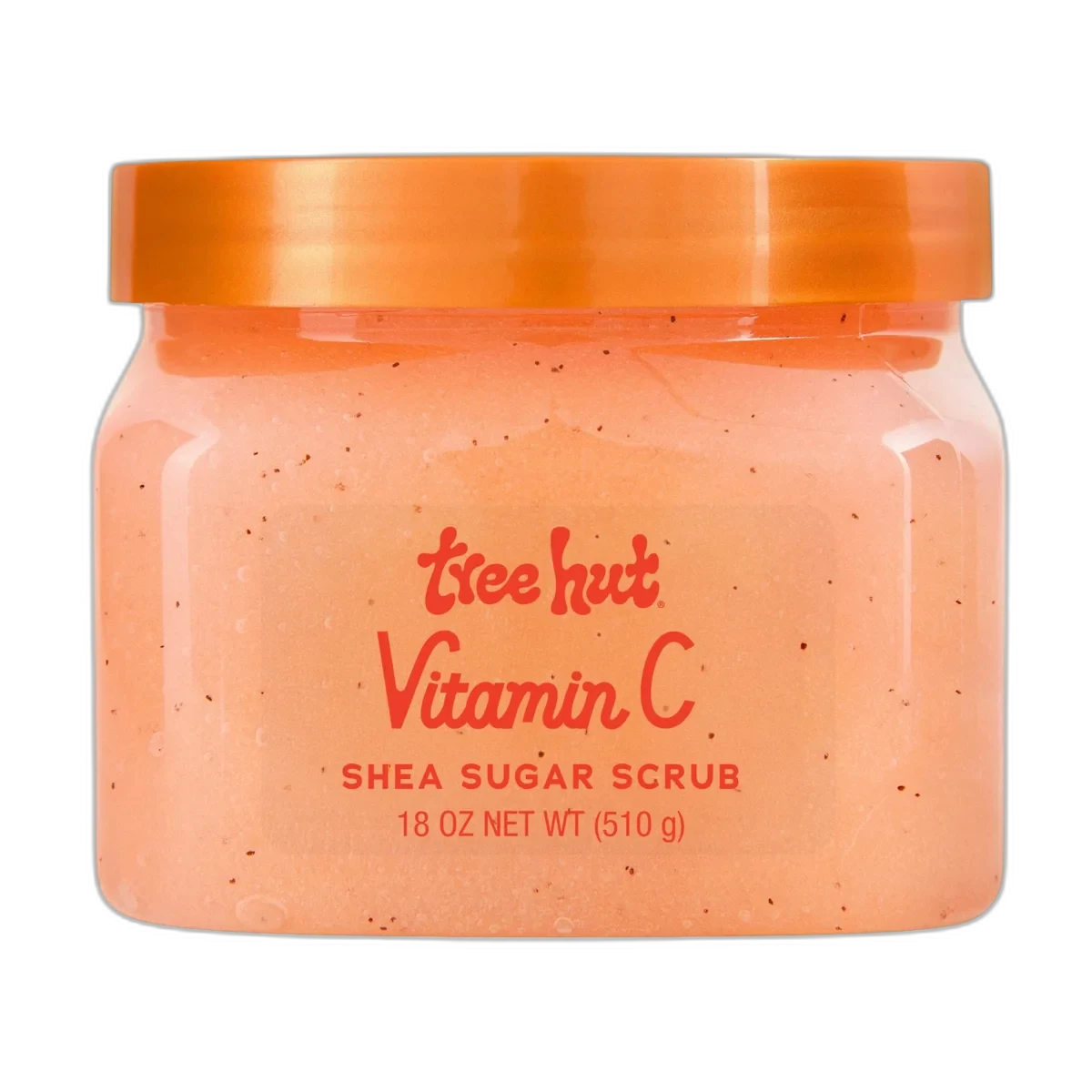
Vitamin C Shea Sugar Scrub
Brightening Body Scrub
 Verified reviewer
Pros & cons.
- +Hybrid mechanical and chemical exfoliation delivers more visible smoothing than scrubs that rely on physical action alone
- +Bright citrus scent escapes the sweetness of other Tree Hut options
- +Visible brightening sensation immediately after use
- +Excellent value at approximately $10 for 18 oz of an active formulation
- +Effective on keratosis pilaris due to the lactic acid component
- +Lactic acid tolerates the short wash-off contact time better than other actives
- +More dramatic results than the brand's standard sugar scrubs
- −Most potentially irritating scrub in the Tree Hut line by a noticeable margin
- −Citrus oils introduce meaningful photosensitivity risk
- −Stings on freshly shaved skin from the acid and citrus combination
- −Not appropriate for sensitive skin, eczema, or rosacea
- −Should not be used more than 1–2 times per week to avoid over-exfoliation
- −Contains retinyl palmitate, which dermatologists recommend avoiding during pregnancy
The full review.
This scrub differs from the rest of the Tree Hut lineup because it contains chemical exfoliants. Most drugstore body scrubs at this price point use purely mechanical exfoliation: sugar or salt in oil with fragrance. The exfoliation relies solely on rubbing crystals against skin. Vitamin C changes this. The formula adds ascorbic acid and lactic acid to the sugar, creating a hybrid of physical and chemical exfoliation. This is unusual at this price point and requires a more careful approach than other Tree Hut products.
Ascorbic acid appears high in the INCI deck, suggesting more than the trace amounts found in many “vitamin C” products. In a leave-on serum, this provides brightening and antioxidant effects over time. In a wash-off body scrub, the contact time is too short for the vitamin C to penetrate the stratum corneum like a serum. Therefore, brightening claims are lower: the ascorbic acid contributes to surface acidity and provides a mild brightening sensation immediately after use. It won’t fade body hyperpigmentation like a leave-on vitamin C body lotion, but it does more than nothing and pairs well with a leave-on brightening product as a second step.
Lactic acid is the more effective active for wash-off use because AHAs tolerate short contact better than vitamin C. Even with a few minutes of contact, lactic acid provides mild surface chemical exfoliation that loosens dead corneocytes and complements the sugar. The combined effect delivers more visible smoothing than standard Tree Hut formulas; you feel the difference within one or two uses, especially on rough areas like elbows, knees, and the backs of upper arms. For keratosis pilaris, this scrub may outperform the rest of the Tree Hut line because chemical exfoliation addresses the keratin plug that mechanical scrubbing alone cannot clear.
The scent also distinguishes this from other Tree Hut offerings. The Tree Hut catalog usually features sweet, floral, or tropical scents like coconut, rose, vanilla, and mango. Vitamin C uses a bright, sharp citrus blend of grapefruit and sweet orange peel oil. It feels energetic and slightly aggressive, matching its brightening positioning. Users who find sweet Tree Hut scents cloying will prefer this. The citrus also feels “active” due to a brisk, slightly tingling quality that the cushioned tropical scents lack.
This brings us to the limitations, which are more significant here than with the rest of the Tree Hut line. The ascorbic acid, lactic acid, grapefruit oil, orange peel oil, and limonene content makes this the most potentially irritating scrub in the brand’s catalog. It can sting on freshly shaved skin where the barrier is disrupted. Skip this if you have sensitive skin, eczema-prone body skin, or a history of contact dermatitis; the irritation potential is higher than standard Tree Hut scrubs, and gentler options exist in the Tree Hut catalog. The grapefruit and orange peel oils also contain furocoumarins and other compounds with photosensitizing potential, making this riskier to use in the morning before sun exposure than non-citrus formulas. Use it in the evening and apply SPF to scrubbed areas the next day.
Usage frequency must be more conservative than with standard Tree Hut scrubs. Combined chemical and physical exfoliation is more aggressive than mechanical exfoliation alone; using this daily or three times a week risks barrier disruption and overexfoliation. Stick to once or twice a week, skip days when you have shaved, and do not layer this with other body actives like a lactic acid lotion or a body retinoid on the same day. It works well as a periodic deep-exfoliation product rather than a daily staple.
The retinyl palmitate in the ingredient list follows standard pregnancy precautions. While the wash-off context makes absorption negligible, dermatology guidance recommends avoiding it during pregnancy. Given the heavy fragrance load, citrus oils, and chemical exfoliants, pregnant users should skip this Tree Hut scrub for a gentler fragrance-free option.
Value remains the strongest part of the Tree Hut case. Eighteen ounces for around $10, containing actual ascorbic acid and lactic acid, is a strong proposition for users seeking a brightening or aggressive exfoliating body scrub. Compared to dedicated AHA body washes or vitamin C body products from premium brands at $25 to $40, this delivers comparable wash-off function for less.
The bottom line: for resilient body skin that wants an active, brightening sugar scrub at drugstore pricing—and can tolerate fragrance, citrus oils, and chemical exfoliants—this is the most effective scrub in the Tree Hut line. For sensitive skin, freshly shaved skin, pregnancy, fungal acne, or anyone wanting gentler exfoliation, choose another Tree Hut scent. Use it in the evening and apply SPF the next day.
Ingredient analysis.
Full INCI list
Sucrose, Glycerin, Polysorbate 20, Silica, Ascorbic Acid, Citrus Paradisi (Grapefruit) Peel Oil, Lactic Acid, Butyrospermum Parkii (Shea) Butter, Persea Gratissima (Avocado) Oil, Carthamus Tinctorius (Safflower) Seed Oil, Prunus Amygdalus Dulcis (Sweet Almond) Oil, Oenothera Biennis (Evening Primrose) Oil, Citrus Aurantium Dulcis (Orange) Oil, Macadamia Ternifolia Seed Oil, Aloe Barbadensis Leaf Juice, Cocos Nucifera (Coconut) Shell Powder, Aqua (Water), Caprylyl Glycol, Retinyl Palmitate, Phenoxyethanol, Sorbic Acid, Orange 4 (CI 15510), Red 4 (CI 14700), Parfum (Fragrance), Limonene, Linalool
Skin match.
The science.
The Science
This formula uses sugar crystals for mechanical exfoliation and ascorbic acid and lactic acid for chemical exfoliation, setting it apart from the rest of the Tree Hut sugar scrub line. Lactic acid is an alpha hydroxy acid (AHA) with extensive evidence regarding the stratum corneum. Multiple studies, including foundational work in the Journal of the American Academy of Dermatology, show lactic acid reduces corneocyte cohesion and promotes desquamation. At the right concentration and pH, leave-on lactic acid improves brightening and texture; in a wash-off scrub like this, the effect is smaller but still works because scrubbing time allows surface exfoliation. Ascorbic acid has limited utility in a wash-off product because its brightening and antioxidant effects need sustained contact and stability, which a wash-off scrub lacks. Here, ascorbic acid provides acidity, mild surface exfoliation, and a fresh sensation after use. Coconut shell powder acts as a secondary mechanical exfoliant; it is more aggressive than sugar and makes the physical scrubbing stronger. The citrus peel oils — grapefruit and orange — provide fragrance but carry a known photosensitivity risk from furocoumarin, a documented phototoxic concern in dermatology literature. The limonene and linalool in the fragrance are common contact allergens in standard patch testing, and combined with the chemical actives, this is the highest irritation-risk scrub in the Tree Hut catalog.
Dermatologist Perspective
Dermatologists see AHA-containing body scrubs as appropriate for keratosis pilaris, body hyperpigmentation, dull body texture, and rough patches on elbows and knees. Board-certified dermatologists note that lactic acid is a well-tolerated AHA and that combining mechanical and chemical exfoliation works better than either alone — if the user tolerates the active load. The citrus oil and furocoumarin content is a concern; dermatologists often tell patients to use citrus-containing products in the evening and apply SPF the next day to scrubbed areas. This scrub is not recommended for patients with sensitive skin, rosacea, eczema, contact dermatitis, or a recent shave. Pregnancy guidance suggests avoiding both the retinyl palmitate and the heavy fragrance and citrus content of this formula for gentler alternatives.
Where it fits in your routine.
Use 1–2 times per week in the evening during a warm shower. Scoop a large amount with clean fingers and apply to wet skin. Massage in circles, focusing on rough areas like elbows, knees, feet, and the backs of upper arms. Avoid the face, freshly shaved skin, irritated patches, and broken or sunburned areas. Rinse thoroughly. Apply SPF the next morning to scrubbed areas because citrus oils increase photosensitivity. Do not use with other body actives like body retinoids or AHA lotions on the same day.
At about $10 for 18 oz, this offers one of the best per-ounce values for AHA-containing body scrubs. Tree Hut provides comparable wash-off chemical exfoliation at a discount compared to First Aid Beauty or Naturium AHA body washes or chemical exfoliating body products priced at $25 to $40. The tradeoff is higher fragrance and citrus oil content and a lower-end fragrance ingredient profile. This is hard to beat for users seeking a brightening or more aggressive exfoliating body scrub at drugstore prices. Some retailers also sell a 27.5 oz value size for even better per-ounce pricing.
This sugar scrub works for normal-to-resilient body skin seeking brightening and active exfoliation at drugstore pricing. It suits users with keratosis pilaris, body hyperpigmentation, or rough body texture who tolerate fragrance and chemical exfoliants. It also fits users who prefer bright citrus scents over sweet or floral options.
Use this if you have sensitive, eczema-prone, or rosacea-prone skin, or avoid fragrance. Skip if you are pregnant, shave the areas you scrub, or use other body actives like a retinoid or AHA lotion. Do not use if you cannot commit to evening-only use and SPF application the next day.
Product details.
Thick orange-tinted oil holds coarse sugar crystals. The added coconut shell powder makes this Tree Hut sugar scrub more aggressive than other versions.
Grapefruit and sweet orange dominate this bright citrus blend. It has a sharp, uplifting energy that differs from the rest of the Tree Hut lineup.
Wide orange-labeled plastic tub with screw-top lid, standard Tree Hut format.
The citrus scent dominates the first use; this is the most aromatic Tree Hut scrub. The exfoliation feels more substantive than other scrubs because it includes coconut shell powder. The lactic and ascorbic acids may cause a slight tingle on freshly shaved skin.
Approximately 2–4 months with weekly full-body use.
12 months
All Year
The backstory.
Tree Hut launched the Vitamin C variant in 2019 as a more 'active' positioning of the standard sugar scrub formula, capitalizing on the broader skincare trend of vitamin C as a brightening hero ingredient. It became one of the brand's top-selling scents and has remained in continuous production.
About Tree Hut
Established Brand (5–20 years)Tree Hut launched in 2002 in Frisco, Texas, under Naterra International. The Vitamin C variant joined the sugar scrub line to brighten skin, using actual ascorbic acid and lactic acid in the formula.
Common myths.
Vitamin C in a wash-off scrub does not brighten skin like a serum does.
Wash-off products have too little contact time for ascorbic acid to penetrate and brighten like a leave-on serum. The vitamin C in this formula lowers surface acidity and provides a mild brightening sensation, but it does not replace a leave-on vitamin C product.
I can use this every day for faster results.
This formula uses mechanical and chemical exfoliation, making it more aggressive than a typical sugar scrub. Daily use causes over-exfoliation, barrier disruption, and irritation. Use it 1–2 times per week.
FAQ.
Does the vitamin C in this scrub actually brighten skin?
Partially. Wash-off products have too little contact time for ascorbic acid to penetrate like a leave-on serum, but the formula's acidity provides mild surface brightening. For real brightening results on body hyperpigmentation, use this with a leave-on vitamin C body lotion.
Why does it sting on shaved skin?
The lactic acid and ascorbic acid in the formula act as mild chemical exfoliants, and the citrus oils contain limonene. This combination causes stinging on freshly shaved skin where the barrier is temporarily disrupted. Do not use immediately after shaving.
Is it safe to use in the morning?
Grapefruit and orange peel oils contain furocoumarins and limonene. These photosensitizing compounds increase sun sensitivity. Use this in the evening and apply SPF the next day, especially on skin you scrubbed recently.
How is it different from the other Tree Hut scrubs?
Vitamin C is the only Tree Hut scrub that uses chemical exfoliants (ascorbic acid and lactic acid) alongside sugar mechanical exfoliation. This is the line's most active formulation and its most aggressive on skin.
Can I use it on my face?
No — this scrub is more aggressive than the other Tree Hut formulas, and the citrus oils, fragrance, and combined chemical and physical exfoliation are too harsh for facial skin.
Is it pregnancy-safe?
The formula contains retinyl palmitate, which dermatologists generally recommend avoiding during pregnancy. The citrus oils and fragrance load also make this a less-than-ideal pregnancy product even setting the retinol concern aside. Choose a fragrance-free body exfoliant instead during pregnancy.
How often should I use it?
Use 1–2 times per week maximum. This combined chemical and physical exfoliation is more aggressive than a standard sugar scrub; overuse disrupts the skin barrier. Skip days when you've shaved or used other body actives.
What the community says.
"Bright citrus scent is uplifting"
"Skin looks visibly more radiant after use"
"More noticeable smoothing than the other scents"
"Helps fade body hyperpigmentation with regular use"
"Stings on shaved or sensitive skin"
"Citrus oils can cause photosensitivity"
"Heavier scent than other Tree Hut scrubs"
"Not for delicate or compromised skin"