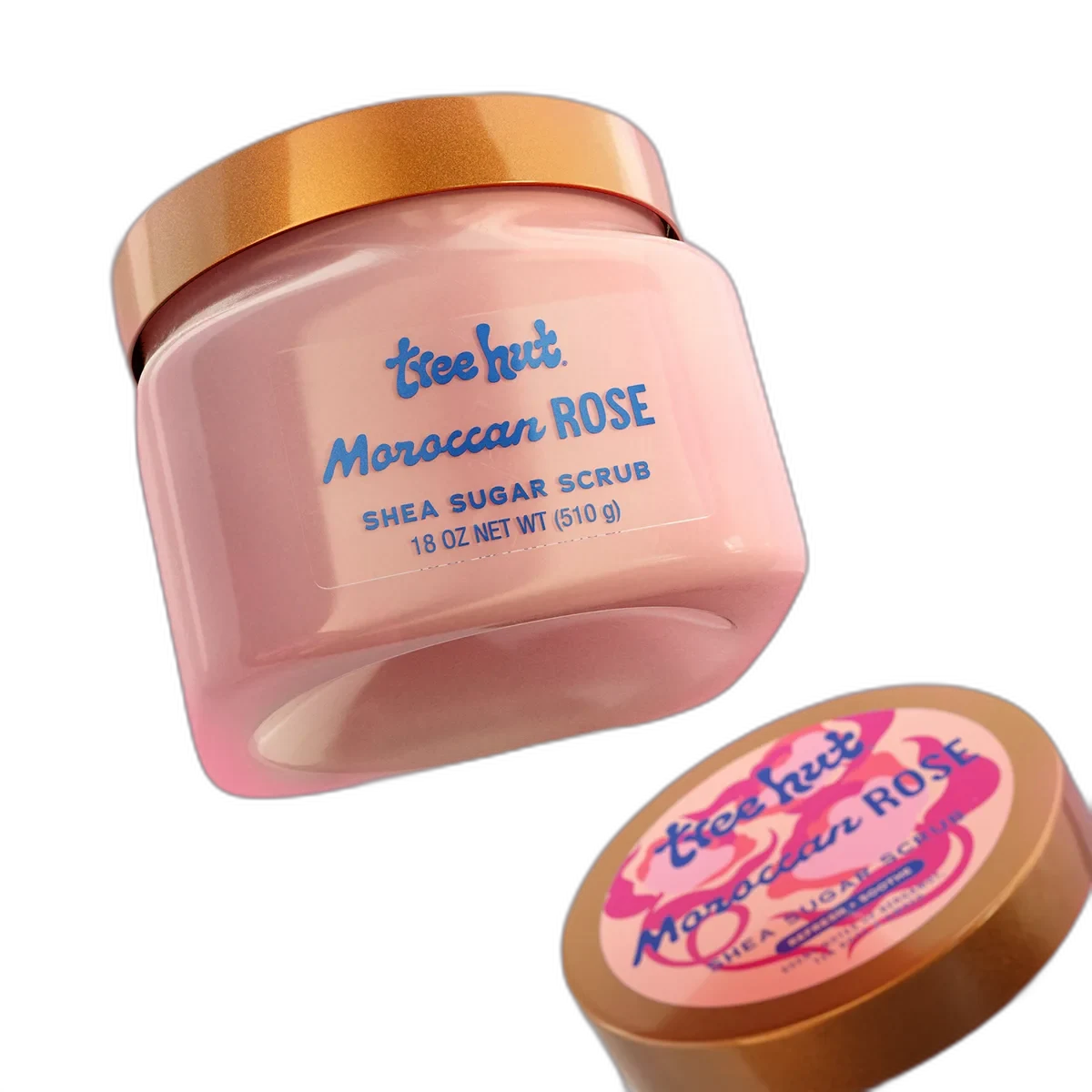
Moroccan Rose Shea Sugar Scrub
Drugstore Spa-Day Favorite
 Verified reviewer
Pros & cons.
- +Modern fresh rose scent that escapes the dated powdery rose stereotype
- +Argan and rosehip oils add genuine conditioning over the base formula
- +Excellent value at approximately $10 for 18 oz
- +Visible improvement in keratosis pilaris with consistent use
- +Sugar crystals dissolve into a gentler exfoliation than salt or apricot scrubs
- +Skin feels conditioned enough to skip body lotion for most users
- +Available in larger 27.5 oz size for heavy users at better per-ounce pricing
- −Heavy fragrance and dye content makes it inappropriate for sensitive skin
- −Pink dye can stain light-colored grout if left to sit
- −Coconut oil and shea content not fungal-acne friendly
- −Slippery oil residue accumulates in the shower
- −Contains retinyl palmitate, which some users avoid during pregnancy
The full review.
Rose has a public relations problem in drugstore body care. For decades the category has been dominated by interpretations that read as powdery, soapy, or vaguely medicinal — the kind of scent you associate with a grandmother’s bathroom or a hand cream you would only use ironically. The result is that even people who love actual roses have learned to be skeptical of anything labeled ‘rose’ on a drugstore shelf, because the chances of it smelling like a real rose are slim. Tree Hut’s Moroccan Rose is one of the few products in this category that actually makes good on the promise. The fragrance is fresh, slightly sweet, and contemporary in a way that registers as modern florals rather than antique potpourri. It is not a perfumer’s masterpiece, but it is a credible interpretation of rose that does not require any apologetic explanation when someone smells it on you.
The formula underneath the scent is Tree Hut’s standard sugar scrub base — sugar crystals suspended in a generous oil and shea butter emulsion — but with two genuinely meaningful additions that distinguish this version from the rest of the line. Argan oil and rosehip oil are listed high enough in the ingredient list to suggest more than trace inclusion, and these are oils that show up in scrubs that retail for $30 to $40 at specialty beauty retailers. Argan is high in vitamin E and tocotrienols, rosehip carries a respectable omega-6 and omega-3 fatty acid profile, and together they give this scrub a slightly more luxurious feel on the skin than the standard Tree Hut oil blend delivers on its own. None of this is going to revolutionize your skin, but it is a meaningful upgrade for the same $10 price point, and it is the kind of detail that explains why Tree Hut’s value proposition has stayed durable through multiple drugstore body care trend cycles.
The scrubbing experience is exactly what you would expect from a Tree Hut sugar scrub — a chunky, oily paste that scoops generously, dissolves under warm water as you massage it into wet skin, and leaves behind a soft conditioned layer that makes body lotion feel optional. The exfoliation is real but not aggressive; the sugar crystals soften as you scrub rather than scratching, which makes this gentle enough for most people’s regular shower routine. Skin feels noticeably smoother on the first use, particularly on rougher areas like elbows, knees, and the backs of upper arms. Anyone with keratosis pilaris on their arms or thighs will likely see visible improvement within a couple of weeks of consistent use, especially when paired with a urea or lactic acid body lotion between scrubs. The conditioning oils address the dryness component of KP that mechanical exfoliation alone cannot fix, which is part of why these scrubs have gained such a strong following among the KP community.
The pink color of the formula is purely cosmetic — Red 4 and Blue 1 dyes give it a soft pink that looks pretty in the tub but doesn’t transfer to skin in any meaningful way. It will, however, stain very light-colored grout or shower walls if left sitting, so a quick rinse of the tub after use is worth getting in the habit of doing. The same is true of the oil residue that accumulates on the shower floor after use; the conditioning that makes this scrub so effective comes at the cost of leaving a slightly slick layer behind that has caused more than one slip incident in user reviews. A non-slip mat solves it.
The limitations of this product are the same limitations that apply to every Tree Hut scrub. The fragrance load is significant — there is parfum, orange peel oil, and synthetic dyes in the formulation, and these are not friendly to sensitive skin, eczema-prone body skin, or anyone with a history of contact dermatitis. The coconut and shea butter content in the formula also means this is not fungal-acne safe, so if you struggle with body acne that turns out to be Malassezia-related, this scrub will probably make it worse rather than better. The retinyl palmitate listed in the ingredient deck is also worth knowing about for anyone pregnant or trying to avoid retinoids out of an abundance of caution. The actual concentration in a wash-off product is minimal and the absorption is essentially negligible, but dermatologists generally recommend the safer call during pregnancy.
Value is where this scrub continues to make a strong case. Eighteen ounces for around $10 is significantly more product per dollar than competitive scrubs from any of the higher-end body care brands, and the formulation actually delivers on the promise. Sol de Janeiro and Frank Body sell similar shea butter sugar scrubs at roughly $30 to $40, and while their fragrance profiles are different and arguably more sophisticated, the basic mechanical and conditioning function is identical. For someone who scrubs once or twice a week, a Tree Hut tub easily lasts two to three months, putting the cost per use in essentially negligible territory. There is also a 27.5 oz value size of this scent available at some retailers, which drops the per-ounce cost even further for heavy users.
The bottom line: for resilient body skin that tolerates fragrance and wants a modern rose scent without paying boutique prices, this is one of the better drugstore body scrubs on the shelf, and the argan and rosehip oils give it a small but real edge over the rest of the Tree Hut lineup. For sensitive skin, eczema, fungal acne, or pregnancy, look elsewhere — Tree Hut also offers a fragrance-free option in the same base formula that is worth checking out.
Ingredient analysis.
Full INCI list
Sucrose, Glycerin, Polysorbate 20, Silica, Rosa Canina Fruit Oil, Argania Spinosa Kernel Oil, Butyrospermum Parkii (Shea) Butter, Persea Gratissima (Avocado) Oil, Carthamus Tinctorius (Safflower) Seed Oil, Citrus Aurantium Dulcis (Orange) Oil, Macadamia Ternifolia Seed Oil, Oenothera Biennis (Evening Primrose) Oil, Prunus Amygdalus Dulcis (Sweet Almond) Oil, Aqua (Water/Eau), Caprylyl Glycol, Ascorbic Acid, Retinyl Palmitate, Phenoxyethanol, Sorbic Acid, Red 4 (CI 14700), Blue 1 (CI 42090), Parfum (Fragrance)
Skin match.
The science.
The Science
This product uses mechanical exfoliation. Sucrose crystals physically remove dead corneocytes from the stratum corneum and dissolve during use. This self-limiting behavior makes sugar a gentler physical exfoliant. The formula conditions skin using a blend of triglyceride-rich oils, specifically argan (Argania spinosa) and rosehip (Rosa canina). A 2015 review in the Journal of Cosmetic Dermatology shows argan has antioxidant capacity from tocopherol and tocotrienol, with evidence supporting improved skin elasticity and barrier support in topical applications; however, most evidence involves leave-on use rather than wash-off. Rosehip oil has omega-3 and omega-6 fatty acids and trace trans-retinoic acid, which interests dermatologists, though evidence again relies on leave-on application. In a wash-off product, these oils mostly affect immediate post-rinse conditioning and sensory feel rather than measurable long-term skin effects. Limonene, parfum, and azo-type colorants drive irritation risk, as these are common contact allergens in standard patch testing series.
Dermatologist Perspective
Dermatologists view Tree Hut sugar scrubs as an acceptable affordable option for body exfoliation, especially for patients with keratosis pilaris, dry body texture, or rough patches on elbows and feet. The conditioning oil base makes this category more skin-friendly than mineral-oil-based budget scrubs, and the Moroccan Rose formula adds argan and rosehip as an upgrade. Board-certified dermatologists note that fragrance and synthetic dyes are inappropriate for sensitive skin, eczema, or contact dermatitis patients, and these patients should skip this product line. Patients using prescription topical retinoids for the body should also avoid mechanical scrubs to reduce irritation on sensitized skin.
Where it fits in your routine.
In a warm shower, scoop a large amount with clean fingers and apply to wet skin. Massage in circles, targeting rough areas like elbows, knees, feet, and the backs of upper arms. Avoid the face, irritated patches, and broken or sunburned skin. Rinse thoroughly. Use 1–3 times per week. Most users do not need extra body lotion afterward, but dry winter skin can still use a moisturizer. Rinse the tub after use so dye residue does not stain grout.
At about $10 for 18 oz, this has one of the best per-ounce values in body scrubs. Argan and rosehip oils upgrade the brand's standard formula at no extra cost. A 27.5 oz value size offers better per-ounce pricing for heavy users. Tree Hut provides comparable mechanical and conditioning function for less than a third of the cost of specialty body scrubs from brands like Sol de Janeiro or Frank Body, which retail for $30 to $40. The tradeoff is more aggressive fragrance and synthetic dye content. For users who tolerate scent, this is hard to beat.
This rose-scented sugar scrub works for normal-to-dry body skin, keratosis pilaris management, or general body smoothing. It costs drugstore prices, making it a good gift for rose lovers or an entry point into body exfoliation for users avoiding $30+ spends.
Users with sensitive, eczema-prone, fungal-acne-prone, or fragrance-avoidant skin. Skip if you are pregnant and avoid retinyl palmitate, or if pink dye might stain light-colored shower grout.
Product details.
Modern rose blend — softer and less powdery than traditional rose products. It stays on skin for 30–60 minutes after rinsing.
Wide pink-labeled plastic tub with screw-top lid. Standard Tree Hut format — easy to scoop, slightly messy in shower environments. Finish non-greasynatural What to Expect on First Use First use, the rose scent is noticeable but not overwhelming. The scrub feels cushioned by the oil base, and skin feels soft and faintly perfumed after rinsing. The pink dye does not transfer to skin in any meaningful way despite the visible color of the product. How Long It Lasts Approximately 2–3 months with twice-weekly full-body use. Period After Opening 12 months
All Year
The backstory.
Moroccan Rose has been part of the Tree Hut sugar scrub lineup since the mid-2010s, predating the TikTok wave that made the brand viral. It has consistently been one of the brand's top-three sellers because rose is a perennial drugstore favorite scent and the formulation upgrade with argan and rosehip oils makes it feel slightly more luxurious than the brand's other scents.
About Tree Hut
Established Brand (5–20 years)Tree Hut launched in 2002 in Frisco, Texas, under Naterra International. Moroccan Rose is one of the brand's oldest scents, existing before TikTok-era virality made Tree Hut a household drugstore name.
Common myths.
Rose products are old-fashioned and grandma-y.
Modern rose fragrances no longer use the powdery, soapy notes of the 1980s. Tree Hut's blend smells like fresh-cut rose petals with a sweet undertone, making it contemporary instead of dated.
The pink dye in the formula will stain my skin.
The synthetic colorants are cosmetic only and rinse off with water. They stain light-colored grout or shower surfaces if left to sit, so rinse the tub after use.
FAQ.
Is the rose scent strong?
The scent is noticeable but not overwhelming. It smells like modern fresh rose, not the powdery, traditional rose in older fragrance products. The scent stays on skin for 30–60 minutes after rinsing.
Will the pink dye stain my skin or shower?
The dye does not transfer to skin. It stains very light-colored grout if left to sit, so rinse with a quick shower after use.
How does it compare to the Coco Colada version?
The base formula and exfoliating action are the same. Moroccan Rose adds argan oil and rosehip oil, which the Coco Colada formula lacks, and uses a rose fragrance instead of tropical. It is slightly more conditioning and costs about the same.
Is it safe for pregnancy?
The formula contains retinyl palmitate (vitamin A). Dermatologists generally recommend avoiding this during pregnancy. While topical absorption from a wash-off product is minimal, sensitive users may prefer a retinol-free body exfoliant.
Can I use it on my face?
No — the fragrance, dye, and coarse sugar grain are too harsh for facial skin. Use it on the body only.
Will it help with keratosis pilaris on my arms?
Yes, consistent twice-weekly use reduces bumps for most KP sufferers within a few weeks. For best results, use a urea or lactic acid body lotion between scrubs.
How often should I use it?
Use 1–3 times per week for body use. Daily use is unnecessary and causes over-exfoliation, especially in winter or on already-dry skin.
Community
What the community says.
"Romantic rose scent without being grandma-floral"
"Leaves skin glowing soft"
"Pretty pink color"
"Makes shower feel like a spa moment"
"Pink dye stains light shower walls"
"Heavy fragrance"
"Oily floor in shower"
"Not for sensitive skin"