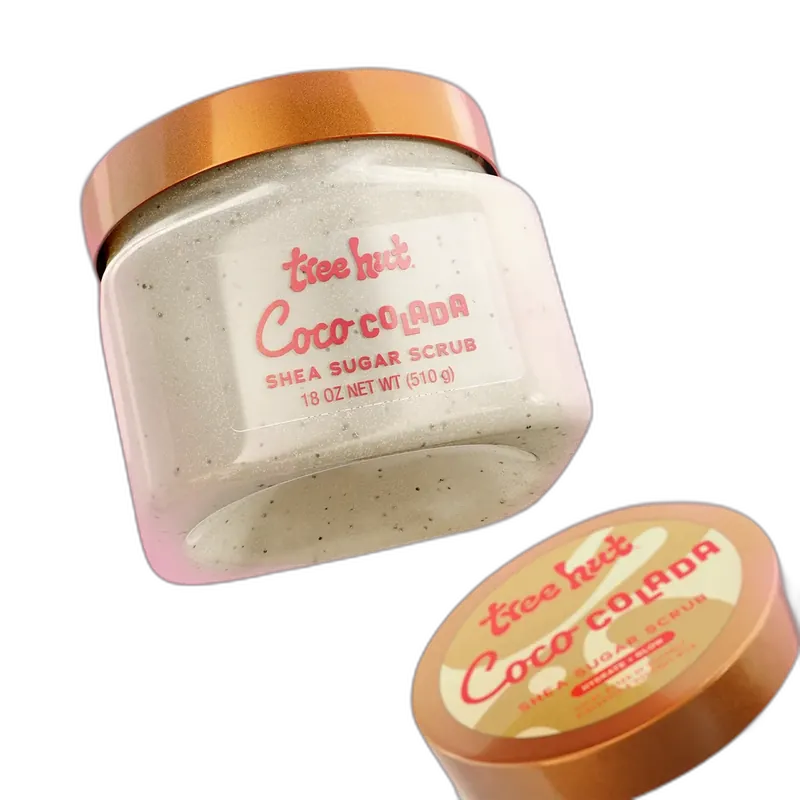
Coco Colada Shea Sugar Scrub
Drugstore Body Scrub Cult Favorite
 Verified reviewer
Pros & cons.
- +Substantial oil and shea butter base genuinely conditions while exfoliating
- +Excellent value at roughly $10 for an 18 oz tub
- +Visible reduction in keratosis pilaris with consistent weekly use
- +Sugar crystals dissolve into a gentler exfoliating action than salt or apricot
- +Lingering tropical scent doubles as an in-shower aromatherapy moment
- +Skin feels conditioned enough to skip body lotion if desired
- +Smooths rough patches on elbows, knees, and feet on first use
- −Heavy fragrance load makes it unsuitable for sensitive or eczema-prone skin
- −Contains limonene and citrus oils that are known contact irritants
- −Coconut oil and shea butter are not fungal-acne friendly
- −Slippery oil residue accumulates in the shower after use
- −Wide tub gets messy with wet hands during showering
The full review.
About Tree Hut
Tree Hut existed for nearly two decades before most people who use it today had ever heard of it.
Reality
The brand was founded in 2002 in Frisco, Texas, and quietly built a steady business at Walmart and Target throughout the 2000s and 2010s as a competent, mid-shelf body care option you bought when you wanted something nicer than store brand but did not want to spend money on Bath & Body Works. Then TikTok happened. Around 2020 and 2021, the sugar scrubs — and Coco Colada in particular — became one of the platform’s running visual jokes about people scooping out enormous handfuls of buttery scrub in their shower routine videos. By 2022, Tree Hut had transformed into a household name. The actual product had not changed at all. The internet just decided it was time to notice.
What the internet was noticing was the oil base. Most drugstore body scrubs at this price point are essentially fragranced sugar mixed into cheap mineral oil — they exfoliate fine, but they leave skin feeling tight and stripped because there is no real conditioning happening. Tree Hut went a different direction. The Coco Colada scrub contains shea butter, coconut oil, evening primrose oil, almond oil, macadamia oil, avocado oil, and safflower oil. That is a genuinely substantial blend, and you feel it on your skin both during the scrub and for hours after. The scrub does not leave you reaching for body lotion the way a typical drugstore scrub does, and that single difference is most of why this product became viral.
The scent is the other half of the story, and it is the part where opinions split sharply. Coco Colada smells like a piña colada that has been handed to you by someone who really wanted to make sure you knew it was a piña colada — heavy on coconut, sweet pineapple in the background, with the dessert-like quality that polarizes some users. If you love it, it is genuinely transporting and lingers on the skin for thirty minutes after rinsing in a way that doubles as a passive perfume. If you do not love sweet tropical scents, you will know within five seconds of opening the tub. The fragrance is not subtle, and the formula contains both ‘parfum’ and orange peel oil with limonene, so it is meaningfully scented from multiple sources.
The texture experience is part of the appeal too. You scoop a generous amount with your fingers — and it is hard not to scoop generously — and the chunky, oily paste plops into your palm with the kind of satisfying weight that drugstore scrubs rarely have. Massaged onto wet skin in the shower, the sugar dissolves quickly under warm water, leaving behind the oil-and-butter layer that does the conditioning work. Skin feels noticeably smoother on the first use, particularly on rough areas like elbows, knees, and the backs of arms. With consistent use two or three times a week, anyone with keratosis pilaris on their upper arms or thighs will probably see a real reduction in the bumps within a few weeks — the mechanical exfoliation handles the surface texture while the oils address the dryness component that drives the condition.
The limitations are real and worth taking seriously before adding this to your shower. The fragrance load makes it a bad choice for sensitive skin, eczema-prone body skin, or anyone with a history of contact dermatitis. The orange peel oil and limonene are well-documented contact allergens, and the synthetic fragrance adds another layer of potential irritants. The coconut oil and shea butter content also means this is not a friendly product for fungal acne — if you struggle with body acne that turns out to be Malassezia folliculitis, this scrub will likely make it worse rather than better. The retinyl palmitate buried in the ingredient list also means dermatologists generally recommend avoiding this during pregnancy, even though the absorption from a wash-off product is minimal — it is a precautionary call, not a hard rule.
The shower slip issue is also worth a mention. The oil content is generous enough that residue accumulates on the tub floor, and people regularly mention slipping incidents in reviews. A quick rinse of the tub after use solves it, but it is the kind of small annoyance that is worth knowing in advance.
Value is where this product is genuinely impressive. Eighteen ounces for around $10 is significantly more product per dollar than almost any equivalent body scrub, and the formulation actually delivers — this is not a case of getting what you pay for in a bad way. For someone who scrubs once or twice a week, a single tub will easily last two to three months, which puts the cost per use in the realm of pocket change. Compared to luxury body scrubs from brands like Sol de Janeiro or Frank Body, you get more product for less money with comparable or better conditioning, the only honest tradeoff being the more aggressive fragrance load.
Ingredient analysis.
Full INCI list
Sucrose, Glycerin, Polysorbate 20, Silica, Fragrance (Parfum), Phenoxyethanol, Caprylyl Glycol, Aqua (Water/Eau), Cocos Nucifera (Coconut) Shell Powder, Sorbic Acid, Ascorbic Acid, Cocos Nucifera (Coconut) Oil, Oenothera Biennis (Evening Primrose) Oil, Carthamus Tinctorius (Safflower) Seed Oil, Macadamia Ternifolia Seed Oil, Prunus Amygdalus Dulcis (Sweet Almond) Oil, Persea Gratissima (Avocado) Oil, Butyrospermum Parkii (Shea) Butter, Ananas Sativus (Pineapple) Fruit Extract, Retinyl Palmitate, Citrus Aurantium Dulcis (Orange) Peel Oil, Tocopherol, Limonene, Titanium Dioxide (CI 77891)
Skin match.
The science.
The Science
This product uses mechanical exfoliation — sugar crystals physically strip dead corneocytes from the stratum corneum surface. Sucrose works as a topical exfoliant because it dissolves in water during use, providing self-limiting abrasion gentler than salt, apricot kernels, or pumice. The formula conditions skin using a blend of triglyceride-rich plant oils: shea butter (Butyrospermum parkii), coconut oil (Cocos nucifera), almond oil (Prunus amygdalus dulcis), macadamia oil (Macadamia ternifolia), and avocado oil (Persea gratissima). A 2018 study in the International Journal of Molecular Sciences shows shea butter contains cinnamic acid esters and triterpenes, which support the skin barrier and provide anti-inflammatory effects. Coconut oil has lauric acid, which has antimicrobial activity against gram-positive bacteria but also increases comedogenicity; this makes the scrub a poor choice for acne-prone body skin. Retinyl palmitate is mostly cosmetic at this concentration in a wash-off product — meaningful retinoid activity requires leave-on application — but some dermatologists flag it as a pregnancy precaution. Fragrance and citrus oil (specifically limonene) drive the irritation risk in this formula; these are common contact allergens in standard patch testing series.
Dermatologist Perspective
Dermatologists see Tree Hut sugar scrubs as a reasonable, affordable body exfoliation option, especially for patients with keratosis pilaris, dry body skin, or rough patches on elbows and feet. Board-certified dermatologists note that mechanical body scrubs complement chemical exfoliants like urea or lactic acid lotions, and the conditioning oils make this formula more skin-friendly than mineral-oil-based budget scrubs. Standard caution applies — fragrance and citrus oils make this unsuitable for sensitive skin, eczema, or anyone with a history of contact dermatitis on the body. Patients using prescription topical retinoids on the body should also skip this product to avoid mechanical irritation on sensitized skin.
Where it fits in your routine.
In a warm shower, scoop a large amount with clean fingers and apply to wet skin. Massage in circles across the body. Focus on rough areas like elbows, knees, feet, and the backs of upper arms (for keratosis pilaris). Avoid the face and any irritated, broken, or sunburned skin. Rinse thoroughly. Use 1–3 times per week; adjust frequency based on skin tolerance. Most users do not need additional body lotion after, but dry skin can still use a final moisturizer.
At approximately $10 for 18 oz, this is genuinely one of the best per-ounce values in the body scrub category, and the formulation quality is meaningfully better than other scrubs at the same price point. Smaller 3.4 oz travel sizes are also available and useful for testing the scent before committing to the full tub. For users who scrub regularly and tolerate fragrance, this is hard to beat. For luxury-scrub buyers comparing to brands like Sol de Janeiro, Tree Hut delivers comparable conditioning at less than a third of the price, with the only honest tradeoff being a more aggressive scent profile and lower-end fragrance ingredients.
This sugar scrub works for normal-to-dry body skin needing affordable conditioning and a strong tropical fragrance. It helps keratosis pilaris, rough elbows and knees, and general body smoothing. It also makes a great gift for anyone who loves dessert-like scents.
Use this if you have sensitive skin, eczema-prone skin, or fungal-acne-prone skin, and avoid fragrance. Skip this if you are pregnant and avoid retinyl palmitate, or if you dislike heavy tropical scents.
Product details.
Strong, dessert-like coconut-pineapple tropical fragrance smells like a piña colada. It stays on skin for 30+ minutes after rinsing.
Wide plastic tub with a screw-top lid. The wide opening makes scooping easy but gets messy in the shower.
The scent dominates the first use — you smell it before you feel it. The scrub feels gritty and oily, and skin feels softer immediately after rinsing.
Use twice weekly for the full body for 2–3 months, or longer if you use it as a targeted treatment for elbows and feet.
12 months
All Year
The backstory.
Tree Hut was founded in 2002 in Frisco, Texas, and quietly built a following at Walmart and Target before its sugar scrubs went viral on TikTok in 2020–2021, transforming the brand from a quiet drugstore presence to one of the most-talked-about body care brands in the country. Coco Colada was one of the original scents that benefited most from the viral wave.
About Tree Hut
Established Brand (5–20 years)Naterra International owns Tree Hut, which launched in 2002. The brand is a major US drugstore body-care player. It built its reputation on affordable shea-butter-based body scrubs and washes that went viral in the late 2010s.
Common myths.
Sugar scrubs damage skin like apricot scrubs.
Harsh scrubs get their reputation from apricot-pit scrubs with sharp, irregular fragments. Sugar crystals have softer edges and dissolve during use, making them gentler on the skin barrier.
All drugstore body scrubs are basically the same.
The oil base determines quality here. Cheap scrubs use mineral oil and little butter, which leaves skin tight and stripped. Tree Hut's blend of shea butter and multiple plant oils conditions skin like much more expensive products.
FAQ.
Can I use this on my face?
No — Tree Hut sugar scrubs work for body use only. The fragrance, citrus oils, and coarse sugar grain irritate facial skin and damage the barrier.
How often should I use it?
Use this 1–3 times per week. Daily use is unnecessary and causes over-exfoliation, especially if your routine includes other body actives like a retinoid or AHA body lotion.
Is it safe for sensitive skin?
No — the formula contains fragrance, limonene, and orange peel oil, which are common contact irritants. People with sensitive skin or eczema should use a fragrance-free body exfoliant instead.
Does it help with keratosis pilaris?
Mechanical exfoliation reduces KP bumps, while conditioning oils address dryness. Use a urea or lactic acid body lotion for better results.
Will it clog my pores?
Most people won't have issues on the body. However, the coconut oil and shea butter make it unsuitable for body acne-prone skin or fungal acne (Malassezia folliculitis), as oils feed these conditions.
Is it safe during pregnancy?
The formula contains retinyl palmitate (vitamin A). Dermatologists generally recommend avoiding this during pregnancy. While topical absorption from a wash-off body scrub is minimal, sensitive users may choose a retinol-free alternative.
Why does the shower get slippery after using it?
The oil content is high enough that residue washes off the skin onto the tub floor. Rinse the shower briefly after use, and use a non-slip bath mat if you have one.
What the community says.
"Smells amazing — like real coconut and pineapple"
"Leaves skin soft for hours"
"Affordable for the size"
"Visible smoothing after one use"
"Heavy fragrance can irritate sensitive skin"
"Oily residue in shower can be slippery"
"Tub packaging gets messy with wet hands"
"Not suitable for facial use"