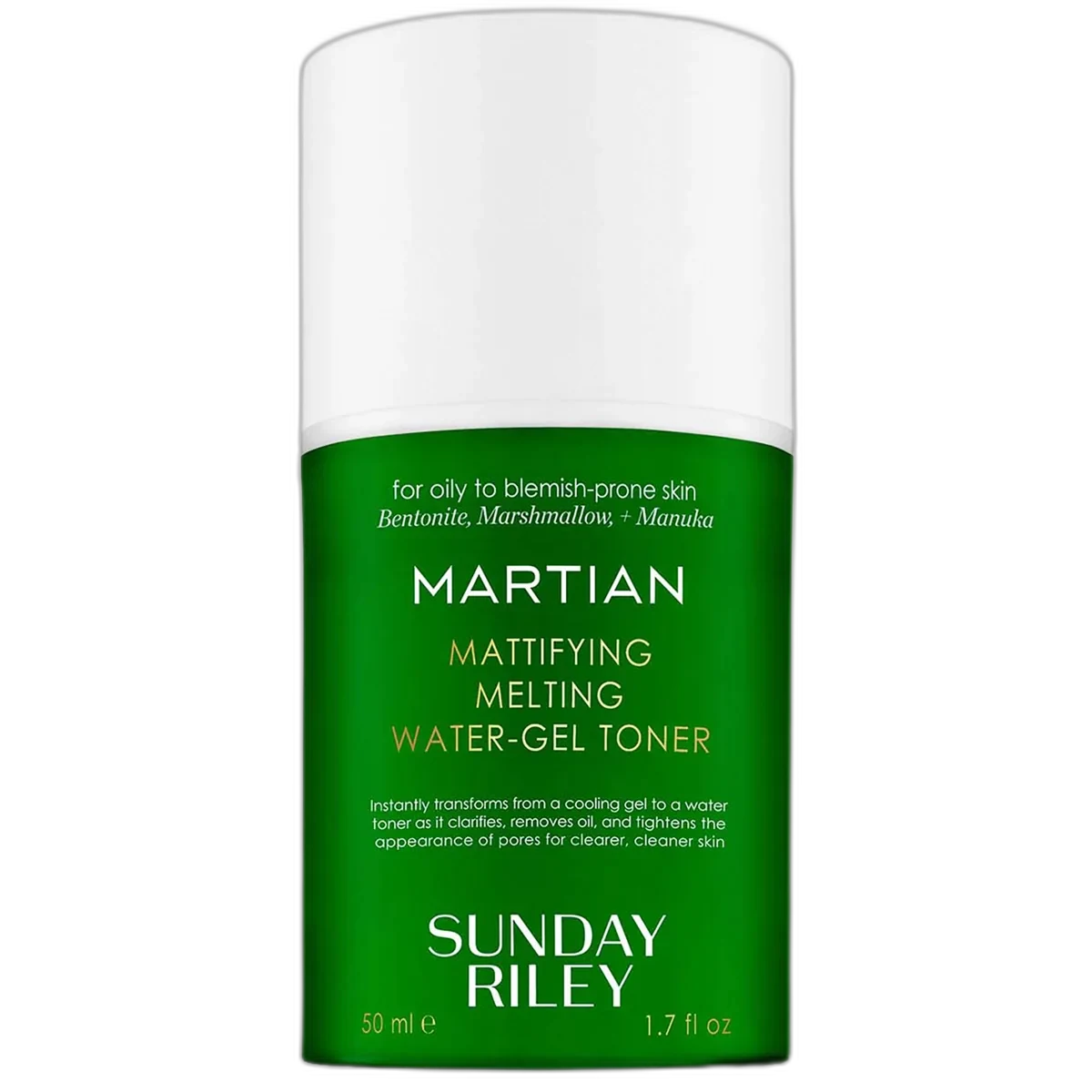
Martian Mattifying Melting Water-Gel Toner
Oil-Control Novelty
 Verified reviewer
Pros & cons.
- +Gel-to-water melting texture is genuinely innovative and satisfying to apply
- +Immediate visible pore-blurring and mattifying effect within minutes
- +Manuka oil and black cumin seed oil provide a thoughtful antibacterial approach for oily skin
- +Creates an excellent smooth canvas for makeup application
- +Cooling sensation feels refreshing on overheated or oily skin
- +Bentonite clay and tapioca starch provide effective short-term sebum absorption
- −Alcohol denat. as second ingredient is drying and contradicts the product's gentle positioning
- −Post-absorption scent transforms into an unpleasant earthy odor — the most common user complaint
- −Mattifying and pore-minimizing effects are temporary, lasting only 3-5 hours
- −Product appears to be discontinued with very limited remaining availability
- −Not vegan due to pearl powder despite the brand's overall vegan-leaning positioning
- −Jar packaging requires finger-dipping, which is less hygienic than pump alternatives
The full review.
Some skincare products exist primarily to be interesting. You show them at sleepovers or post them on Instagram before they work on your skin. Sunday Riley’s Martian Mattifying Melting Water-Gel Toner, launched in 2016, fits this category. The question remains whether the science justifies the price.
The spectacle works. You scoop a fingertip of thick, green-tinted gel from the jar, press it onto your face, and it melts into a watery liquid that disappears into the skin. It feels like a magic trick. The cooling sensation is immediate. Within minutes, pores look blurred and the T-zone has a soft-matte finish that works as a makeup base. The brand cited clinical data: a 53% reduction in T-zone pore size within 10 minutes in a study of 56 subjects. This matches the real-world experience; the effect is noticeable and nearly instant.
But Sunday Riley’s Martian Mattifying Melting Water-Gel Toner loses altitude here. The pore-minimizing effect is temporary. bentonite clay, tapioca starch, and polymethylsilsesquioxane (silicone microspheres) perform a cosmetic trick by physically blurring and absorbing at the skin’s surface. These ingredients do what they claim, but they wash off or fade by midafternoon on most oily skin types. Temporary cosmetic improvement is what a primer does, but the toner positioning and $25 price tag suggest more transformation than the results provide.
The active ingredients tell a complex story. Manuka oil, black cumin seed oil, and magnolia bark extract form an antibacterial trio. Manuka oil’s beta-triketones show in vitro activity against Propionibacterium acnes, and black cumin’s thymoquinone offers anti-inflammatory support. Green tea extract and witch hazel add antioxidant and astringent properties. This combination targets the root causes of oily, congested skin through oil-control and antimicrobial ingredients.
The second ingredient is alcohol denat. In high concentrations, alcohol denat. creates the melting texture and fast-drying finish. It also introduces drying that seems counterproductive for daily use on skin producing excess sebum due to dehydration. The formula includes emollients and botanical oils to offset the alcohol, but it is a contradiction: drying oily skin to control oil is like fighting fire with a flamethethrower.
Then there is the smell. Initial application smells herbal and lemongrass-forward. As the product absorbs and volatile notes evaporate, the scent becomes earthy and pungent. Reviewers compare it to dried shrimp, wet rags, or bird seed. This is the most consistent complaint across every retailer. When the most common user feedback concerns an unpleasant odor, it is a formulation problem that texture cannot hide.
The texture innovation is worth examining. Gel-to-water technology uses surfactant systems—sorbeth-30 tetraisostearate and sorbitan sesquiisostearate—to create a gel that breaks on contact with skin to release the aqueous phase. This is clever cosmetic chemistry, and Sunday Riley’s cosmetic chemist founder clearly engineered it well. But clever chemistry should serve skin health, not just sensory novelty. The transformation is satisfying, but a light film of mattifying minerals on alcohol-dried skin could be achieved more simply.
The ingredient list includes pearl powder as the final ingredient, so this product is not vegan despite the brand’s general lean toward vegan formulations. Pearl powder at that concentration likely only adds marketing appeal, but consumers should note it.
Value is where the Martian struggles. At $25 for 1.7 ounces, it is moderately priced for Sunday Riley but expensive for a toner with temporary effects and a divisive scent. The 4.4-ounce bottle at $55 offers better per-ounce value but commits you to a product you may not love once the novelty fades.
Sunday Riley appears to have quietly discontinued the product. It is no longer on the brand’s official website and is out of stock at most major retailers as of 2026. This is not surprising. The Martian never reached the cult status of Sunday Riley’s hero products. The novelty texture, niche audience (strictly oily skin), and scent issue likely limited repeat purchases. It was an interesting experiment, but interesting is not essential.
Formula
Ingredient analysis.
Full INCI list
Water, Alcohol Denat., Dicaprylyl Carbonate, Dimethyl Isosorbide, Sorbeth-30 Tetraisostearate, Sorbitan Sesquiisostearate, PPG-8 Ceteth-20, Acrylates/Beheneth-25 Methacrylate Copolymer, Dipropylene Glycol, Taraktogenos Kurzii Seed Oil, Nigella Sativa (Black Cumin) Seed Oil, Leptospermum Scoparium (Manuka) Branch/Leaf Oil, Potassium Lauroyl Wheat Amino Acids, Palm Glycerides, Capryloyl Glycine, Magnolia Grandiflora Bark Extract, Lauryl Lactate, Phenoxyethanol, Caprylyl Glycol, Chlorphenesin, Tapioca Starch, Polymethylsilsesquioxane, Bentonite, Tapioca Starch Polymethylsilsesquioxane, Propanediol, Cucumis Sativus (Cucumber) Fruit Extract, Althaea Officinalis (Marshmallow) Root Extract, Hamamelis Virginiana Leaf Extract, Camellia Sinensis (Green Tea) Leaf Extract, Cymbopogon Schoenanthus Oil, Triethanolamine, Melia Azadirachta Leaf Extract, Melia Azadirachta Flower Extract, Amino Esters-1, Mimosa Tenuiflora Bark Extract, Coccinia Indica Fruit Extract, Solanum Melongena (Eggplant) Fruit Extract, Aloe Barbadensis Flower Extract, Lawsonia Inermis (Henna) Extract, Ocimum Sanctum Leaf Extract, Curcuma Longa (Turmeric) Root Extract, Corallina Officinalis Extract, Ocimum Basilicum (Basil) Flower/Leaf Extract, Pearl Powder
Skin match.
The science.
The Science
The Martian toner controls oil through physical absorption and antibacterial activity. Bentonite clay, a montmorillonite mineral, adsorbs sebum via ion exchange; its negatively charged platelets bind the positively charged lipid components of sebum. A 2017 review in the Iranian Journal of Public Health confirmed bentonite's oil-absorbing and antimicrobial properties (Iranian J Public Health, 2017). However, a 2023 study in the Journal of Cosmetic Dermatology found that bentonite clay masks improved sebum content and skin evenness but did not significantly change actual pore area—distinguishing how pores look from their actual size (J Cosmet Dermatol, 2023).
Manuka oil (Leptospermum scoparium) is the formula's most distinctive active ingredient. A 2020 review in Molecules confirmed strong in vitro antimicrobial activity from beta-triketone compounds, including activity against Propionibacterium acnes—the bacterium linked to inflammatory acne. The review also noted manuka oil's anti-inflammatory properties via 5-lipoxygenase inhibition, which reduces redness and swelling in acne lesions (Molecules, 2020). However, the review noted that clinical evidence in human skincare remains limited.
The alcohol denat. in this formula has two roles: it enables the gel-to-water phase transition and enhances penetration for oil-soluble actives. However, high concentrations of denatured alcohol can impair the skin barrier by dissolving lipids in the stratum corneum, which may trigger compensatory sebum production—the opposite of the product's intended long-term effect.
References
- Bentonite Clay as a Natural Remedy: A Brief Review — Iranian Journal of Public Health (2017)
- Comprehensive assessment of the efficacy and safety of a clay mask in oily and acne skin — Journal of Cosmetic Dermatology (2023)
- Manuka Oil — A Review of Antimicrobial and Other Medicinal Properties — Molecules (2020)
Dermatologist Perspective
Dermatologists view mattifying toners with high alcohol content cautiously, as short-term oil control can damage barrier function. Board-certified dermatologists note that alcohol denat. as the second ingredient suggests a high concentration that may cause rebound oiliness in some users. The manuka oil and bentonite clay components have dermatological merit; manuka's antimicrobial properties are recognized, and clay-based sebum absorption is a standard approach. However, dermatologists typically recommend that patients with oily, acne-prone skin prioritize barrier-supportive ingredients (niacinamide, salicylic acid) over astringent-based approaches. This product is best used as an occasional mattifying step rather than a daily toner.
Where it fits in your routine.
Use clean fingers to scoop a small amount of gel. Press it onto clean, dry skin, targeting the T-zone and visible pores. Massage gently until the gel melts into a watery texture and absorbs. Wait 30-60 seconds for the mattifying effect to set before you apply serum, moisturizer, or sunscreen. Use this in the morning before makeup. It is not necessary for evening routines.
At $25 for 1.7 fl oz, the Martian toner is moderately priced for Sunday Riley, but expensive for a mattifying toner with mostly temporary cosmetic effects. The 4.4 fl oz size at $55 has better per-ounce value. Sunday Riley's prestige reputation justifies the price for its complex formulation and textural innovation, but the temporary results and the product's apparent discontinuation make it harder to recommend than simpler, more accessible mattifying options.
Oily-skinned people wanting an immediate pore-blurring effect before makeup, users who enjoy textural novelty in their skincare routine, and those who tolerate botanical fragrances and a polarizing scent profile.
This is for people with dry, sensitive, or compromised skin that reacts to alcohol denat.; those bothered by strong or changing scents in skincare; people seeking permanent pore reduction instead of temporary cosmetic blurring; and anyone who prefers widely available products, as this is discontinued.
Product details.
This thick, milky gel turns into a lightweight, watery texture when massaged into the skin. The melting sensation is the product's signature experience. Once absorbed, the bentonite and tapioca starch leave a soft-focus matte finish.
The initial application has pleasant herbal and lemongrass notes. As the product absorbs, the scent changes. Many users describe the post-absorption smell as earthy, musty, or like dried botanicals. This scent transformation is the most polarizing aspect and the single most common complaint in user reviews.
A frosted glass jar shows a green-toned gel. This jar format requires finger-dipping, which is less hygienic than pump or tube packaging. The aesthetic matches Sunday Riley's apothecary-inspired branding.
The first application features a texture transformation — the thick gel melts into water on contact with skin. Most users see immediate tightening and mattifying effects. The scent shifts from fresh to earthy. No adjustment period or purging occurs.
6-8 weeks with daily morning use (1.7 oz size)
12 months
spring summer
The backstory.
Martian launched in 2016 as Sunday Riley's play for the oily-skin market, complementing the brand's existing focus on treatment serums and oils. The 'Martian' name and green gel aesthetic leaned into the brand's whimsical naming convention (alongside 'Luna' and 'Saturn'). The product appears to have been quietly discontinued, suggesting it never achieved the cult following of Sunday Riley's hero products.
About Sunday Riley
Established Brand (5–20 years)Cosmetic chemist Sunday Riley founded Sunday Riley in 2009 in Houston, Texas. The brand is Leaping Bunny and PETA certified cruelty-free, B Corp certified, and uses active-driven formulations. The Martian toner is discontinued or has very limited availability as of 2026.
Common myths.
Toners with alcohol denat. harm oily skin and cause rebound oiliness.
Alcohol denat. can dry skin and strip natural oils. This formula uses dicaprylyl carbonate, humectants, and botanical oils to partially offset that drying effect. But for daily use on compromised or sensitized oily skin, the alcohol content is a concern that may outweigh the mattifying benefits.
This toner permanently shrinks pores.
The pore-minimizing effect is cosmetic and temporary. bentonite clay and tapioca starch create a soft-focus blurring effect that lasts only hours. Genetics, sebum production, and skin elasticity determine pore size. No topical toner permanently reduces pore diameter.
FAQ.
Is Sunday Riley Martian toner discontinued?
The Martian toner is discontinued or has very limited availability as of 2026. Sunday Riley removed it from their official website, and most major retailers are out of stock. Third-party sellers may still have remaining inventory.
Why does Sunday Riley Martian toner smell bad after applying?
The botanical oil blend — specifically manuka oil, black cumin seed oil, and lemongrass oil — reacts with your skin's warmth and chemistry to change the scent. The initial herbal scent becomes an earthier, more pungent aroma as the product absorbs. Users report this downside most often.
Is the alcohol in Sunday Riley Martian toner bad for skin?
Alcohol denat. is the second ingredient, so the concentration is high. It helps the gel-to-water transformation and mattifying effect, but daily use can dry and irritate sensitized skin. The formula includes emollients and botanical oils to offset drying, but users with compromised barriers should be cautious.
Can I use Sunday Riley Martian toner with retinol?
You can, but use caution. The alcohol denat. and witch hazel in this formula can increase the drying and sensitizing effects of retinol. If you use both, apply the Martian toner in the morning and your retinol at night to minimize interaction. Watch for more dryness or irritation.
What the community says.
"Unique gel-to-water texture feels refreshing and satisfying to apply"
"Effective immediate mattifying and pore-blurring effect"
"Creates a smooth base for makeup application"
"Cooling sensation feels pleasant on oily skin"
"Noticeable reduction in midday shine with regular use"
"Unpleasant lingering scent after the product absorbs into skin"
"Alcohol denat. as second ingredient is drying and potentially irritating"
"Mattifying effect wears off after a few hours"
"Results not dramatic enough to justify the price point"
"Strong initial fragrance from lemongrass and botanical oils"