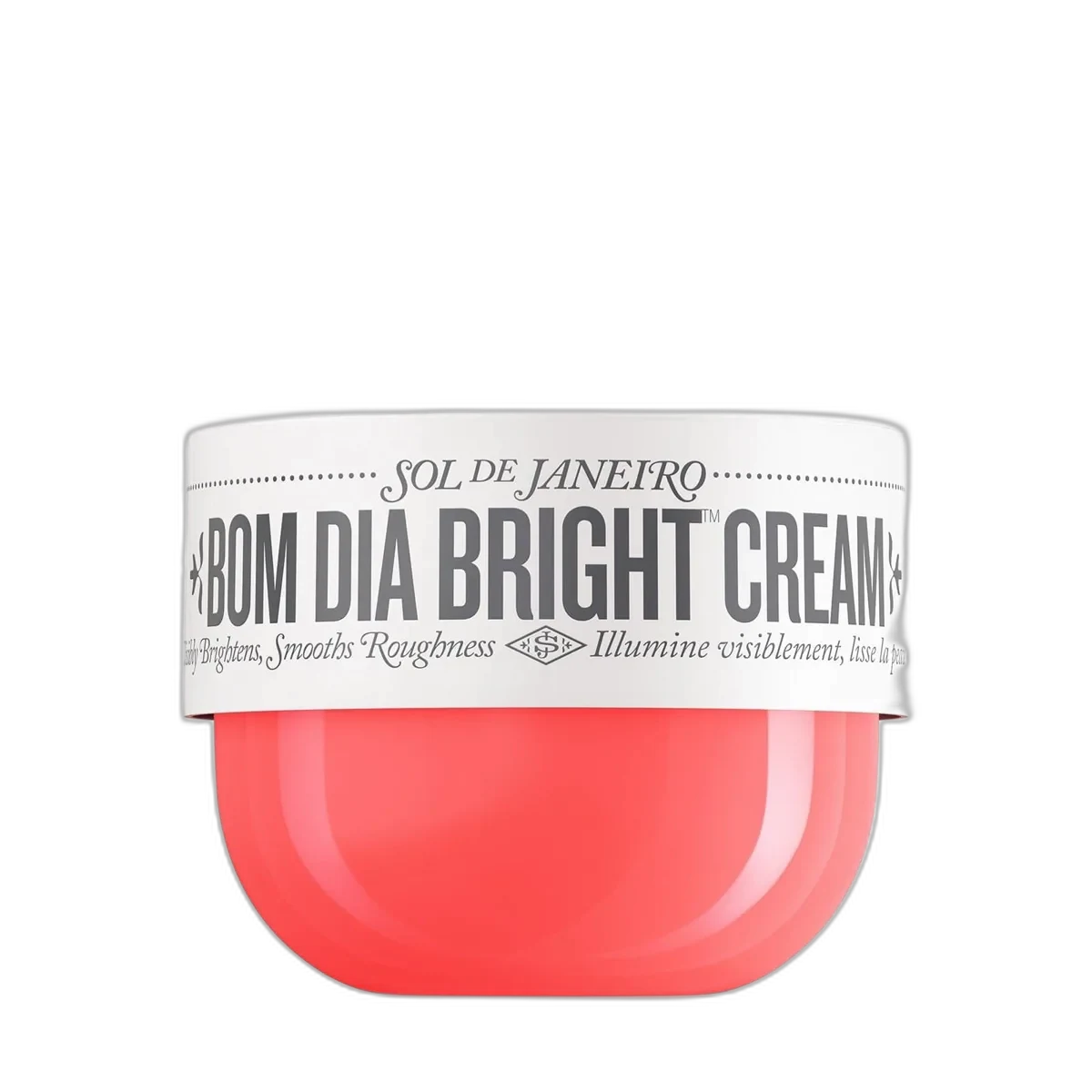
Bom Dia Bright Body Cream
KP and Dullness Body Cream
 Verified reviewer
Pros & cons.
- +Tetrahexyldecyl ascorbate is a genuine stable vitamin C with real research support
- +Mild fruit acid blend and willow bark provide gentle exfoliation on rough body areas
- +Cupuaçu and açaí oil base gives a plush, non-greasy finish
- +Measurable improvement in mild keratosis pilaris over 4-8 weeks
- +Cruelty-free and available in multiple sizes including a 75 mL mini
- +Pleasant Cheirosa 40 fragrance for users who love the scent family
- −Heavy fragrance load rules it out for sensitive skin
- −Contains synthetic colorants (Red 33 and Yellow 5)
- −Coconut oil limits use for fungal-acne-prone body areas
- −Fruit acids are weaker than dedicated AHA body lotions
- −Expensive compared to clinical body treatment products with higher active concentrations
The full review.
About Sol de Janeiro
Sol de Janeiro spent two decades as a brand where the scent was the product and the cream base was the delivery mechanism. Brazilian Bum Bum Cream made the brand globally famous on the strength of its Cheirosa 62 fragrance, not on any particular active ingredient work. Bom Dia Bright, launched in 2021, was the brand’s quiet pivot: a body care line positioned around actual actives — vitamin C and fruit AHAs — in a cream base aimed at dullness, surface texture, and body hyperpigmentation. It is the first Sol de Janeiro product that treats the ingredient list like it matters, and that shift deserves more attention than the brand’s fragrance-first marketing usually gives it.
Reality
Read the INCI list and the treatment story is real. Tetrahexyldecyl ascorbate sits about halfway down the list — the same oil-soluble, stable vitamin C ester found in professional-channel serums from SkinMedica, SkinCeuticals, and Paula’s Choice. At body cream concentrations it will not match a dedicated facial vitamin C serum, but it provides genuine antioxidant and pigment-pathway activity on skin that usually never sees vitamin C at all (chest, arms, shoulders, legs). Ahead of the vitamin C sit four fruit pulp extracts — caja, banana, mango, and papaya — that supply mild fruit acids and fruit enzymes for a gentle exfoliating layer. Salix alba bark extract, a plant source of salicin that slowly converts to salicylic acid, provides a secondary mild BHA effect on keratinized areas. The butter-and-oil base leans on cupuaçu butter and açaí fruit oil, both Sol de Janeiro staples, for a plushy emollient feel that softens the active work. This is a real formula, not a marketing vehicle.
Texture
Cosmetically, it delivers on the immediate sensory expectations you would have from any Sol de Janeiro product. The cream is rich, spreads easily, absorbs within about a minute, and leaves a satin finish that is not greasy.
Scent
The Cheirosa 40 fragrance — tropical fruit, coconut, light floral — is brighter and more breakfast-themed than Cheirosa 62 or Cheirosa 68, and is polarizing in the same way all Sol de Janeiro fragrances are polarizing: you either love it immediately or you do not want it in your house. There is no unscented version.
Works for
The performance story comes together over time. Most users notice softer, smoother skin from the first few applications, which is emollient activity from the butters and oils. The actual active-driven changes — gradual brightening on the décolletage and shoulders, smoother texture on the upper arms where keratosis pilaris likes to settle, subtle evening of body hyperpigmentation — build across four to twelve weeks of consistent daily use. For mild KP on the arms, this cream works meaningfully well because the combination of gentle acids, willow bark, and rich emollients is exactly the mechanism KP responds to.
Not ideal for
For severe KP, you will still need a dedicated lactic acid or urea lotion. For real hyperpigmentation, you will still want a body-safe BHA or glycolic treatment. Bom Dia Bright is a solid maintenance layer, not a targeted treatment. The limitations are where the product’s fragrance-driven heritage shows up. Parfum sits very high on the INCI list, which rules this out for fragrance-sensitive skin, eczema, contact dermatitis, or any compromised barrier. Red 33 and Yellow 5 are FDA-approved synthetic cosmetic colorants included purely for appearance, and readers who avoid synthetic dyes should look elsewhere. Coconut oil is high enough in the formula to be a concern for readers managing fungal acne on the back, chest, or arms. And the product is absolutely not intended for facial use despite the vitamin C, since the fragrance and colorant load make it wrong for face skin.
Common Complaints
None of these are surprising for a Sol de Janeiro product, but they are worth flagging for anyone considering this as a treatment first and a scented body cream second.
Price
Price is $48 for 240 mL, which places it in the same category as the rest of the Sol de Janeiro body cream line. Against drugstore body lotions with comparable emollient content and much cheaper price tags, it is expensive. Against dedicated body treatment products from clinical brands — AmLactin, CeraVe SA lotion, Paula’s Choice Weightless Body Treatment — it is roughly comparable in price but competes on a different axis: fragrance and sensory experience instead of highest-potency clinical performance.
Who Should Buy
The best case for buying Bom Dia Bright is if you want a treatment-oriented body cream that you actually enjoy applying daily, and you care more about the vitamin C and the fruit acid brightening curve than about maximum active concentration.
Not ideal for
The worst case is expecting it to outperform a dedicated BHA or glycolic body treatment; it will not.
How to Use
A 75 mL mini is available for around $24 and is the right entry point for first-time buyers. If the scent works for you and the cream lives up to the brightening claims on your skin, scaling up to the full-size jar is a reasonable upgrade.
Ingredient analysis.
Full INCI list
Aqua (Water, Eau), Methyl Glucose Sesquistearate, Dodecane, Caprylic/Capric Triglyceride, Cetearyl Alcohol, Parfum (Fragrance), Phenyl Trimethicone, Cetyl Alcohol, Glycerin, Cocos Nucifera (Coconut) Oil, Spondias Mombin (Caja) Pulp Extract, Musa Sapientum (Banana) Pulp Extract, Mangifera Indica (Mango) Pulp Extract, Carica Papaya (Papaya) Fruit Extract, Theobroma Grandiflorum (Cupuaçu) Seed Butter, Euterpe Oleracea (Açaí) Fruit Oil, Salix Alba (Willow) Bark Extract, Gardenia Taitensis Flower Extract, Tetrahexyldecyl Ascorbate, Tocopherol, Glyceryl Caprylate, Ethylhexylglycerin, Sorbitan Isostearate, Ethylene Brassylate, Xanthan Gum, Glyceryl Stearate Citrate, Hydroxyethyl Acrylate/Sodium Acryloyldimethyl Taurate Copolymer, Sodium Stearoyl Glutamate, Phenoxyethanol, Benzyl Alcohol, Potassium Sorbate, Citric Acid, Sorbic Acid, CI 17200 (Red 33), CI 19140 (Yellow 5)
Skin match.
The science.
The Science
Tetrahexyldecyl ascorbate is a well-studied, stable vitamin C ester in cosmetic chemistry. It is oil-soluble and more stable than L-ascorbic acid. It converts to ascorbic acid in the skin and has published data showing antioxidant and brightening effects at cosmetically achievable concentrations. Using it in a body cream instead of a serum is notable; body products rarely include stable vitamin C esters because high usage volumes make meaningful levels expensive. Fruit-derived AHAs from tropical fruit extracts deliver less than formulated glycolic, lactic, or mandelic acid products. These extracts contain small amounts of malic, citric, and tartaric acids and enzymes. They provide mild surface exfoliation, but their effect is much smaller than a dedicated AHA product at 5-10 percent acid concentrations. Willow bark extract contains salicin, a precursor the body slowly converts to salicylic acid. This conversion rate is low, so the BHA activity is mild compared to synthetic salicylic acid at typical treatment concentrations. Published research supports the water-absorption capacity and barrier-supportive fatty acid profile of Cupuaçu butter. Açaí fruit oil provides antioxidants and essential fatty acids. The formulation is a body cream with mild supporting actives rather than a clinically-dosed treatment product—the vitamin C is the only active with a real evidence base at meaningful inclusion levels.
Dermatologist Perspective
Dermatologists often recommend dedicated body treatment lotions with higher concentrations of lactic acid, urea, or salicylic acid for patients with keratosis pilaris, body hyperpigmentation, or severe body texture issues. Board-certified dermatologists typically view products like Bom Dia Bright as reasonable maintenance options for mild concerns, not primary treatments for significant body conditions. For patients wanting a brightening body cream that is pleasant for daily use, this product is generally safe and reasonable, though doctors usually steer sensitivity-prone patients toward unscented alternatives.
Where it fits in your routine.
Apply daily to clean skin after showering. Focus on rough or dull areas: upper arms, elbows, knees, chest, shoulders, and shins. Let it absorb for one minute before dressing. Use daily sunscreen on exposed body areas because vitamin C and fruit acids increase sun sensitivity. For mild keratosis pilaris, use consistently for 4-6 weeks to see results. Do not apply to face or to broken or irritated skin.
At $48 for 240 mL, Bom Dia Bright costs the same as other Sol de Janeiro body creams and costs more than drugstore body lotions. The active ingredients — specifically the stable vitamin C ester — are more substantive than most products at this price, which justifies the premium. Compared to clinical brands with higher-concentration AHA or BHA body lotions at similar prices, value depends on if fragrance and sensory experience matter more than maximum active potency. A 75 mL mini costs around $24 and is the best entry point for first-time buyers to test the scent and the cream's performance before committing.
This scented body cream works for readers seeking mild brightening and texture improvement, especially for mild keratosis pilaris on the arms, general body dullness, or uneven tone on the chest and décolletage. It matches the Sol de Janeiro sensory experience for fans who want treatment-oriented body care.
Sensitive or eczema-prone skin. Readers who avoid synthetic colorants. Fungal-acne-prone users who react to coconut oil. Anyone seeking serious body treatment results, where clinical brands with higher concentrations of lactic acid, glycolic acid, urea, or salicylic acid deliver more meaningful change.
Product details.
Thick cream with a slightly whipped feel spreads easily and absorbs within a minute to a satin finish.
Cheirosa 40: bright tropical fruit notes with coconut and floral undertones.
Tangerine-colored branded jar in the Bom Dia Bright line; comes in 75 mL, 240 mL, and travel sizes.
The first application provides immediate softness and a subtle brightening glow via the emollient base and mica-like light reflection. Active-driven brightening and texture improvements take 4-12 weeks to build, the standard timeline for body-care actives at cream-level concentrations.
The 8.1 oz jar typically lasts 2-3 months with daily full-body application.
12 months
All Year
The backstory.
Sol de Janeiro launched Bom Dia Bright in 2021 as the brand's first treatment-oriented body care sublline, distinct from the purely moisturizing Brazilian Bum Bum Cream. The Bom Dia Bright line was positioned as a bright, breakfast-themed companion to the brand's other fragrance families and built around vitamin C and AHA chemistry for users wanting body care that also addressed dullness and texture.
About Sol de Janeiro
Established Brand (5–20 years)Sol de Janeiro launched in 2002 as a Brazilian-inspired body care brand and grew into a global phenomenon after Brazilian Bum Bum Cream went viral. Bom Dia Bright is the brand's entry into treatment-oriented body care, combining its signature tropical fruit extracts with a stable vitamin C ester and fruit-derived AHAs.
Common myths.
A body cream with vitamin C and AHAs replaces a separate body exfoliating serum.
Body creams use lower active concentrations than serums. Fruit extracts provide less AHA than formulated glycolic or lactic acid products. Bom Dia Bright works for maintenance, but dedicated AHA or BHA lotions from a clinical brand treat keratosis pilaris or severe body hyperpigmentation faster.
Topical vitamin C is only for your face.
Vitamin C works on body skin via the same mechanisms as facial skin: antioxidant protection, pigment pathway modulation, and collagen support. It is an effective active for the chest, arms, and décolletage, areas where UV damage accumulates but receives less treatment than the face.
What the community says.
"Visibly smoother, brighter skin after a few weeks"
"Helps with keratosis pilaris bumps on the arms"
"Rich, pleasantly scented base"
"Skin looks more even-toned over time"
"Fragrance is too strong for some"
"Contains synthetic colorants (Red 33, Yellow 5)"
"Expensive compared to dedicated body AHA lotions"
"Coconut oil limits it for fungal-acne-prone users"