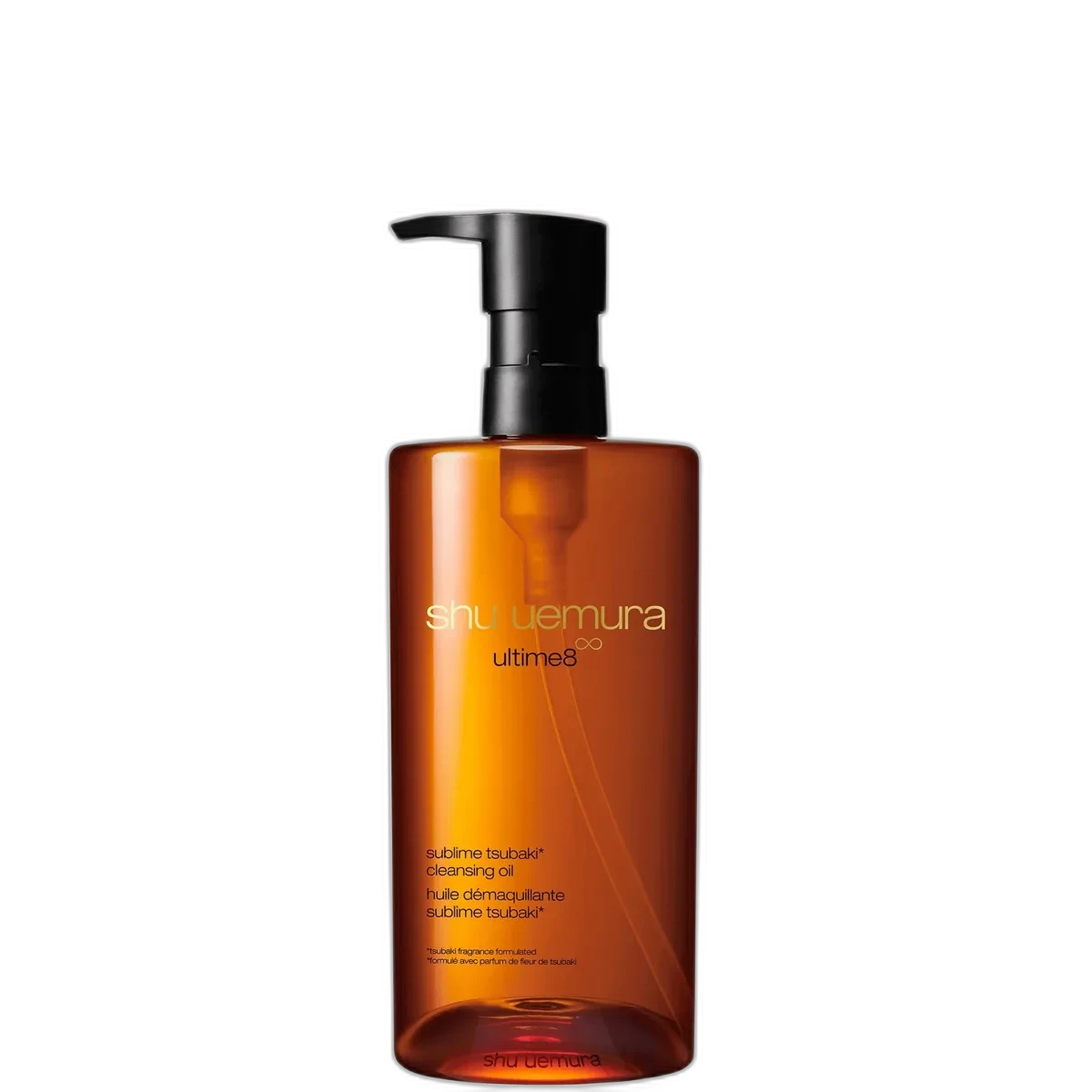
Ultime8 Sublime Beauty Cleansing Oil
Luxury J-Beauty Flagship
 Verified reviewer
Pros & cons.
- +Eight-plant-oil complex with genuine formulation sophistication rather than single-oil filler
- +Phospholipid addition provides real barrier support during cleansing
- +Camellia japonica oil is a traditional Japanese beauty ingredient with skin-compatibility research
- +Polyglyceryl emulsifier cascade ensures clean rinse despite richer oil phase
- +Luxurious fragrance and texture appropriate for a ritual cleansing experience
- +Larger 450ml size dramatically improves per-ounce value
- −$85 for 150ml is the highest price point in the Shu Uemura cleansing oil range
- −Contains parfum, linalool, and geraniol — not for fragrance-sensitive skin
- −Isopropyl myristate and heavy oils raise comedogenicity risk for acne-prone users
- −Richer feel may be too heavy for oily-skin users who prefer a lighter cleanser
The full review.
Most skincare buyers overlook a key question: what should a cleanser cost? It stays on your face for about 60 seconds. Most of it goes down the drain. The mechanism is mechanical — dissolve oil, emulsify with water, rinse away. While some cleansers work better than others, the difference in outcome between a $12 drugstore cleansing oil and a $40 mid-tier one is usually smaller than the price gap. When Shu Uemura asks $85 for 150ml of cleansing oil, you should ask what that money buys.
The answer, after analyzing this specific formula, is substantive. The Ultime8 name refers to the eight-plant-oil complex at the core: camellia japonica, meadowfoam, jojoba, squalane, safflower, soybean, corn germ, and shea butter. Each oil is on the label deliberately, not as filler. Camellia japonica is the signature — the traditional Japanese beauty oil used for skin and hair for centuries, prized for its oleic acid and skin compatibility. Meadowfoam seed oil adds stability and a lightweight feel. Squalane is the skin-mimetic lipid that integrates invisibly. Shea butter, low on the INCI, adds a plush feel during massage. Phospholipids sit further down as barrier-support lipids. Vitamin E stabilizes the whole oil phase; in an eight-oil formulation, this is a necessity because complex plant oil blends oxidize rapidly without protection.
The same three-polyglyceryl emulsifier system used in the rest of Shu Uemura’s cleansing oil family sits above this oil phase. The emulsifiers in Ultime8 are higher on the INCI than in the lighter Anti/Oxi+ version. This makes sense — a richer, more lipid-dense oil phase needs more emulsifier to rinse cleanly, so the formulators scaled the system. The rinse-off remains clean and residue-free despite the nourishing feel, a formulation achievement most users benefit from without seeing.
On skin, this differs from a standard cleansing oil. It feels plush rather than watery. For the target audience of dry or mature skin, it leaves a faint sense of softness and barrier support that the Anti/Oxi+ variant lacks. Makeup dissolves cleanly, including waterproof mascara, and the fragrance is warm and floral-citrus rather than the lighter green citrus of other Shu cleansing oils. It is a more indulgent sensory experience, which is part of the cost.
The price problem remains. At $85 for 150ml, this cleanser costs three times more than drugstore cleansing oils that clean your face equally well. You cannot buy the eight-oil complex, the phospholipid support, the luxury fragrance, or the formulation logic of a legacy J-beauty brand with 50 years of experience at the drugstore. If those matter to your cleansing ritual, Ultime8 is a defensible purchase — especially the 450ml size, which lowers the per-ounce cost. If they do not matter, or if you want purely functional skincare, the math does not work.
This is not the right cleansing oil for everyone. It is not acne-safe — the isopropyl myristate and heavy plant oils are risky for congested or acne-prone users. It is not sensitive-skin-safe either — the linalool, geraniol, and parfum content is unsuitable for reactive users. It excels for dry, normal, and mature skin that wants a cleansing experience that feels like a treatment. For that profile, it earns its status.
Ingredient analysis.
Full INCI list
Zea Mays Germ Oil, Ethylhexyl Palmitate, Caprylic/Capric Triglyceride, Isopropyl Myristate, Polyglyceryl-10 Dioleate, Polyglyceryl-6 Dicaprate, Polyglyceryl-2 Oleate, Limnanthes Alba (Meadowfoam) Seed Oil, Phenoxyethanol, Linalool, Squalane, Camellia Japonica Seed Oil, Simmondsia Chinensis (Jojoba) Seed Oil, Isopropyl Lauroyl Sarcosinate, Carthamus Tinctorius (Safflower) Seed Oil, Dicaprylyl Ether, Dicaprylyl Carbonate, Tocopherol, Geraniol, Glycine Soja (Soybean) Oil, Glyceryl Stearate Citrate, Butyrospermum Parkii (Shea) Butter, Phospholipids, Panax Ginseng Root Extract, Bambusa Vulgaris (Bamboo) Extract, Citric Acid, Parfum
Skin match.
The science.
The Science
Multi-oil cleansing formulations work better than single-oil cleansers for a simple reason. Different plant oils have different fatty acid profiles — camellia oil has high oleic acid, meadowfoam has long-chain fatty acids, jojoba has wax esters that resemble human sebum, and squalane is the saturated hydrocarbon squalane. Blending them creates a wider range of molecular polarities. This helps the cleanser dissolve the diverse mixture of makeup, SPF ingredients, environmental debris, and sebum on facial skin at the end of a day. Research in the Journal of Cosmetic Science shows multi-oil formulations produce broader debris-removal profiles than single-oil systems, though the benefit over a well-chosen single oil is modest.
Camellia japonica seed oil is the signature ingredient. Research in Natural Product Communications documents its high oleic acid content (up to 80%) and shows skin-compatibility and emollient effects similar to olive oil but with a lighter feel. Traditional Japanese use of camellia oil for skin and hair has mechanistic support, though head-to-head clinical comparisons to simpler oils are limited.
The phospholipid addition is an interesting formulation choice. Phospholipids — specifically lecithin-derived phospholipids — are the same lipid class in the stratum corneum intercellular matrix. Research on topical phospholipids in the International Journal of Cosmetic Science shows they integrate with the skin's lipid barrier and help barrier repair, though short contact time limits their benefit in a rinse-off product.
The polyglyceryl emulsifier system has the same evidence base as other Shu Uemura cleansing oils — it is mild, non-ionic, and produces less barrier disruption than sulfate-based surfactants.
Dermatologist Perspective
Dermatologists see multi-oil cleansing formulations as no more efficacious than single-oil cleansers for actual cleansing performance. However, they recognize that a nourishing cleansing experience helps patients with dry or mature skin, especially those prone to barrier disruption from standard surfactant cleansers. This formulation uses a phospholipid addition and skin-compatible oil blend. It fits the description of a thoughtful cleansing oil for dry skin — one that removes debris without compromising the barrier. It is not typically recommended for acne-prone patients because of the comedogenic ester content, or for fragrance-sensitive or rosacea patients. For the right patient profile, it is a reasonable option when patients want a luxury-tier cleansing experience.
Where it fits in your routine.
Apply 3-4 pumps to dry skin using dry hands at the end of the day. Massage gently for 60 seconds across the entire face and eye area to dissolve makeup and SPF. Lightly wet your hands and massage to trigger emulsification; the oil turns into a light milky emulsion. Rinse thoroughly with warm water. Use a gentle water-based cleanser to finish a full double cleanse, then use your normal evening routine of toner, essence, serums, and moisturizer.
At $85 for 150ml, this is the most expensive cleansing oil in the Shu Uemura lineup and the most expensive in the category. The per-ounce cost is roughly triple drugstore cleansing oils and higher than other luxury cleansing oils like Tatcha's Pure One Step Camellia. You pay for the eight-oil complex, the phospholipid support, the fragrance, and the brand legacy that defined the cleansing oil category. The 450ml size lowers the per-ounce cost and is the smarter purchase for regular users — the smaller size acts as a sampling option at this price point.
Users with dry, normal, or mature skin who want a cleansing oil that feels nourishing as well as functional, and who approach evening cleansing as a ritual rather than a chore. Particularly suited to committed J-beauty skincare routines where the cleansing step is valued as part of the experience.
Acne-prone users need a cleanser designed for their skin. Sensitive or rosacea-prone users must avoid fragrance. Budget-focused shoppers get equivalent core cleansing performance from drugstore oils at a fraction of the price.
Product details.
Richer golden oil, slightly heavier than the Anti/Oxi+ variant
Warm floral-citrus luxury fragrance
Glass bottle with pump dispenser
The texture feels thick and nourishing from the first pump. Dry and mature skin types see immediate softening that lighter cleansing oils do not provide.
About 2 months at nightly use for 150ml
12 months
All Year
The backstory.
Launched around 2013 as the flagship of Shu Uemura's cleansing oil hierarchy, positioned at the top of the brand's J-beauty skincare ritual. The Ultime8 name refers to the eight-plant-oil complex at the formula's core, and the product is the brand's attempt to justify a genuine luxury-tier cleansing experience with formulation sophistication rather than packaging alone.
About Shu Uemura
Legacy Brand (20+ years)Shu Uemura founded his brand in 1967 and introduced cleansing oil to international beauty markets. The Ultime8 line launched around 2013. It is the brand's luxury flagship cleansing oil, sitting above both the Anti/Oxi+ and Fresh Pore variants.
Common myths.
A cleansing oil can replace a moisturizer
Even a nourishing oil like this one is a rinse-off product — most of the lipids and extracts wash away. It supports the barrier during cleansing, but it does not replace a leave-on moisturizer. Follow it with your normal hydration steps.
FAQ.
How is Ultime8 different from Shu Uemura's other cleansing oils?
Ultime8 is the brand's luxury flagship. It uses an eight-plant-oil complex with camellia japonica, jojoba, squalane, meadowfoam, and shea butter. The formula is thicker and more nourishing than the Anti/Oxi+ or Fresh Pore variants, but costs significantly more. It works best for dry and mature skin.
Is this worth the price?
Value depends on your cleansing rituals. This formulation is more sophisticated than other Shu Uemura oils, and users with dry or mature skin will see the difference. If cleansing is a chore instead of a ritual, other cleansing oils work just as well at a third of the price.
Will it clog pores?
The formula contains isopropyl myristate, which is comedogenic in leave-on products. In a rinse-off cleanser with short contact, most users tolerate it, but acne-prone users should patch test first or choose a different cleansing oil.
Can dry skin use this alone?
No. Even a nourishing cleansing oil is a rinse-off product; most lipids wash away. Use a hydrating essence, serum, and moisturizer afterward. The cleanser removes dirt gently; it does not provide leave-on hydration.
What the community says.
"Feels nourishing rather than stripping"
"Suitable for dry and mature skin"
"Luxurious sensory experience"
"Very expensive per ounce"
"Heavier than other Shu oils"
"Fragrance-heavy"
People also looked at.