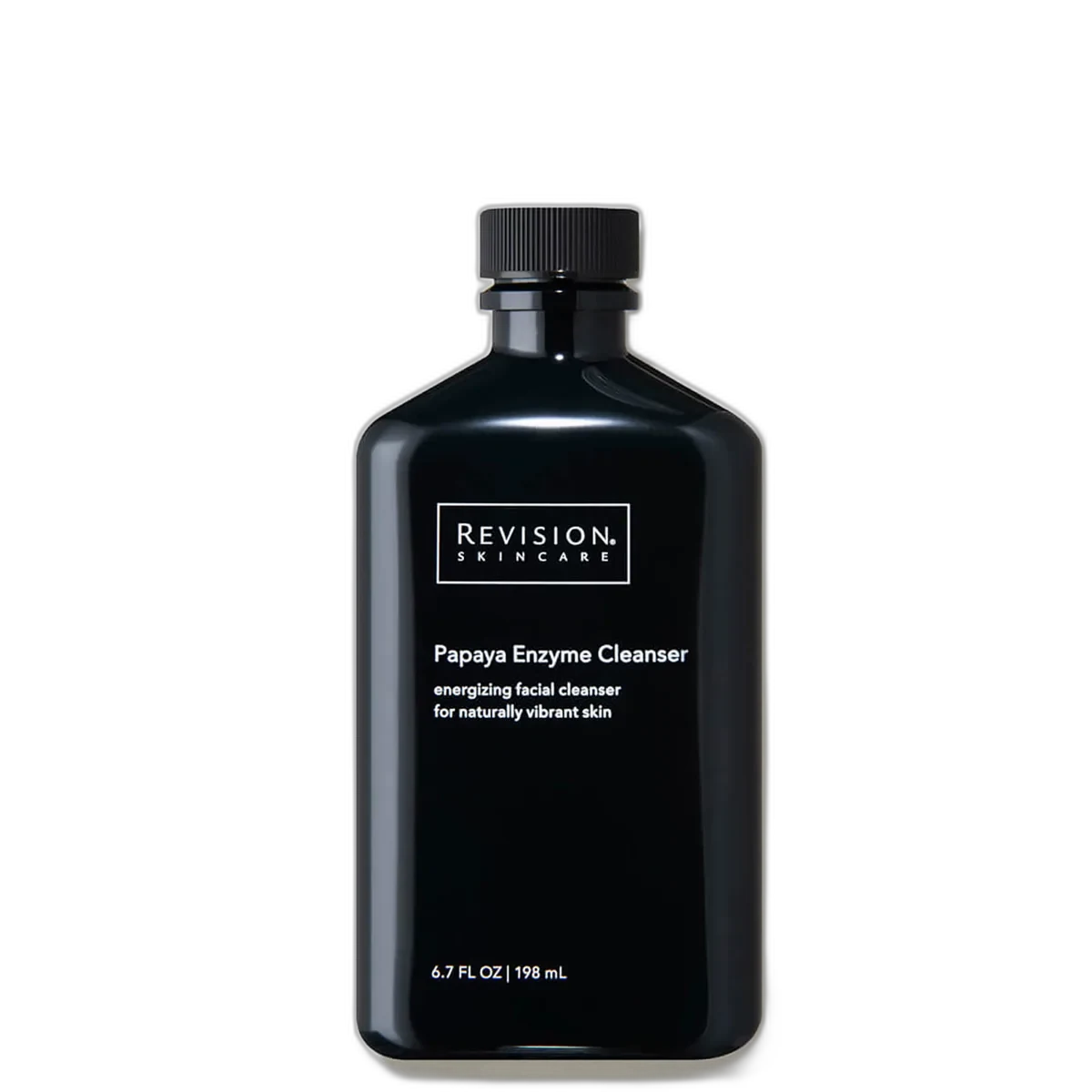
Papain Enzyme Cleanser
Daily Enzyme Exfoliation Made Simple
 Verified reviewer
Pros & cons.
- +Dual enzymatic exfoliation from both isolated papain and whole papaya fruit extract
- +Salicylic acid extends exfoliation into pores for blackhead and congestion relief
- +Reasonable $47 price for 6.7 oz — one of the most accessible Revision products
- +Gel texture lathers gently and rinses completely clean without residue
- +Effective daily exfoliation that does not require an additional exfoliating step
- +3-4 month supply with twice-daily use keeps the per-day cost under a dollar
- −Contains Sodium Lauryl Sulfate, an aggressive surfactant unusual for physician-dispensed brands
- −Added fragrance limits suitability for sensitive skin
- −Not appropriate for dry, sensitive, or barrier-compromised skin types
- −Ingredient profile lacks the sophistication of Revision's treatment products
- −Salicylic acid concentration not disclosed — limits informed use decisions
The full review.
In a product line known for eight-peptide neck creams and DEJ-targeting moisturizers, the Papain Enzyme Cleanser is refreshingly uncomplicated. It does not promise to rebuild your skin’s structural proteins or reverse a decade of aging. It promises to wash your face and leave it slightly more exfoliated than before. And it delivers on that promise with quiet competence.
The cleansing mechanism centers on papain, a proteolytic enzyme extracted from papaya fruit. Unlike AHA and BHA exfoliants that dissolve the bonds between skin cells chemically, papain breaks them down enzymatically — targeting the keratin proteins that keep dead cells adhered to the skin surface. The result is a smoother, brighter complexion after each wash without the tingling, stinging, or redness that acid-based cleansers can trigger. Revision doubled down on the papaya angle by including both isolated papain and whole Carica Papaya Fruit Extract, providing two tiers of enzymatic activity in a single product.
The addition of salicylic acid gives this cleanser reach that papain alone lacks. While the enzyme works at the surface, salicylic acid is oil-soluble and penetrates into pores to dissolve sebum and dead cell buildup. For anyone dealing with blackheads, congestion, or the general dullness that comes from sluggish cell turnover, this combination addresses both surface and subsurface concerns in one cleansing step.
The texture is a straightforward gel that lathers gently and rinses clean. No residue, no film, no tightness afterward. It is pleasant to use in a totally unremarkable way, which is what you want from a daily cleanser. The papaya-tinged scent from the extracts is overlaid with added fragrance, making the experience slightly more aromatic than strictly necessary.
Now for the elephant in the INCI list: Sodium Lauryl Sulfate. SLS is listed as the third ingredient, which is unusual for a physician-dispensed cleanser in an era where sulfate-free formulations have become standard even at the drugstore level. SLS is an effective surfactant and there is nothing inherently dangerous about it, but it is a known irritant for dry and sensitive skin types, and its presence here narrows the product’s audience in a way that seems unnecessary. For a brand that formulates fragrance-free, paraben-free treatment products with ceramide complexes, the decision to include both SLS and fragrance in a cleanser feels inconsistent.
Bixa Orellana Seed Extract (annatto) provides antioxidant and soothing properties, partially offsetting the irritation potential of the SLS and salicylic acid. It is a thoughtful inclusion but cannot fully compensate for a surfactant system that will be too aggressive for sensitive, dry, or compromised skin.
At $47 for 6.7 fluid ounces, the pricing is reasonable by physician-dispensed standards and actually competitive when you factor in the enzyme and salicylic acid exfoliation built into a cleanser. A bottle lasts 3-4 months with twice-daily use, putting the daily cost well under a dollar. This is one of the more accessible products in the Revision lineup, and the value proposition is straightforward — daily enzymatic exfoliation with pore-clearing BHA in a format that requires no additional steps.
The honest assessment is that this is a good cleanser that sits somewhat awkwardly in Revision’s product ecosystem. The formulation is effective for its intended purpose — daily exfoliating cleansing for oily and combination skin — but it lacks the ingredient sophistication that defines the brand’s treatment products. You will not find eight peptides here, or DEJ-targeting technology, or ceramide complexes. You will find a competent enzyme cleanser with a BHA boost, and for many routines, that is all the cleansing step needs to be.
For oily and combination skin types looking for a daily cleanser that provides mild exfoliation without requiring a separate exfoliating step, the Papain Enzyme Cleanser is a reliable choice. It prepares the skin effectively for the treatment products that follow, which is its primary job in the Revision regimen. Just be aware of the SLS and fragrance if your skin tends toward sensitivity — this is one Revision product where the formulation does not quite match the brand’s clinical reputation.
Formula
Texture
The texture is a straightforward gel that lathers gently and rinses clean. No residue, no film, no tightness afterward. It is pleasant to use in a totally unremarkable way, which is what you want from a daily cleanser.
Scent
The papaya-tinged scent from the extracts is overlaid with added fragrance, making the experience slightly more aromatic than strictly necessary.
Best for
For oily and combination skin types looking for a daily cleanser that provides mild exfoliation without requiring a separate exfoliating step, the Papain Enzyme Cleanser is a reliable choice.
Works for
It prepares the skin effectively for the treatment products that follow, which is its primary job in the Revision regimen.
Not ideal for
Just be aware of the SLS and fragrance if your skin tends toward sensitivity — this is one Revision product where the formulation does not quite match the brand’s clinical reputation.
Ingredient analysis.
Full INCI list
Water (Aqua), Cocamidopropyl Betaine, Sodium Lauryl Sulfate, PEG-18 Glyceryl Oleate/Cocoate, Sorbitol, Glycereth-2 Cocoate, Carica Papaya Fruit Extract, Butylene Glycol, Salicylic Acid, Papain, Bis-PEG/PPG-20/20 Dimethicone, Acrylates/Aminoacrylates/C10-30 Alkyl PEG-20 Itaconate Copolymer, Citric Acid, Bixa Orellana Seed Extract, Carbomer, 1,2-Hexanediol, Caprylyl Glycol, Xanthan Gum, Disodium EDTA, Maltodextrin, Benzoic Acid, Fragrance (Parfum)
Skin match.
The science.
The Science
Papain is a cysteine protease enzyme from Carica papaya used in wound debridement and dermatology for decades. It works by breaking peptide bonds in keratin proteins, which dissolves devitalized tissue and dead skin cells but leaves healthy cells intact. Research in the Journal of Cosmetic Dermatology shows that papain-based formulations improve skin texture, reduce fine lines, and help subsequent products absorb better by removing dead cell buildup.
Salicylic acid, a beta-hydroxy acid, works alongside papain using a different mechanism. Its lipophilic nature lets it penetrate the sebaceous follicle to dissolve sebum and keratin plugs that cause blackheads and comedonal acne. The American Academy of Dermatology recognizes salicylic acid as an effective acne treatment and recommends it for its keratolytic and comedolytic properties.
Combining enzymatic and chemical exfoliation in one cleanser creates a multi-level approach — papain targets the surface stratum corneum while salicylic acid works inside pores. This dual mechanism is more comprehensive than using either alone, though the short contact time of a rinse-off cleanser means it exfoliates less deeply than leave-on treatments.
Dermatologist Perspective
Dermatologists recommend enzyme cleansers like this one for patients needing daily exfoliation without the irritation risk of AHA cleansers. Board-certified dermatologists note that enzyme-based cleansing helps the skin absorb treatment products better — which is why doctors often recommend this cleanser as the first step in a Revision Skincare regimen. The salicylic acid makes it a practical choice for oily and acne-prone patients. However, dermatologists caution that the SLS content makes this less suitable for patients with dry skin, eczema, or rosacea, who may need a gentler surfactant system.
Where it fits in your routine.
Wet your face and hands with warm water. Dispense one pump into your palms and lather. Massage over your face for 30-60 seconds so the enzymes and salicylic acid work, focusing on oily or congested areas. Rinse well with warm water. Use morning and evening. Follow with your serum, moisturizer, and sunscreen.
At $47 for 6.7 fl oz, this cleanser is competitively priced for the physician-dispensed category. The built-in enzyme and salicylic acid exfoliation removes the need for a separate exfoliating product, adding functional value. Using it twice daily lasts 3-4 months, making the per-day cost about $0.40-0.50 — a reasonable price for a cleanser that cleanses and exfoliates. Other medical-grade brands price comparable enzyme cleansers similarly.
Oily and combination skin types want a daily cleanser that uses mild enzymatic and BHA exfoliation to skip a separate exfoliating step. Use this to improve skin texture, reduce dullness, and prep skin to absorb treatment products better.
Dry, sensitive, or barrier-compromised skin types needing a gentle, sulfate-free cleanser. Anyone with fragrance sensitivity. Users of strong leave-on exfoliants who do not need extra exfoliation from their cleanser.
Product details.
Clear to slightly amber gel that foams into a gentle lather. The smooth consistency spreads easily on wet skin.
Contains fragrance — a mild, fresh scent from the fragrance and papaya extracts.
The 6.7 fl oz size comes in a standard pump bottle. It works easily at the sink or in the shower.
The gel lathers gently on first use and cleanses without irritation. The papaya enzyme exfoliates mildly; it does not tingle, but skin feels noticeably smooth after rinsing. Skin feels clean, bright, and soft without the tight, stripped feeling from harsher cleansers.
3-4 months with twice-daily use
12 months
All Year
The backstory.
Revision Skincare developed this cleanser as an everyday exfoliating option that would be gentle enough for daily use but effective enough to prepare the skin for their treatment products. Papain was chosen for its ability to break down dead skin cell bonds without the irritation profile of glycolic or lactic acid cleansers — making it suitable for the combination and oily skin types that form a large part of the physician-dispensed market.
About Revision Skincare
Legacy Brand (20+ years)Revision Skincare launched in 1984. It sells exclusively through dermatologists, plastic surgeons, and medical spas.
Common myths.
Enzyme cleansers are too gentle to make a real difference.
Papain targets keratin protein bonds in dead skin cells. This provides targeted exfoliation that physical scrubs and some chemical exfoliants cannot match without irritation. Salicylic acid in this formula extends exfoliation into pores, making this a dual-action cleanser.
FAQ.
Can I use Revision Papain Enzyme Cleanser every day?
Yes — the enzyme-based exfoliation in this cleanser works daily for normal, combination, and oily skin types. The papain breaks down dead skin cells without the aggressive stripping seen in strong AHA cleansers. If you use exfoliating treatments like retinol or chemical peels, alternate use to avoid over-exfoliation.
Does Revision Papain Enzyme Cleanser contain sulfates?
Yes — it uses Sodium Lauryl Sulfate (SLS) to foam and cleanse. SLS removes oil and impurities well, but it can dry out sensitive or dry skin. If you have sulfate sensitivity, use a sulfate-free alternative for your cleansing step.
Is Revision Papain Enzyme Cleanser good for acne?
Salicylic acid clears pores and papain enzyme removes dead skin buildup to help manage acne. It works best for oily and combination skin prone to blackheads and congestion. For inflammatory or severe acne, use it as part of a comprehensive routine instead of a standalone treatment.
Why is this cleanser called Papain Enzyme Cleanser but listed as Papaya Enzyme Cleanser on some sites?
Both names refer to the same thing — papain is the enzyme from papaya fruit. Revision uses Papaya Enzyme Cleanser on current branding, but the formulation contains both isolated papain enzyme and whole papaya fruit extract.
Should I leave the cleanser on my skin for it to work?
Massage damp skin for 30-60 seconds so the papain enzyme breaks down dead skin cells. This is a rinse-off formula; do not leave it on as a mask. The salicylic acid provides residual exfoliating benefits after rinsing.
What the community says.
"Cleanses thoroughly without stripping the skin"
"Leaves skin feeling smooth and bright"
"Gentle enough for daily use on combination skin"
"Pleasant texture and rinses clean"
"Contains SLS, which some users prefer to avoid"
"Mixed opinions on value for money as a cleanser"
"Fragrance may bother sensitive skin"
"Less innovative than other Revision products"
People also looked at.