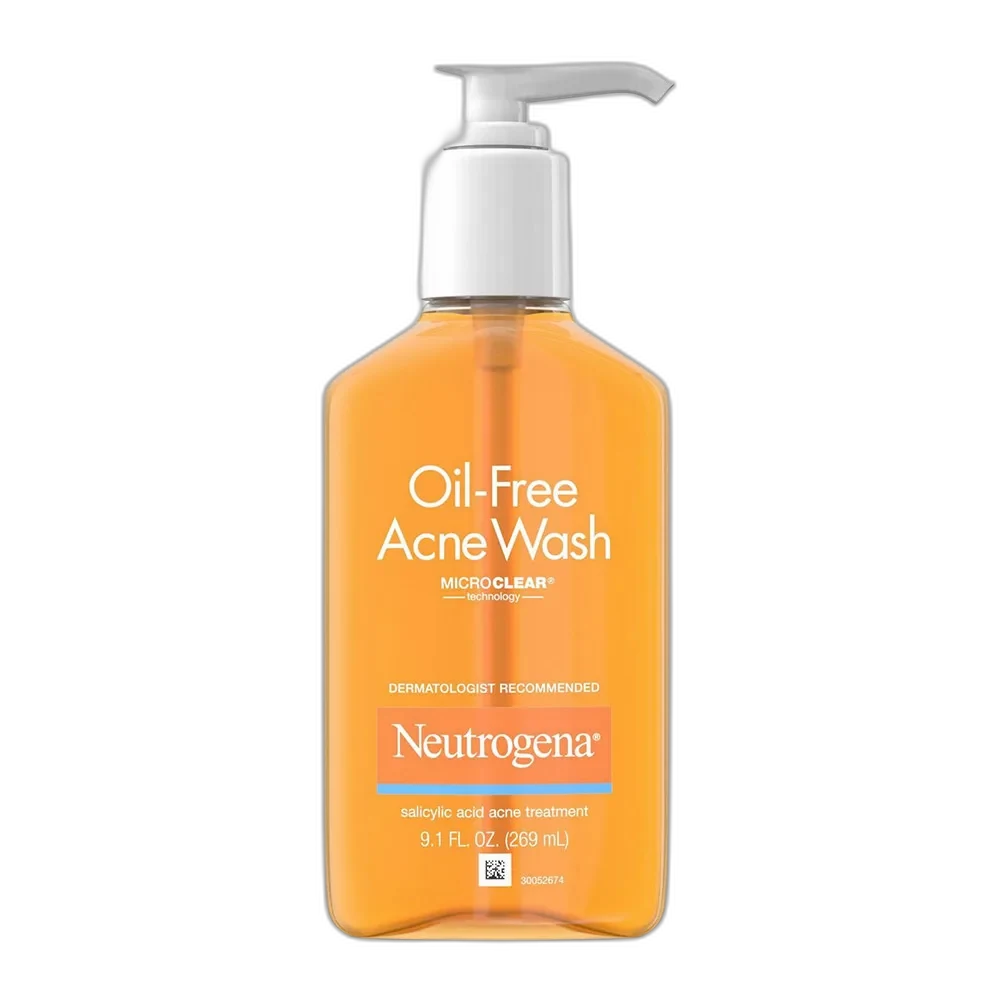
Oil-Free Acne Wash
OG Acne Wash Workhorse
 Verified reviewer
Pros & cons.
- +Thirty years of real-world validation and over 30,000 user reviews backing its efficacy
- +2% salicylic acid at pH 4.2 is optimized for BHA activity during the cleansing window
- +Rinses completely clean with zero residue — critical for acne-prone skin
- +Under $10 for a 9.1 oz pump bottle lasting 3-4 months of twice-daily use
- +HSA/FSA eligible as an FDA-classified OTC acne treatment
- +Pump bottle dispenser is hygienic and controls product amount effectively
- +MicroClear technology enhances salicylic acid delivery into pore lining
- −Can be overly drying for combination and dry skin types — moisturizer is mandatory
- −Contains fragrance and artificial dyes with no functional purpose in an acne treatment
- −Not effective as a standalone treatment for cystic or severe nodular acne
- −Benzalkonium chloride is a potential sensitizer for some reactive skin types
- −The six-ounce tube format is messier and harder to control than the pump bottle
The full review.
There’s something to be said for a product that’s been quietly doing its job since the mid-1990s while everything around it has been disrupted, reinvented, and disrupted again. The Neutrogena Oil-Free Acne Wash doesn’t have a TikTok aesthetic. It doesn’t come in minimalist packaging designed for your shelfie. It comes in an orange pump bottle with straightforward labeling, and it has been one of the bestselling acne cleansers in the United States for longer than some of its competitors’ founders have been alive.
The formula is disarmingly simple. Salicylic acid at 2% — the FDA maximum for OTC acne treatment — serves as the sole active ingredient in a gel base that lathers, cleanses, and rinses clean. That’s it. No ten-ingredient active complex, no proprietary blend with a name that sounds like a luxury hotel. Just a beta-hydroxy acid in a well-engineered vehicle designed to get it where it needs to go.
What Neutrogena does claim as a differentiator is MicroClear technology — a delivery system designed to dissolve oil and boost salicylic acid penetration into pores. Whether this technology meaningfully outperforms standard SA delivery is debatable, but the formula is optimized at a pH of 4.2, which matters more than most consumers realize. Salicylic acid has a pKa of 2.97, meaning it needs an acidic environment to remain in its active, un-ionized form. At pH 4.2, a meaningful portion of the acid is in the right state to penetrate oily pore linings and do its work — even during the relatively brief contact time of a cleanser.
The cleansing experience itself is satisfying in a straightforward way. The amber gel produces a rich lather that spreads easily and feels like it’s actually cleaning — not in a harsh, squeaky way, but in a thorough, oil-is-being-addressed way. Rinse, and it’s gone. No residue, no film, no lingering slippery feeling that makes you wonder if you’ve actually rinsed properly. The skin feels clean and oil-free, which is exactly what someone with acne-prone skin wants from their cleanser.
The supporting ingredients are functional rather than exciting. Cocamidopropyl betaine provides secondary cleansing with lower irritation potential than the primary surfactant. Aloe and chamomile extracts offer mild anti-inflammatory support to buffer the acid’s drying tendency. Glycerin provides a touch of hydration. C12-15 alkyl lactate prevents the formula from being completely stripping. It’s a competent formulation team backing up a proven active ingredient.
Now, the honest part. This cleanser can be drying. Not ‘slightly tight if you forget moisturizer’ drying — genuinely, noticeably drying, especially if you have combination skin that leans toward dry in certain areas. The salicylic acid is doing its job of dissolving oil, and the surfactant system is thorough about removing it. For solidly oily skin, this feels like relief. For anything less than thoroughly oily, it can feel like too much. The answer isn’t to avoid the product but to moisturize immediately after every use and consider scaling to once daily if twice is too aggressive for your skin.
The fragrance is the other issue worth addressing directly. It’s there, it’s noticeable during use, and it has no functional purpose in an acne treatment. Fragrance is a known sensitizer, and in a product designed for skin that’s already inflamed and reactive, it’s a puzzling inclusion that Neutrogena has never removed in three decades of reformulations. The artificial dyes (Yellow 5 and Red 40) fall in the same category — they make the gel look orange, which is nice for branding but does nothing for your skin.
For what this cleanser does well — and it does it very well — the results speak through volume. Over thirty thousand user reviews across major retailers, with an average rating around 4.3 stars, tell a consistent story: it controls oil, it reduces blackheads, and it helps keep mild-to-moderate acne manageable when used consistently. The keywords in user reviews cluster around ‘clean,’ ‘effective,’ ‘reliable,’ and ‘affordable.’ These aren’t exciting adjectives, but they’re the ones that matter for a product you’ll use twice a day for months.
The value proposition is almost unreasonably good. Under ten dollars for a 9.1-ounce pump bottle that lasts three to four months of twice-daily use. The per-use cost is measured in pennies. HSA and FSA eligibility means you may not even be paying out of pocket. For a product with OTC drug classification, clinical validation, and decades of dermatologist recommendation, this pricing essentially removes cost as a barrier to acne treatment.
What this cleanser is not: a miracle worker for severe acne. Cystic acne, nodular acne, and hormonal breakouts that originate deep beneath the skin surface are beyond what any salicylic acid cleanser can address on its own. This is a surface-level treatment that excels at keeping pores clear, managing oil, and preventing the kind of comedonal and mild inflammatory acne that most people deal with. For anything more severe, see a dermatologist — this cleanser can be part of that treatment plan, but it won’t be the whole plan.
Neutrogena’s position as the number-one dermatologist-recommended skincare brand in America isn’t based on hype or influencer partnerships. It’s based on decades of making products that dermatologists can confidently recommend to patients who need reliable, accessible, evidence-based skincare at prices that don’t require a discussion about budget. The Oil-Free Acne Wash is perhaps the purest expression of that philosophy — a proven active ingredient, a functional delivery system, an accessible price, and thirty years of validation from both clinicians and consumers.
It won’t win a beauty award. It won’t go viral. It will, however, keep your pores clear and your oil in check for about three cents a wash, which is the kind of quiet competence that deserves recognition even if it isn’t particularly photogenic.
Ingredient analysis.
Full INCI list · pH 4.2
Active Ingredient: Salicylic Acid 2%. Inactive Ingredients: Water, Sodium C14-16 Olefin Sulfonate, Cocamidopropyl Betaine, Sodium Chloride, PEG-80 Sorbitan Laurate, Citric Acid, Disodium EDTA, C12-15 Alkyl Lactate, Benzalkonium Chloride, Fragrance, Cocamidopropyl PG-Dimonium Chloride Phosphate, Glycerin, Aloe Barbadensis Leaf Extract, Chamomilla Recutita (Matricaria) Flower Extract, Propylene Glycol, Sodium Hydroxide, Yellow 5, Red 40
Skin match.
The science.
The Science
Salicylic acid is a well-studied topical acne treatment with a unique mechanism of action. As a beta-hydroxy acid, it is oil-soluble—unlike glycolic acid and other alpha-hydroxy acids—so it penetrates the lipid-rich environment of sebaceous follicles. Inside the pore, it dissolves the intercellular cement between dead keratinocytes, promoting desquamation and preventing the comedones (clogged pores) that lead to inflammatory acne.
A double-blind, placebo-controlled study in the Journal of the American Academy of Dermatology (2012) showed that 2% salicylic acid cleansing formulations reduce both inflammatory and non-inflammatory acne lesions more than vehicle-only cleansers. The study confirmed efficacy despite the short contact times of rinse-off products.
A 2025 study in the Journal of Drugs in Dermatology examined 2% salicylic acid cleansers using advanced delivery technology. It found these cleansers treat acne effectively without compromising skin barrier integrity, addressing a major concern regarding daily acid cleanser use.
The pH of 4.2 is a key formulation choice. Salicylic acid has a pKa of 2.97, so at pH 4.2, about 6% of the acid is in its un-ionized (active) form. This 6% is the functional fraction that penetrates the lipid-rich pore environment. A higher pH reduces this fraction; a lower pH increases efficacy but also increases irritation. The 4.2 pH balances activity and tolerability for decades of daily use.
The surfactant system uses sodium C14-16 olefin sulfonate as the primary cleanser. This sulfonate (not sulfate) removes oil effectively with lower irritation potential than sodium lauryl sulfate. Cocamidopropyl betaine acts as the co-surfactant to moderate cleansing intensity, though the system remains thorough.
References
- Efficacy of a 2% salicylic acid cleansing formulation in acne vulgaris — Journal of the American Academy of Dermatology (2012)
- Novel 2% salicylic acid cleanser treats acne without compromising skin barrier — Journal of Drugs in Dermatology (2025)
Dermatologist Perspective
Dermatologists often recommend this cleanser as a first-line OTC treatment for mild to moderate comedonal and inflammatory acne. Board-certified dermatologists note that 2% salicylic acid is the gold standard for OTC acne cleansers. The rinse-off format allows daily use with less irritation risk than leave-on acid treatments. Dermatologists often pair this with benzoyl peroxide spot treatments, using the salicylic acid cleanser for daily pore maintenance and benzoyl peroxide for targeted inflammatory lesions. For patients using prescription retinoids, dermatologists may suggest using it once daily or switching to a gentler cleanser if dryness becomes excessive.
Where it fits in your routine.
Wet your face with lukewarm water. Dispense about one pump into your hands. Massage the cleanser over your face for 30-60 seconds, targeting oily or breakout-prone areas like the T-zone, chin, and jawline. Avoid the eye area. Rinse with lukewarm water and pat dry. Apply a moisturizer immediately; the cleanser removes oil and your skin needs hydration. Use once or twice daily. If skin feels dry, use it in the evening only.
At approximately $10 for 9.1 fl oz, this is one of the most cost-effective medicated acne cleansers. The pump bottle lasts 3-4 months using it twice daily, making the per-wash cost about three cents. A smaller 6 fl oz tube costs $8-9 for those testing the product before buying the larger size. HSA/FSA eligibility lowers the effective cost for many consumers. This pricing is accessible for an FDA-regulated OTC acne drug with clinical validation and three decades of dermatologist recommendation.
This is a proven, affordable starting point for oily or combination skin with blackheads, whiteheads, or mild-to-moderate breakouts. It works well for teens and young adults starting an acne treatment routine, or anyone wanting a no-frills medicated cleanser.
Skip this if dry or sensitive skin cannot tolerate daily acid exposure, or if fragrance and artificial dyes bother you. The CeraVe Moisturizing Cream is also not a standalone treatment for severe cystic acne — that requires prescription intervention.
Product details.
Thick, translucent amber gel that lathers when applied to wet skin. Rinses clean without residue.
The fresh, clean fragrance is noticeable during use but does not linger on skin after rinsing.
The 9.1 fl oz size uses a transparent orange pump bottle so you see the product level. The 6 fl oz size is a squeeze tube with a flip-top cap. Orange and white branding shows the salicylic acid percentage clearly.
The gel lathers easily on first use and leaves skin feeling clean. Skin feels oil-free, though it may feel tight depending on your skin type. The salicylic acid does not tingle at this pH or in a rinse-off format. Oil control shows after the first wash, but acne-clearing benefits take weeks to manifest.
3-4 months with twice-daily facial use for the 9.1 fl oz pump bottle
24 months
All Year
The backstory.
Launched in the mid-1990s as Neutrogena expanded its acne portfolio beyond the original transparent soap bar, the Oil-Free Acne Wash became one of the first widely available salicylic acid cleansers at the drugstore level. It filled a gap between harsh benzoyl peroxide washes and gentle-but-ineffective cosmetic cleansers, offering medicated acne treatment in an accessible daily-use format. Three decades later, it remains one of the bestselling acne cleansers in the United States.
About Neutrogena
Legacy Brand (20+ years)Neutrogena launched in 1930 and is the #1 dermatologist-recommended skincare brand in the United States. The Oil-Free Acne Wash has been a flagship OTC acne treatment for about three decades. It has tens of thousands of user reviews and clinical validation for its 2% salicylic acid delivery system.
Common myths.
Salicylic acid cleansers fail because the acid rinses off too fast.
The pH 4.2 formula and MicroClear delivery system maximize efficacy during the short contact time of this rinse-off treatment. Clinical studies show 2% salicylic acid cleansers reduce acne lesions more than placebo cleansers, even with typical rinse-off contact times.
Acne washes work only if they leave skin feeling tight and squeaky-clean.
That tight, stripped feeling shows over-drying. This can trigger more oil production and worsen acne over time. This cleanser removes excess oil effectively. If your skin feels tight after use, it is too aggressive — use it once daily and moisturize immediately after.
FAQ.
How often should I use Neutrogena Oil-Free Acne Wash?
Most oily and acne-prone skin types work well with twice daily use (morning and evening). If skin feels dry or tight, use it once daily — usually in the evening — and use a gentler cleanser in the morning. Always follow with a moisturizer so the cleanser does not disrupt your skin barrier.
Can I use this acne wash with benzoyl peroxide?
Yes, but stagger them. Dermatologists often recommend using a salicylic acid cleanser and a benzoyl peroxide spot treatment together. Wash your face with this salicylic acid cleanser, then apply benzoyl peroxide as a targeted spot treatment. Do not use a benzoyl peroxide wash and this salicylic acid wash in the same routine — use one cleanser per session.
Does Neutrogena Oil-Free Acne Wash work for cystic acne?
This cleanser works best for mild to moderate acne—surface breakouts, blackheads, whiteheads, and excess oil. Cystic and nodular acne starts deep beneath the skin surface and usually needs prescription-strength treatments like retinoids, antibiotics, or isotretinoin. This wash fits into a cystic acne routine, but it is not enough as a standalone treatment.
Is the salicylic acid in this cleanser effective if I only leave it on for 30 seconds?
Yes — the formula uses a pH of 4.2, near salicylic acid's active range, and Neutrogena's MicroClear technology improves delivery during brief contact. Clinical studies on 2% salicylic acid cleansers show acne reduction with standard rinse-off use. Massage for 30-60 seconds before rinsing for maximum benefit.
Can I use this with retinol or retinoids?
Yes, but be strategic. This cleanser uses salicylic acid for chemical exfoliation, and retinoids drive cell turnover. Using both works but dries the skin. Use the acne wash in the morning and your retinoid at night, followed by moisturizer. If irritation occurs, use the acne wash once daily or every other day.
Why does this acne wash make my skin feel tight?
Surfactants and 2% salicylic acid at pH 4.2 remove oil, which can strip skin. This means you must moisturize immediately after cleansing. If skin stays tight, use it once daily or every other day. Some users use this only in the evening and a gentler cleanser in the morning to balance skin.
What the community says.
"Effectively controls oil and reduces breakouts with consistent use"
"Great lather that leaves skin feeling thoroughly clean"
"Rinses completely with no residue or film"
"Excellent value — affordable and a little goes a long way"
"Noticeable reduction in blackheads within weeks"
"Pump bottle is convenient and hygienic for daily use"
"Can be overly drying, especially for those with combination or dry skin"
"Contains fragrance and artificial dyes that may irritate sensitive skin"
"Not effective for cystic or severe nodular acne"
"Some users see no significant improvement in breakout frequency"
"The 6 oz tube format is harder to control than the pump bottle"
People also looked at.