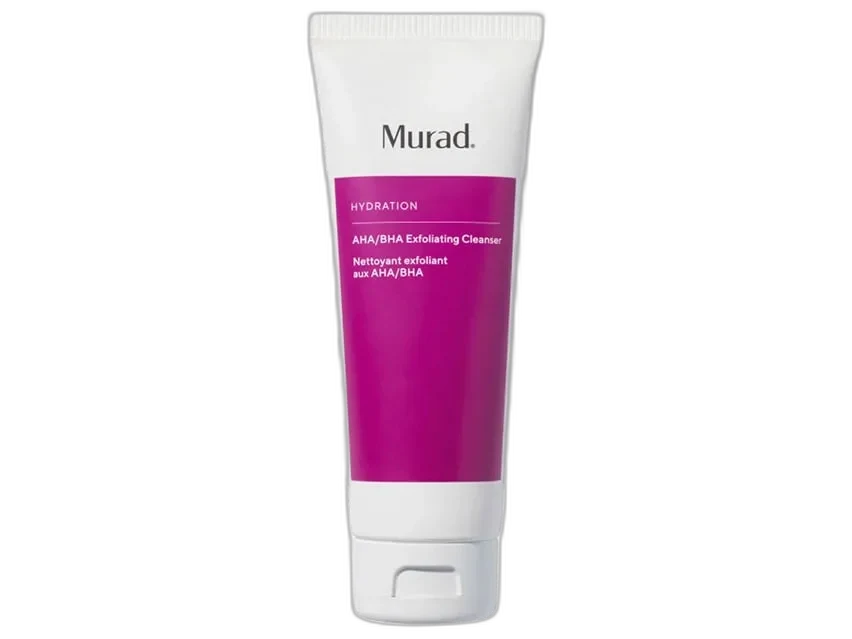
AHA/BHA Exfoliating Cleanser
Derm-Developed Triple Exfoliator
 Verified reviewer
Pros & cons.
- +Triple-acid formula provides comprehensive chemical exfoliation across multiple skin depths
- +Jojoba beads add gentle physical exfoliation without micro-tear risk
- +Fragrance-free formula from a dermatologist-founded brand
- +Generous 6.75 oz tube lasts 4-6 months at recommended 2-3x/week usage
- +Immediate visible smoothness and brightness after first use
- +Addresses both surface texture and pore congestion in one wash step
- +Vitamin C derivative and licorice root add brightening support
- −Contains methylparaben and propylparaben as preservatives
- −Sodium laureth sulfate may be too stripping for dry or compromised skin
- −Triple-acid intensity is too much for sensitive or rosacea-prone skin
- −Active ingredient concentrations not disclosed on packaging
- −Wash-off format limits acid contact time compared to leave-on treatments
The full review.
Dr. Howard Murad had treated tens of thousands of faces before launching this cleanser, and his clinical experience shows in the formula’s logic. Instead of using one exfoliating acid, he combined three—each with a different mechanism and depth—into a wash-off format. This delivers professional-grade exfoliation without the intimidation of a leave-on peel. It is a cleanser with a treatment mindset.
The triple-acid approach defines the formula. Glycolic acid, the smallest alpha-hydroxy acid molecule, penetrates most deeply to dissolve the intercellular bonds holding dead skin cells to the surface. Lactic acid, a larger AHA, works more gently on the outermost layers and acts as a humectant; it draws moisture into the skin while it exfoliates. Salicylic acid adds a BHA dimension, penetrating pores to dissolve the sebum-and-dead-cell mixture that forms blackheads and comedonal acne. Each acid reaches territory the others cannot.
Jojoba ester beads add physical exfoliation. These are not jagged walnut shell fragments; jojoba beads are smooth, round, and partially dissolve during use. This provides a gentle mechanical action that helps lift the dead cells the acids have already begun to dissolve. This dual-modality approach (chemical plus physical) creates more immediate results than either method alone.
Texture and application are straightforward. The creamy gel lathers lightly with water, distributes the beads evenly, and rinses clean without residue. The acids create a mild tingling during the recommended one-to-two-minute contact time—noticeable but not uncomfortable for most skin types. That tingling signals the acids are working, not just a marketing-engineered sensation.
Results appear immediately after the first use. Skin feels smoother, looks brighter, and has a subtle glow that lasts into the next day. Using it consistently two to three times per week yields cumulative effects: refined pores, fewer blackheads, more even tone, and smoother texture that helps moisturizers and serums absorb more evenly. It is a prep product that creates a better canvas for subsequent steps.
The honest disclaimers: this cleanser contains sodium laureth sulfate as its primary surfactant and includes methylparaben and propylparaben as preservatives. SLS cleanses effectively but can be stripping, especially for dry skin. The FDA, CIR, and EU scientific committees consider parabens safe at cosmetic concentrations, though some consumers avoid them. These are older-generation formulation choices that Murad hasn’t updated—a rare area where the brand’s three-decade heritage shows its age.
The fragrance-free formulation is a positive, especially with active acids. Many competitors add fragrance to mask the chemical scent of AHAs and BHAs, but Murad lets the formula speak for itself. There are no essential oils or perfume—just the clean, faintly clinical scent of the actives.
Vitamin C (as sodium ascorbyl phosphate) and licorice root extract (dipotassium glycyrrhizate) provide antioxidant and brightening support, though contact time limits their efficacy in a wash-off format. Sodium PCA, a natural moisturizing factor component, helps offset the stripping potential of the acids and SLS.
The value is strong. At $42 for 6.75 ounces, used two to three times per week, the bottle lasts four to six months—roughly two to three dollars per use for a clinically effective exfoliating treatment. A professional value size (16.9 oz) is available for regular users. Compared to in-office chemical peels or dedicated exfoliating treatments, this is accessible and practical.
Murad positions this for all skin types, but sensitive and very dry skin should proceed with caution. Start with once weekly and increase only if the skin tolerates it. On non-exfoliating nights, use a gentle, non-active cleanser. Always follow with sunscreen the next morning, as the acids accelerate cell turnover and make fresh skin more vulnerable to UV damage.
For acne-prone users, the salicylic acid makes this more versatile than AHA-only cleansers. Many exfoliating cleansers skip the BHA, limiting them to surface smoothing. Including salicylic acid means this single product addresses both rough texture on cheeks and forehead and clogged pores in the T-zone—a common combination in adult acne.
This cleanser does not reinvent skincare. It delivers a proven approach from a dermatologist who understood decades ago that most people need exfoliation, most people overdo it, and the best exfoliating product works effectively enough to use infrequently. Three acids, a few times a week, in a format that rinses away before it does too much. That restraint comes from having seen fifty thousand faces.
Formula
PM routine
Ingredient analysis.
Full INCI list
Water/Aqua/Eau, Sodium Laureth Sulfate, Cocamidopropyl Betaine, Jojoba Esters, Acrylates Copolymer, Glycol Stearate, Butylene Glycol, Sodium PCA, Dipotassium Glycyrrhizate, Sodium Ascorbyl Phosphate, Glycolic Acid, Lactic Acid, Salicylic Acid, Polyquaternium-4, Sodium Hydroxide, Sodium Chloride, Citric Acid, Disodium EDTA, Phenoxyethanol, Methylparaben, Propylparaben
Skin match.
The science.
The Science
The triple-acid exfoliation approach targets different skin renewal processes. Glycolic acid (molecular weight 76 Da) is the smallest AHA and penetrates the deepest. Research in Dermatologic Surgery (1997) shows glycolic acid reduces corneocyte cohesion and speeds epidermal turnover, even at low concentrations and brief contact times.
Lactic acid (molecular weight 90 Da) has dual functions: it exfoliates by disrupting corneocyte desmosomes and acts as a humectant via its hygroscopic properties. A Journal of the American Academy of Dermatology (1996) study confirmed lactic acid improves skin texture and hydration at once—a unique trait among exfoliating acids that adds value to a potentially stripping cleanser format.
Salicylic acid's lipophilicity lets it penetrate the sebaceous follicle to dissolve the sebum and keratinized cells that form comedones. A Clinical Therapeutics (2010) review characterized this mechanism, confirming salicylic acid works for both inflammatory and non-inflammatory acne lesions at concentrations of 0.5-2%.
Combining AHAs and BHA in one formulation creates 'multimodal exfoliation'—targeting the surface stratum corneum (AHAs) and the follicular infundibulum (BHA). This cleanser does not disclose individual acid concentrations, but the brief contact time of a wash-off product provides a safety margin that reduces over-exfoliation risk compared to leave-on formulations.
Dermatologist Perspective
Board-certified dermatologists see multi-acid cleansers as an accessible entry point for patients who want exfoliation but fear leave-on peels or prescription retinoids. Dermatologists note the wash-off format sets a natural safety limit—brief skin contact time prevents the aggressive exfoliation leave-on products cause if used improperly. The AHAs and BHA combination works for patients with both textural concerns and comedonal acne. However, dermatologists caution against using this cleanser alongside other active exfoliants and emphasize using post-exfoliation sun protection.
Where it fits in your routine.
Wet your face and put a small amount on your fingertips. Massage in circular motions for 1-2 minutes so the acids and beads work. Avoid the eye area. Rinse well with lukewarm water. Use 2-3 times per week, not daily. Use a gentle, non-active cleanser on non-exfoliating days. Always apply broad-spectrum SPF 30+ the next morning. Stop or use less often if you get excessive redness, peeling, or sensitivity.
At $42 for 6.75 oz, using this 2-3 times per week costs about $2-3 per use over 4-6 months. This dermatologist-developed exfoliating treatment offers solid value, matching or beating many leave-on exfoliants per use. The professional/value size (16.9 oz) has better per-ounce economics for frequent users. The main value question is if a wash-off format provides enough active benefit to justify the price over a cheaper daily gentle cleanser and a leave-on exfoliant.
Normal, combination, and oily skin types use this comprehensive exfoliating cleanser for dullness, texture, blackheads, and mild acne. It works for those who want acid exfoliation in a low-commitment, wash-off format.
Sensitive, rosacea-prone, or eczema-affected skin. People with a compromised skin barrier or active irritation. Users who prefer paraben-free or sulfate-free products. Not suitable during pregnancy because it contains salicylic acid.
Product details.
Fragrance-free. Clean, minimal chemical scent that's barely noticeable.
The 6.75 oz squeeze tube is a generous size. Professional/value sizes (16.9 oz) also exist for long-term users.
The acids cause mild tingling during use; this is normal and usually stops within 30 seconds of rinsing. Skin feels smoother and cleaner immediately after the first use. Using the product as directed (2-3x/week) causes no burning or excessive dryness. Start once weekly to assess tolerance.
4-6 months with 2-3x weekly use
12 months
All Year
The backstory.
Dr. Howard Murad pioneered the concept of a dermatologist-branded product line in 1989, and this exfoliating cleanser has been a cornerstone of the Murad lineup for years. Born from Dr. Murad's clinical experience treating thousands of patients with dull, congested skin, it translates the in-office chemical peel approach into a safe, at-home wash format. The triple-acid formula was designed to provide professional-grade exfoliation without the downtime of an in-office treatment.
About Murad
Legacy Brand (20+ years)Dr. Howard Murad, a board-certified dermatologist and trained pharmacist who treated over 50,000 patients, founded Murad in 1989. The brand started the modern clinical skincare category and has over 30 years of cruelty-free, clinically proven formulations made to pharmaceutical-grade standards.
Common myths.
Exfoliating cleansers are too harsh — acids need skin contact to work
Leave-on exfoliants provide more intense treatment, but acids in a cleanser work during the 1-2 minute contact time. Studies show measurable exfoliation from brief acid exposure. The cleanser format works well for exfoliation beginners who want benefits without the intensity of a leave-on product.
Use an exfoliating cleanser daily for best results.
Over-exfoliation strips the skin barrier. This causes sensitivity, redness, and worse texture. Murad recommends use 2-3 times per week so the skin barrier recovers between uses. More frequent use does not improve results; it often damages the barrier.
FAQ.
How often should I use Murad AHA/BHA Exfoliating Cleanser?
Start once per week and increase to 2-3 times weekly as your skin tolerates it. Do not use daily; the triple-acid formula compromises the skin barrier if over-used. Use a gentle, non-active cleanser on non-exfoliating days.
Can I use Murad AHA/BHA Cleanser with retinol?
Yes, but not in the same routine. Use this cleanser on nights without retinol to avoid over-exfoliation. Alternating — retinol on Monday/Wednesday, this cleanser on Tuesday/Thursday — works well. Do not use both on the same evening.
Does Murad AHA/BHA Cleanser contain parabens?
Yes — the formula uses methylparaben and propylparaben as preservatives. The FDA and CIR consider parabens safe at cosmetic concentrations, but some consumers avoid them. Murad has not yet reformulated this older formulation to be paraben-free.
Is this cleanser good for acne?
Yes — salicylic acid (BHA) penetrates pores to dissolve sebum plugs. Glycolic and lactic acids smooth surface texture and reduce post-acne discoloration. This triple-acid approach addresses acne from multiple angles. However, a leave-on BHA treatment works better than a wash-off format for moderate to severe acne.
What's the difference between this and the Naturium AHA/BHA Exfoliating Cleanser?
Both use a triple-acid approach. Murad's formula has jojoba beads for physical exfoliation and comes from a dermatologist-developed brand with decades of clinical experience. Naturium's version is usually cheaper. Both use similar active ingredients (glycolic, lactic, salicylic acids), so you choose based on budget and brand preference.
Community
What the community says.
"Skin feels noticeably smoother and brighter after each use"
"Triple acid formula provides comprehensive exfoliation"
"Jojoba beads add satisfying physical exfoliation without harshness"
"Large bottle lasts months when used 2-3 times weekly"
"Effective for both texture and mild acne"
"Contains parabens (methylparaben, propylparaben)"
"Sodium laureth sulfate may be too stripping for dry skin"
"Can cause irritation if used too frequently"
"Expensive for a wash-off product at $42"
People also looked at.