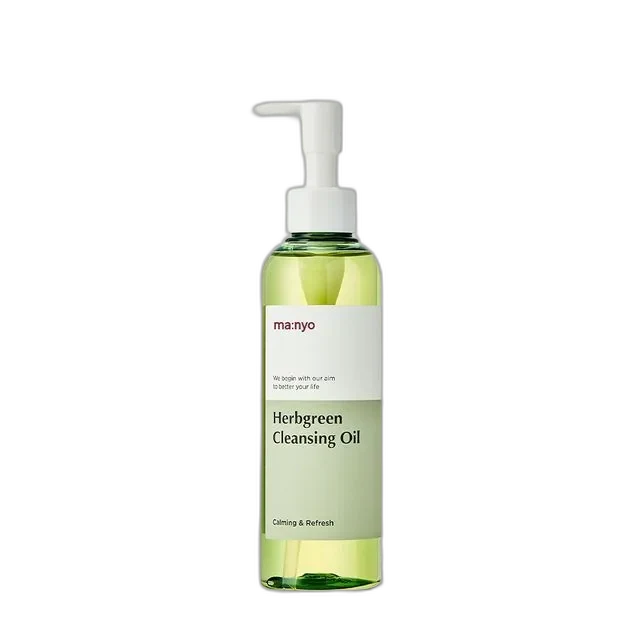
Herb Green Cleansing Oil
K-Beauty Herbal Cleanser
 Verified reviewer
Pros & cons.
- +Effective at removing sunscreen and daily makeup
- +Emulsifies quickly with water for clean rinse-off
- +Pleasant herbal scent for users who enjoy aromatic cleansers
- +Lighter sensory feel than Japanese oil cleansers
- +Reasonable price for a prestige K-beauty cleanser
- +Pore-clarity benefit from consistent double cleansing
- −Essential oil blend is irritating for sensitive skin
- −Strong herbal fragrance is polarizing
- −Not fungal-acne safe
- −Less universal than Pure Cleansing Oil
- −Essential oils are riskier around eye area
The full review.
About Ma:nyo Factory
Ma:nyo Factory gained international fame through the Pure Cleansing Oil, a low-key K-beauty cleanser that became a top recommendation in English-speaking K-beauty communities around 2018. Ma:nyo launched the Herb Green variant in 2021 to offer oily and combination-skin users a version with a stronger sensory profile, not to replace the original. The result is Pure Cleansing Oil with a botanical overlay: it uses the same ethylhexyl palmitate and triglyceride base and the same PEG emulsifier mechanics, but adds houttuynia cordata, green tea extract, centella, and a herbal essential oil blend that defines the user experience.
Scent
The essential oils drive the scent. Rosemary, peppermint, and eucalyptus provide the distinctive green tint and strong fresh-herbal scent. You will either love the first smell or know instantly it is not for you.
Common Praise
Fans call the application a mini spa moment. The herbs feel active, the scent is uplifting, and the mild tingle from the peppermint and eucalyptus feels like a sign of efficacy.
Common Complaints
Critics say the cleansing performance is no different than the Pure version and that the essential oil load is a liability for reactive skin.
Reality
Both views are correct. Mechanically, the cleansing performance is solid. The ester base dissolves sunscreen and most daily makeup, emulsifies quickly with water, and rinses cleanly without residue. Users consistently report pore-clarity improvements over four to six weeks of consistent double cleansing. This is what a good oil cleanser does: it removes surface sebum and debris. This effect does not come from any true anti-sebum mechanism in the botanicals. Houttuynia cordata has traditional use in Korean herbal medicine for oily and acne-prone skin, but clinical evidence for topical anti-sebum effects is limited. The cleanser will not shift your sebum production. It will clean your face thoroughly and make the experience feel more intentional.
Not ideal for
The formulation has expected shortcomings. The essential oil content, specifically peppermint and eucalyptus, makes this a no-go for sensitive skin, rosacea-prone users, or anyone with a compromised barrier. The label declares limonene and linalool, which helps allergen-aware users but confirms the fragrance load. Isopropyl myristate is in the supporting cast, a minor concern for acne-prone users even in a rinse-off application. Fungal acne-prone users should skip it because of the ester-heavy solvent system.
Value
At about $20 for 200ml, the value matches mainstream K-beauty cleansing oils and is roughly twice the price of Japanese drugstore alternatives like Softymo. You pay for the botanical story, the sensory experience, and Ma:nyo brand equity.
Who Should Buy
The math works for oily-combination users who enjoy aromatic cleansers. For anyone wanting a simpler K-beauty cleansing oil without essential oils, Ma:nyo’s own Pure Cleansing Oil is the more universal pick.
Formula
Ingredient analysis.
Full INCI list
Ethylhexyl Palmitate, Caprylic/Capric Triglyceride, Isopropyl Myristate, Olea Europaea (Olive) Fruit Oil, Sorbeth-30 Tetraoleate, PEG-7 Glyceryl Cocoate, Butylene Glycol, Camellia Japonica Seed Oil, Rosmarinus Officinalis (Rosemary) Leaf Oil, Mentha Piperita (Peppermint) Oil, Eucalyptus Globulus Leaf Oil, Houttuynia Cordata Extract, Centella Asiatica Extract, Camellia Sinensis Leaf Extract, Tocopherol, Fragrance, Limonene, Linalool
Skin match.
The science.
The Science
The cleansing mechanics here are well-established. Ethylhexyl palmitate and caprylic/capric triglyceride are short-chain ester solvents with good compatibility for dissolving lipophilic soils — sunscreen filters, wax-based makeup, and sebum — and they work with the sorbeth-30 tetraoleate and PEG-7 glyceryl cocoate emulsifier system to convert to a rinsable emulsion on water contact. The HLB match here is tuned for faster emulsification than mineral-oil-based Japanese cleansers, which is the sensory signature of most K-beauty oil cleansers. Houttuynia cordata has centuries of use in traditional Korean medicine for inflammatory skin conditions, and some in vitro studies in journals like Phytotherapy Research and Journal of Ethnopharmacology have identified antimicrobial and anti-inflammatory activity from its polyphenolic compounds. Robust topical clinical trials specifically on sebum modulation are limited, so claims of active oil control should be viewed as traditional-use positioning rather than clinically demonstrated efficacy. Centella asiatica and green tea have stronger evidence bases — centella's triterpenoids have published wound-healing and barrier-repair activity, and green tea polyphenols have documented antioxidant effects. The essential oils in the formula are the double-edged component. Peppermint, rosemary, and eucalyptus oils have some antimicrobial and stimulant properties in in vitro testing, but published dermatological literature consistently flags them as common contact sensitizers, which is why they're best avoided in leave-on products and approached cautiously even in rinse-off.
Dermatologist Perspective
Dermatologists generally consider essential oils in skincare a risk factor for contact dermatitis, and cleansers containing peppermint, eucalyptus, and rosemary oils are often flagged for patients with rosacea, eczema, or reactive skin. Board-certified dermatologists typically recommend oil cleansers as the first step in a double cleanse for patients wearing daily sunscreen, but the specific product choice is usually directed toward fragrance-free or minimally fragranced options for reactive patients. For oily and combination-skin patients without a history of sensitivity, a fragranced cleansing oil like this one is generally tolerated well in rinse-off application, though clinicians often prefer simpler formulations like the Ma:nyo Pure Cleansing Oil as a safer default recommendation.
Where it fits in your routine.
Apply two to three pumps to dry skin and dry hands; water reduces cleansing power here. Massage gently over the face for 30 to 60 seconds. Avoid the immediate eye area if you have essential oil sensitivity. Wet your fingertips to turn the oil into a milky emulsion, then rinse thoroughly with lukewarm water. Use a gel or foam water-based cleanser next to finish the double cleanse. Do not use as a single cleanse. Stop use if you see tingling, redness, or breakouts.
At roughly $20 for 200ml, this cleanser costs the same as mainstream prestige K-beauty cleansing oils and offers value for users who like botanical sensory experiences. Larger refills or duo packs sometimes appear internationally and offer better per-milliliter value. Herb Green is a lateral move rather than a clear upgrade compared to Ma:nyo Pure Cleansing Oil at similar prices; you choose the sensory experience over better cleansing performance. It costs about twice as much as Japanese drugstore alternatives like Softymo for comparable core function, but has a more refined ingredient story and a more pleasant fragrance profile for some users.
Oily and combination-skin users who want aromatic, botanical cleansers and an active first cleanse beyond simple mineral oil formulas will like this. It works for K-beauty enthusiasts who tolerate essential oils well.
Skip this formula if you have sensitive, reactive, rosacea-prone, or barrier-compromised skin; the essential oil content is too aggressive. Fungal-acne sufferers should also avoid it. Choose Ma:nyo Pure Cleansing Oil for a universally well-tolerated K-beauty cleansing oil.
Product details.
This thin, green-tinted oil glides smoothly on dry skin and emulsifies easily with water.
Rosemary, peppermint, and eucalyptus dominate this strong fresh herbal blend, built on a green botanical backbone.
A clear plastic pump bottle has a signature green cap and shows the oil's herbal green tint.
The scent is strong, herbal, and polarizing. Most users either love it or hate it. The application is smooth and non-greasy. Peppermint and eucalyptus cause a mild tingle for some users; this is normal for this formula but signals a warning for sensitive skin.
Approximately 3 months with nightly use.
12 months
spring summer
The backstory.
Ma:nyo Factory built its reputation on the original Pure Cleansing Oil, which has been a K-beauty mainstay since the mid-2010s. In 2021, the brand introduced the Herb Green variant to target oily and combination skin specifically — adding a botanical anti-sebum complex and a herbal essential oil blend to differentiate it from the Pure original. The green tint in the formula comes from the rosemary and other botanicals and is a visual shorthand for the variant's identity.
About Ma:nyo
Established Brand (5–20 years)Ma:nyo Factory started in South Korea in 2003. It built its reputation on the Pure Cleansing Oil, a consistent K-beauty best-seller. The Herb Green version adds botanical anti-sebum ingredients to that formula.
Common myths.
Essential oils in cleansers are safe because you rinse them off.
Rinse-off contact lasts less time than leave-on, but peppermint and eucalyptus oils still trigger sensitivity, especially on compromised skin. This cleanser is not a good match for reactive users despite its rinse-off format.
Herb Green controls oil production.
No cleanser changes sebum output. Consistent use improves pore clarity by removing surface sebum and makeup, not through an anti-sebum mechanism in the formula.
FAQ.
How is Herb Green different from Ma:nyo Pure Cleansing Oil?
Herb Green uses a botanical anti-sebum complex with houttuynia cordata and an essential oil blend of rosemary, peppermint, and eucalyptus. It targets oily and combination skin. Pure is a gentler formula for all skin types and lacks the fragrance load.
Is it safe for sensitive skin?
No. The peppermint, eucalyptus, and essential oil blend makes this cleanser too aromatic for reactive skin. Sensitive users can use Ma:nyo Pure Cleansing Oil or a fragrance-free alternative instead.
Does it clog pores?
The ethylhexyl palmitate and isopropyl myristate base is low-comedogenic in rinse-off applications but triggers breakout-prone users. Use a water-based second cleanse to remove any residue.
Will it actually reduce my oil production?
No. Cleansers do not change sebum production. Consistent use clears pores of sebum, sunscreen, and makeup. This improves the appearance of blackheads and oiliness over a few weeks.
How does it compare to Japanese oil cleansers?
It feels lighter than traditional Japanese mineral-oil-based cleansers like Softymo Deep and has more fragrance. K-beauty cleansing oils focus on sensory experience and botanical stories, while Japanese ones focus on straightforward makeup-removal mechanics.
Can I use this on eye makeup?
You can, but the essential oil content makes it riskier near the eyes than a fragrance-free alternative. Use a dedicated eye makeup remover for heavy mascara or eyeliner.
What the community says.
"Pleasant herbal scent"
"Effectively removes sunscreen"
"Lighter than Japanese oil cleansers"
"Affordable vs other K-beauty cleansers"
"Pore-clarity effect over time"
"Essential oils irritate some users"
"Not ideal for sensitive skin"
"Strong herbal smell polarizing"
"Pump can clog over time"
People also looked at.