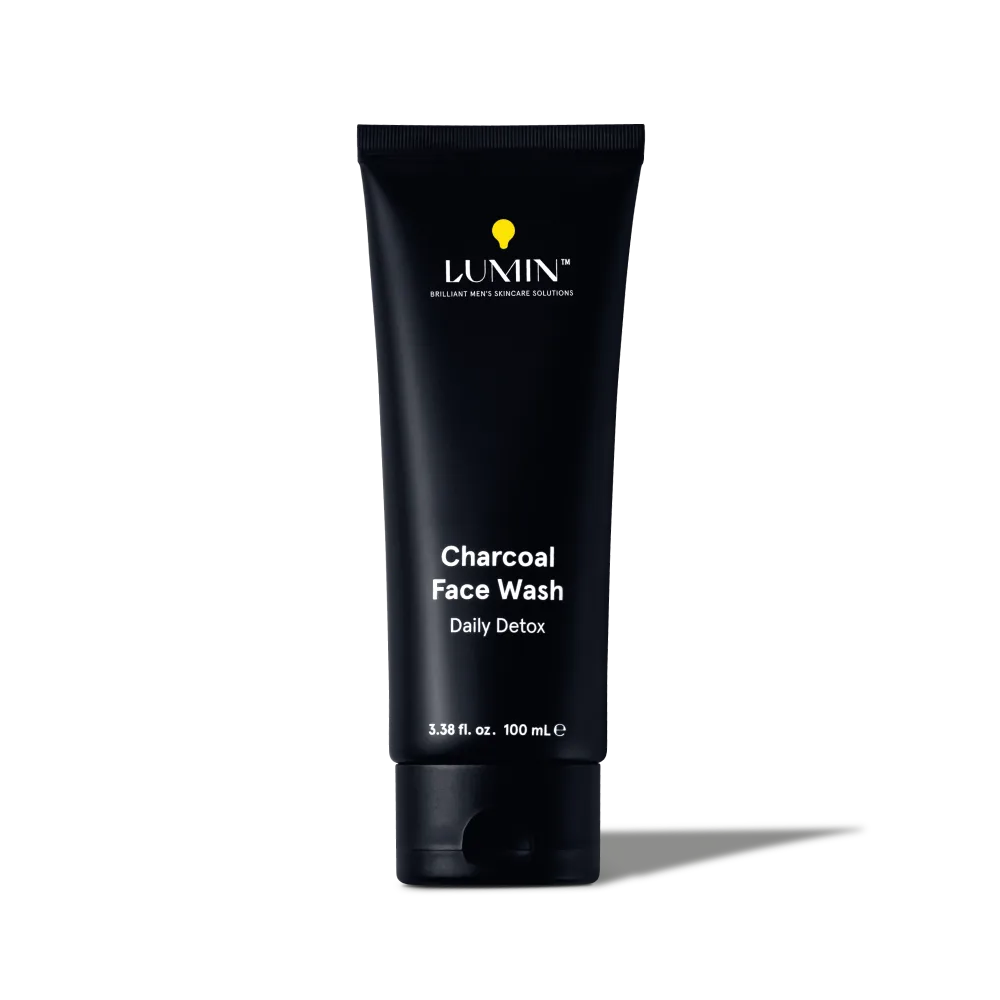
No-Nonsense Charcoal Cleanser
Men's Skincare Gateway Drug
 Verified reviewer
Pros & cons.
- +Amino acid surfactant base is genuinely gentler than most men's face washes at this price
- +Six-botanical extract complex with centella, green tea, and licorice root provides antioxidant support
- +Shea butter prevents the post-wash tightness common in charcoal cleansers
- +Satisfying thick lather and premium texture that encourages consistent daily use
- +Sulfate-free and silicone-free formula suitable for those avoiding harsh surfactants
- +Available in multiple sizes including travel-friendly 0.68 oz option
- −Seven essential oils create significant sensitization risk for reactive skin types
- −Bergamot and lemon peel oils are phototoxic and questionable in a morning cleanser
- −At $20 for 3.4 oz, the price-to-formulation complexity ratio is steep
- −Charcoal is more marketing hook than scientifically validated active in a rinse-off product
- −Shea butter and sandalwood oil may be comedogenic for acne-prone skin
The full review.
Every skincare brand has an origin story, but Lumin targets a specific group: men who have never owned a face wash. Darwish Gani and Richard Hong founded the brand in 2018 in Los Angeles. They built it on the insight that millions of men use bar soap or body wash on their faces because the men’s grooming aisle lacks approachable options. The No-Nonsense Charcoal Cleanser solves this problem. The intentionality shows in everything from the matte-black tube to the name.
The formulation uses charcoal powder as its main ingredient, which often draws skepticism. Charcoal is frequently overhyped; its “detoxifying” claims often exceed its actual mechanism of surface-level oil absorption. It cannot reach deep into pores, it cannot pull out “toxins” in a medically meaningful way, and it looks more dramatic in a face mask than in a cleanser rinsed off in thirty seconds. However, charcoal’s absorbent properties work well in a wash-off product for oily skin. It soaks up excess sebum effectively. The visual of a dark, charcoal-flecked lather also provides psychological value for first-time cleanser users.
The surfactant system deserves more attention than the charcoal. Lumin uses potassium cocoyl glycinate and potassium cocoate—amino acid-derived cleansing agents from K-beauty formulation. These are gentler than the sodium lauryl sulfate found in most men’s face washes at this price. The difference is clear: the lather is dense and creamy rather than stripping, and the post-rinse feel is “clean” rather than “squeaky.” Myristic acid and stearic acid create a thick texture, making the application feel more premium than the price suggests.
The botanical extract complex is impressive, though it has flaws. Centella asiatica, green tea, licorice root, chamomile, Japanese knotweed, and rosemary leaf form a six-plant antioxidant and anti-inflammatory cocktail. Centella calms irritation, green tea delivers polyphenol protection, and licorice root adds mild brightening. These are well-studied actives with established benefits, even in a rinse-off format with limited contact time.
However, the formula contains seven essential oils: bergamot, geranium, lavender, lemon peel, rose, sandalwood, and palmarosa. They create a pleasant, complex, herbal scent, but every one is a potential sensitizer. Bergamot oil contains bergaptene, which is phototoxic. Lemon peel oil carries similar risks during sun exposure. Sandalwood oil has documented comedogenic potential. For a “no-nonsense” product, this essential oil load is the most nonsensical part of the formula.
The shea butter inclusion is smart. Most charcoal cleansers leave skin feeling dry, but the shea deposits a thin film of fatty acids during rinsing. It does not make this a hydrating cleanser, but it prevents extreme post-wash tightness. Combined with the glycerin base, there is enough humectant support to prevent the cleanser from being actively drying.
Texture and experience make this a good gateway cleanser. The cream is thick and dark gray, whipping into a foam that feels more expensive than twenty dollars. For someone used to a bar of Irish Spring, the sensory upgrade is dramatic. This matters because skincare adherence is the biggest challenge in men’s grooming; a satisfying product gets used consistently.
The limitation is that this is a competent, uncomplicated cleanser in excellent packaging. The charcoal absorbs oil. The amino acid surfactants clean gently. The botanicals add antioxidant support. None of this is revolutionary, and the $20 price for 3.4 ounces is high compared to drugstore charcoal cleansers that cost a third as much. You are paying for the K-beauty surfactant upgrade, the botanical complex, and packaging a man will feel comfortable having on his counter.
The value depends on the user. If you are a skincare newcomer needing one product to start a routine, the experience and efficacy work well. If you already have a routine and are judging pure formulation, the essential oil load and price-to-performance ratio make it harder to justify. If you have sensitive or reactive skin, the seven essential oils are a dealbreaker.
Formula
Ingredient analysis.
Full INCI list
Water, Myristic Acid, Butylene Glycol, Stearic Acid, Potassium Hydroxide, Glycerin, 1,2-Hexanediol, Cocamide MEA, Charcoal Powder, Potassium Cocoyl Glycinate, Potassium Cocoate, Butyrospermum Parkii (Shea) Butter, Sorbitan Olivate, Citrus Aurantium Bergamia (Bergamot) Fruit Oil, Pelargonium Graveolens Flower Oil, Lavandula Angustifolia (Lavender) Oil, Citrus Medica Limonum (Lemon) Peel Oil, Rose Flower Oil, Santalum Album (Sandalwood) Oil, Cymbopogon Martini Oil, BHT, Disodium EDTA, Centella Asiatica Extract, Polygonum Cuspidatum Root Extract, Scutellaria Baicalensis Root Extract, Camellia Sinensis Leaf Extract, Glycyrrhiza Glabra (Licorice) Root Extract, Chamomilla Recutita (Matricaria) Flower Extract, Rosmarinus Officinalis (Rosemary) Leaf Extract
Skin match.
The science.
The Science
Charcoal's skincare science is more modest than marketing claims. Medical contexts well-document activated charcoal's adsorptive properties—emergency medicine has used it for decades to absorb toxins—but cosmetic rinse-off product efficacy lacks robust study. A 2019 review in the International Journal of Dermatology noted that charcoal-based cosmetics are popular, yet controlled clinical trials evaluating charcoal cleansers for oil control or pore reduction are sparse. This product uses a physical mechanism: charcoal powder absorbs surface sebum during brief contact.
The amino acid surfactant system is a more interesting formulation choice. Potassium cocoyl glycinate is an acyl amino acid surfactant, which shows significantly lower irritation potential than traditional sulfate surfactants. A 2005 study in the International Journal of Cosmetic Science comparing amino acid-based surfactants to sodium lauryl sulfate found that amino acid variants caused significantly less transepidermal water loss and less disruption to the stratum corneum. This matches the gentler post-wash feel users report with this cleanser.
The botanical extract complex is noteworthy. Studies extensively cover Centella asiatica's active compounds—madecassoside, asiaticoside, asiatic acid, and madecassic acid—for wound healing and anti-inflammatory effects, though most clinical data involves leave-on products rather than rinse-off cleansers. Epigallocatechin gallate (EGCG) from green tea shows antioxidant activity in multiple in vitro and in vivo studies. Glycyrrhiza glabra (licorice root) contains glabridin, which shows tyrosinase inhibition in studies—relevant for mild brightening. Contact time is the question for rinse-off cleansers: these extracts need sustained skin contact to deliver benefits, and a 30-60 second wash limits efficacy compared to leave-on formulations.
Dermatologist Perspective
Dermatologists generally see charcoal cleansers as neither harmful nor special—charcoal provides mild oil absorption but unlikely offers benefits beyond a well-formulated gentle cleanser. Board-certified dermatologists would likely focus on the amino acid surfactant base, which is a meaningful upgrade over sulfate-based men's cleansers for maintaining barrier integrity. However, most dermatologists would flag the essential oil load as a concern, specifically the phototoxic bergamot and lemon oils in a product for morning use. For oily-skinned patients seeking a charcoal cleanser, dermatologists often recommend fragrance-free options to minimize sensitization risk over time.
Where it fits in your routine.
Wet your face with lukewarm water. Squeeze a pea-to-nickel-sized amount onto your fingertips. Massage it onto your face in circular motions for 30-60 seconds. Focus on the T-zone and oily areas. Rinse thoroughly with lukewarm water and pat dry. Use morning and evening, or once daily in the evening for normal or combination skin. Always follow with moisturizer — even oily skin needs hydration after cleansing.
At $20 for 3.4 oz, the No-Nonsense Charcoal Cleanser is mid-range for men's skincare but premium for a charcoal cleanser. The amino acid surfactant system and botanical extract complex justify the price over drugstore charcoal washes, though the formula lacks the complexity for a large markup. A 1.7 oz size exists for those who want to trial the product first. For the target audience — men building their first routine — the premium is partly experiential: the packaging, texture, and scent make skincare feel accessible. Whether that experience tax is worth it depends on your budget and how much you value the on-boarding factor.
Men with oily or combination skin seeking their first 'real' face wash and a satisfying feel will like this. It also works for anyone preferring sulfate-free, amino acid-based cleansing with a natural scent.
The seven essential oils make this unsuitable for sensitive, eczema-prone, or rosacea-affected skin. Experienced skincare users prioritizing ingredient efficiency over experience can find better-formulated fragrance-free options for less money.
Product details.
Thick, dark gray cream that turns into a dense, creamy foam when mixed with water
Complex essential oil blend of bergamot, lavender, rose, sandalwood, and lemon — smells herbal and masculine
Opaque squeeze tube with flip-top cap, minimalist matte black design with white text
It lathers into a thick foam with visible charcoal flecks. Lavender and bergamot scents are strong. Skin feels clean and tight after rinsing but not stripped. The essential oil blend causes slight tingling for some users on first use.
2-3 months with once-daily use
12 months
All Year
The backstory.
Born from founders Darwish Gani and Richard Hong's observation that men's skincare was woefully underdeveloped, this cleanser was designed to be the 'first step' product — the one that converts a bar-soap-on-face guy into someone who actually has a routine. It draws on K-beauty formulation principles, particularly amino acid surfactants, while packaging the concept in a no-frills, masculine aesthetic.
About Lumin
Established Brand (5–20 years)Darwish Gani and Richard Hong founded Lumin in 2018 in Los Angeles as a direct-to-consumer men's skincare brand. Lumin uses Korean skincare as inspiration and has a community in 40+ countries. The brand sells in Target retail but lacks independent clinical validation of its formulations.
Common myths.
Charcoal 'draws out toxins' from deep within your pores
Charcoal powder absorbs surface-level oil and debris, but it does not pull substances from deep within pores. In this cleanser, Charcoal powder works to absorb oil and provides a satisfying visual clean.
Men's skin needs different products than women's skin
Men's skin is generally thicker and produces more sebum, but core ingredients like humectants, antioxidants, and gentle surfactants work the same for all genders. This cleanser works for anyone with oily skin.
FAQ.
Is Lumin Charcoal Cleanser good for acne-prone skin?
Charcoal powder absorbs excess oil and amino acid surfactants are gentle. However, this cleanser contains shea butter and several essential oils (sandalwood, bergamot) that are comedogenic for acne-prone skin. If you break out easily, patch test first and consider a fragrance-free alternative.
Can women use Lumin No-Nonsense Charcoal Cleanser?
The formulation uses amino acid surfactants, charcoal, and botanical extracts. It works on any skin regardless of gender, despite the masculine branding. The main consideration is whether you like the herbal essential oil scent.
How often should I use this charcoal cleanser?
Lumin works best when used every morning and evening. If you have combination or normal skin, using it once daily in the evening prevents over-cleansing. The shea butter in the formula prevents stripping, but charcoal can dry out some users with twice-daily use.
Does Lumin Charcoal Cleanser contain sulfates?
No. This cleanser uses potassium cocoyl glycinate and potassium cocoate as its primary surfactants. Both amino acid-based cleansing agents are gentler than sulfates like sodium lauryl sulfate.
Is Lumin No-Nonsense Charcoal Cleanser fragrance-free?
No. This cleanser contains seven essential oils: bergamot, lavender, rose, sandalwood, lemon peel, geranium, and palmarosa. These are natural fragrances, not synthetic, but they cause irritation or sensitization in reactive skin.
What the community says.
"Lathers well and feels satisfying to use"
"Pleasant masculine scent from the essential oil blend"
"Leaves skin feeling clean without extreme tightness"
"Good introductory cleanser for men new to skincare"
"Essential oil scent can be overpowering for some"
"Not moisturizing enough for dry skin types"
"Price feels high for a charcoal cleanser"
"Some users report breakouts from the heavier oils"
Featured in.
People also looked at.