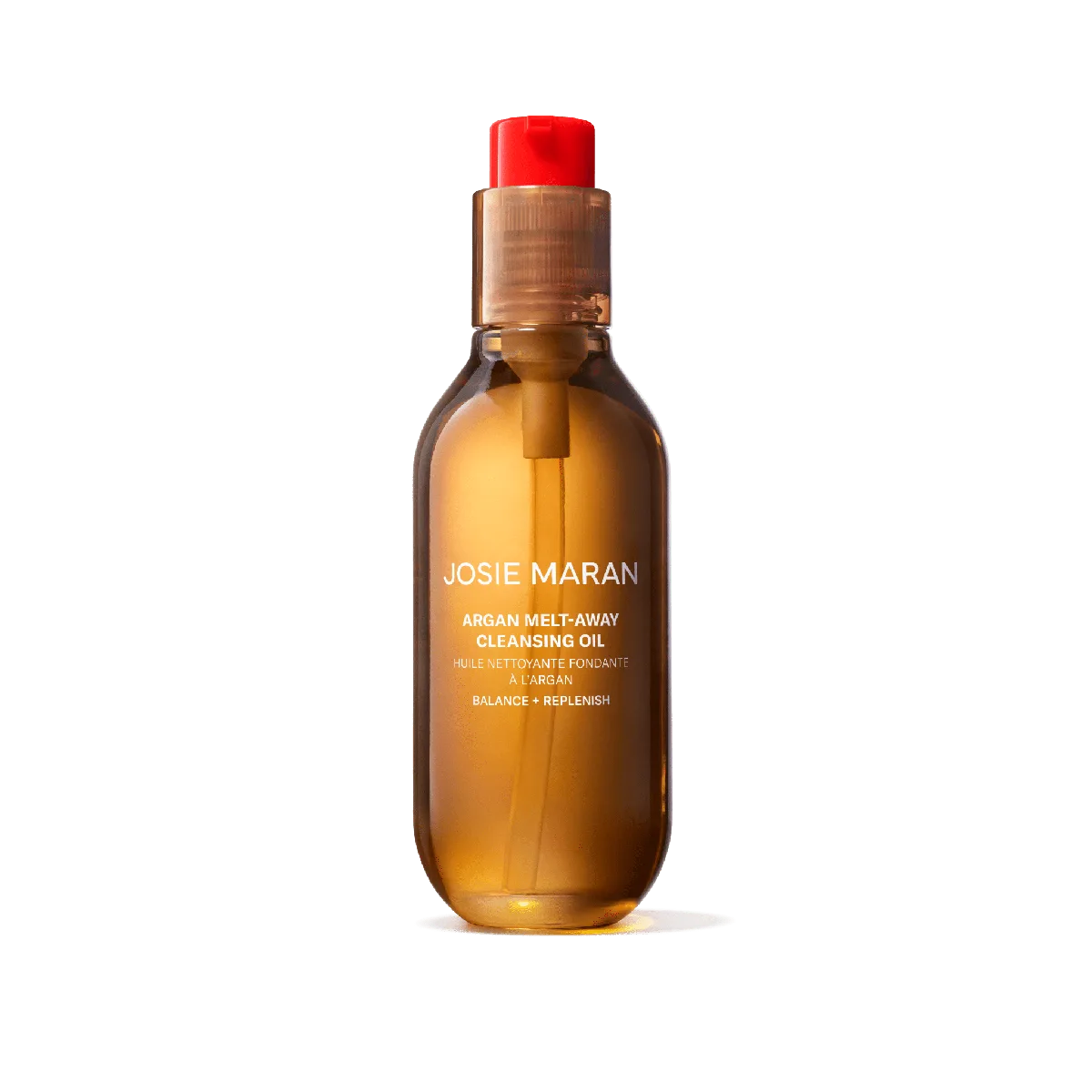
Argan Cleansing Oil
Clean Beauty Pioneer
 Verified reviewer
Pros & cons.
- +Radically minimal 11-ingredient formula with all recognizable plant oils
- +Argan oil provides genuine nourishment during the cleansing process
- +Dissolves heavy makeup and waterproof products effortlessly
- +Leaves skin soft and nourished instead of stripped and tight
- +B Corp certified brand with verified sustainable sourcing practices
- +Vegan, cruelty-free, paraben-free, and silicone-free
- +Elegant glass bottle packaging aligns with sustainability commitment
- −Basic polysorbate emulsification doesn't rinse as cleanly as modern cleansing oils
- −Olive oil inclusion may be comedogenic for some acne-prone individuals
- −Orange peel oil is a potential sensitizer despite natural origin
- −Premium price for a formula that is essentially a blend of plant oils
- −Requires proper double-cleansing technique for complete makeup removal
The full review.
Before Josie Maran launched her brand in 2007, the Western beauty market viewed facial oil as an enemy. Oil-free claims dominated sales. Applying oil to cleanse seemed counterintuitive to most American consumers. Maran’s Argan Cleansing Oil challenged this: the right oils in the right formulation clean the skin thoroughly while improving its condition, unlike harsh detergents.
The ingredient list is brief. It contains eleven ingredients total. Most cleansers list thirty to fifty ingredients, making this brevity radical. Sunflower seed oil leads as the lightweight cleansing base. Polysorbate 20 and 80 follow as mild emulsifiers, allowing the oil to rinse with water without a washcloth. The rest includes safflower seed oil, argan kernel oil, orange peel oil, grapefruit seed oil, olive fruit oil, grape seed oil, sucralose for texture, and tocopherol as a natural preservative. A five-year-old could understand most of this list.
This simplicity is both a strength and a limitation. The strength: every ingredient performs a recognizable task. There are no filler texturizers, synthetic fragrance masking agents, or stabilizers because the formula is inherently stable. The oils have complementary fatty acid profiles: sunflower provides linoleic acid, argan provides oleic acid and vitamin E, and grape seed provides polyphenol antioxidants. This blend respects both the skin and the consumer.
The limitation: the emulsification system is basic. Polysorbate 20 and 80 are gentle emulsifiers, but they lack the thorough oil-to-milk transformation found in sophisticated formulas using PEG-based or polyglyceryl emulsifier systems. This can leave a slight film if you rush the emulsification step. Double cleansing solves this, as the second cleanser removes any residue. As a standalone cleanser, it requires more precise technique than formulas with aggressive emulsifiers.
The oil feels fluid and golden. It warms on the fingertips and glides across the skin without tugging. Makeup dissolves on contact; foundation, concealer, and waterproof mascara break down within seconds of massage. The process is tactile as the oil moves impurities. Adding water turns the formula milky as the polysorbates carry dissolved debris away.
The skin feels different after rinsing compared to conventional cleansers. There is no tightness or stripped feeling, and no immediate need for moisturizer. The argan and sunflower oils leave a barely perceptible nourishing layer of fatty acids and vitamin E. For dry skin, this changes the cleansing step from a moisture barrier assault to a beneficial treatment.
Orange peel oil provides a light, fresh, natural citrus scent, but it is a potential concern. Citrus essential oils contain limonene and linalool, which are known contact sensitizers that cause reactions in sensitive individuals. The concentration is low, and most users tolerate it. However, if you have documented fragrance sensitivity, this is not a fragrance-free formula.
The brand’s B Corp certification and sustainability add value. Josie Maran sources argan oil from women’s cooperatives in Morocco, uses a recyclable glass bottle, and uses third-party verification for environmental commitments instead of self-awarded clean beauty labels. This matters to consumers focused on the supply chain.
Pricing is complex. At approximately $38 for six ounces, this is a premium cleanser. You pay for high-quality cold-pressed argan oil, sustainable sourcing, and a formula without cheap fillers. You do not get proprietary technology, a specialized delivery system, or active ingredients beyond the oils. Value depends on whether you prioritize ingredient sourcing and brand ethics over formula innovation.
Ingredient analysis.
Full INCI list
Helianthus Annuus (Sunflower) Seed Oil, Polysorbate 20, Polysorbate 80, Carthamus Tinctorius (Safflower) Seed Oil, Argania Spinosa (Argan) Kernel Oil, Citrus Aurantium Dulcis (Orange) Peel Oil, Citrus Grandis (Pomelo Grapefruit) Seed Oil, Olea Europaea (Olive) Fruit Oil, Vitis Vinifera (Grape) Seed Oil, Sucralose, Tocopherol
Skin match.
The science.
The Science
Oil cleansing uses the 'like dissolves like' principle. Nonpolar oils dissolve nonpolar substances on the skin surface—including sebum, sunscreen, and oil-based makeup—better than water-based surfactants. This formula uses a sunflower seed oil base. A randomized controlled trial in Pediatric Dermatology (2013) shows sunflower seed oil improves skin barrier function in neonates and reduces transepidermal water loss compared to untreated skin. The oil's high linoleic acid content (65-75%) matters: a study in the Journal of Clinical and Aesthetic Dermatology (2014) shows topical linoleic acid application reduces comedone size in acne patients by 25% over one month.
Argan oil (Argania spinosa kernel oil) has more clinical attention now. A study in Clinical Interventions in Aging (2015) shows daily topical application of argan oil improves skin elasticity and hydration after 60 days. The oil's composition—roughly 45% oleic acid, 35% linoleic acid, and high tocopherols and squalene—creates a fatty acid profile that mimics skin sebum, allowing absorption without comedogenic effects in most individuals.
The polysorbate emulsifier system (polysorbate 20 and 80) uses mild, non-ionic surfactants to emulsify oils gently. Unlike PEG-based emulsifiers in conventional cleansing oils, polysorbates lower the risk of disrupting the skin's lipid barrier during the rinse phase. However, this gentleness trades off rinse efficiency; polysorbates require more water contact time and manual emulsification to remove oil completely compared to higher-HLB emulsifier systems.
References
- Sunflower seed oil and skin barrier improvement in neonates — Pediatric Dermatology (2013)
- Topical linoleic acid and comedone reduction in acne — Journal of Clinical and Aesthetic Dermatology (2014)
- Argan oil effects on skin elasticity and hydration — Clinical Interventions in Aging (2015)
Dermatologist Perspective
Dermatologists recognize oil cleansing as an effective way to remove lipophilic impurities without disrupting the skin barrier. Board-certified dermatologists note oil-based cleansers benefit patients with dry or dehydrated skin who find traditional foaming cleansers irritating. Dermatologists favor the fatty acid composition of argan and sunflower oils because these oils provide linoleic acid supplementation to benefit barrier function. However, dermatologists typically advise against oil cleansing as a sole step for acne-prone patients; they recommend a follow-up water-based cleanser to ensure complete removal of emulsified impurities. The olive oil in this formula is the one ingredient dermatologists frequently flag—oleic acid-rich oils have shown potential to impair barrier function in some studies.
Where it fits in your routine.
Apply 2-3 pumps to dry hands and massage onto dry skin using gentle circular motions for 60-90 seconds. Focus on areas with makeup or sunscreen. The oil dissolves impurities visibly. Add warm water and massage to emulsify the oil into a milky consistency. Rinse thoroughly with warm water. Use a gentle water-based cleanser next for a complete double-cleanse, especially after wearing makeup or sunscreen. Use it alone on bare-face mornings for a lighter cleanse.
Josie Maran's Argan Cleansing Oil costs about $38 for 6 ounces. This price is high compared to conventional cleansers but mid-range for clean beauty oil cleansers. The cost covers high-quality cold-pressed argan oil, B Corp certified sustainable sourcing, and glass packaging. The minimal formula lacks proprietary technology or advanced active ingredients to justify a large price premium over well-formulated alternatives. Each cleanse costs roughly $0.40-0.60 over a 2-3 month lifespan, which is reasonable for a prestige cleanser. The value is better for consumers who prioritize clean formulations and ingredient sourcing ethics.
This works for dry, normal, or combination skin types seeking clean beauty and a cleanser that nourishes instead of strips. It suits heavy makeup wearers needing an effective first-step oil cleanser and consumers who prioritize sustainable, transparently sourced ingredients.
Oily or acne-prone skin types should use this with caution because of the olive oil. Avoid this formula if you have citrus essential oil sensitivities. A follow-up cleanser may be necessary if you want a complete one-step cleanse.
Product details.
This lightweight, fluid oil feels silky on the skin. It turns into a milky emulsion when water is added, but the emulsification is gentler than synthetic cleansing oils.
Orange peel oil gives it a subtle, natural citrus scent. It smells light and fresh, not like perfume.
Clear glass bottle with a pump dispenser. The minimal design matches the brand's natural aesthetic. This glass packaging meets the brand's sustainability commitment.
The first use is satisfying—the oil melts onto skin and dissolves makeup on contact. Adding water turns the oil into a milky rinse. Skin feels softer immediately and lacks the tightness common with foaming cleansers. No adjustment period is needed.
2-3 months with nightly use
12 months
All Year
The backstory.
Josie Maran built her entire brand around the power of argan oil after discovering it during a trip to Morocco. This cleansing oil extends that founding philosophy into the cleansing step, applying the same 'food-grade ingredients on your face' ethos that made her pure argan oil a prestige beauty hit. It arrived at a time when oil cleansing was still unfamiliar to Western consumers, helping normalize the concept that oil dissolves oil without causing breakouts.
About Josie Maran
Established Brand (5–20 years). Josie Maran launched in 2007. Supermodel Josie Maran founded the brand as a prestige clean beauty pioneer, using petrochemical-free and paraben-free formulations long before the movement went mainstream. The brand has a B Corp score of 96.3, earns about $150 million in annual revenue, and is 100% founder-owned.
Common myths.
Oil cleansers cause breakouts because oil clogs pores.
Oil dissolves oil; that is basic chemistry. A well-formulated oil cleanser lifts sebum, sunscreen, and makeup better than water-based formulas. Emulsification is the key: the polysorbate emulsifiers in this formula ensure the oil rinses clean instead of sitting in pores.
You don't need a second cleanser after an oil cleanser.
You can use this oil alone on makeup-free days, but double cleansing works better after makeup or sunscreen. The oil dissolves surface impurities in the first pass, then a water-based cleanser removes remaining residue. This two-step approach is more thorough than either step alone.
FAQ.
Does Josie Maran Argan Cleansing Oil remove waterproof makeup?
Yes — the argan, sunflower, safflower, olive, and grape seed oils blend dissolves oil-based makeup, including waterproof mascara and long-wear foundation. For stubborn eye makeup, hold a few drops on closed eyelids for 10-15 seconds, then wipe away gently.
Is this cleansing oil good for acne-prone skin?
Use with caution. The sunflower seed oil base has high linoleic acid levels to benefit acne-prone skin, but the formula also contains olive oil, which is comedogenic for some. If you have acne-prone skin, patch test on your jawline for one week before full routine use.
Do I need to double cleanse after using this product?
Use this for best results, especially after wearing makeup or sunscreen. The oil dissolves surface impurities, then a gentle water-based cleanser removes any remaining residue. On bare-face days, this oil alone cleanses well with just a splash of water.
Is Josie Maran Argan Cleansing Oil truly clean?
The formula uses only 11 ingredients: plant-derived oils and gentle polysorbate emulsifiers. The brand has a 96.3 B Corp score and has excluded petrochemicals, parabens, and synthetic fragrances since launching in 2007. The natural citrus orange peel oil can irritate very sensitive skin.
What's the difference between this and the Argan Melt-Away Cleansing Oil?
The original Argan Cleansing Oil uses a simpler, traditional oil cleanser formula. The Melt-Away version has a thicker, balm-like texture that transforms on the skin and adds ingredients for better emulsification. Both use argan oil as the hero ingredient.
What the community says.
"Dissolves heavy makeup and waterproof mascara effortlessly"
"Skin feels soft and nourished after cleansing, not stripped"
"Clean ingredient list with recognizable plant oils"
"Pleasant natural citrus scent that isn't overpowering"
"Works beautifully as a first step in double-cleansing"
"Can leave an oily residue if not emulsified properly with water"
"Orange peel oil may irritate very sensitive skin"
"Price is high for what is essentially a blend of plant oils"
"Olive oil inclusion may be problematic for acne-prone skin"
"Emulsification is less thorough than dedicated cleansing oil formulas"
People also looked at.