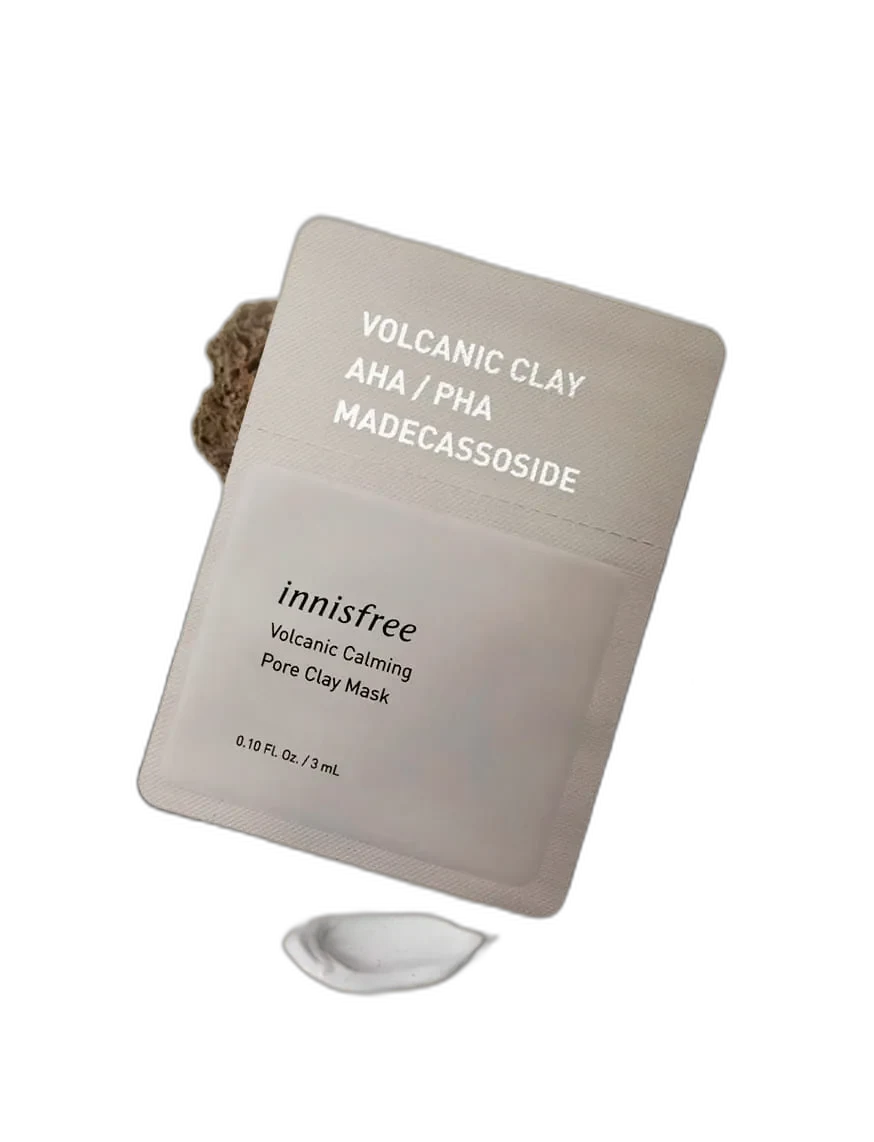
Volcanic Calming Pore Clay Mask
Sensitive Skin Pore Reset
 Verified reviewer
Pros & cons.
- +Madecassoside provides evidence-based anti-inflammatory protection during clay masking
- +PHA (gluconolactone) exfoliates while adding hydration — rare for a clay mask ingredient
- +Quick 3-5 minute application designed for comfortable daily use
- +Whipped cream texture never dries stiff, cracks, or causes uncomfortable tightness
- +Impressively clean formula — fragrance-free, oil-free, silicone-free with only 22 ingredients
- +Hygienic squeeze tube packaging prevents contamination and product drying
- +Same effective triple-mineral system as the Super Volcanic in a gentler delivery
- −Appears discontinued from US Innisfree lineup — difficult to source
- −Less intense than the Super Volcanic mask — may feel too gentle for deep-clean seekers
- −Pore-minimizing effects are temporary and require daily or frequent use to maintain
- −Limited scientific evidence for onsen-sui as a skincare active
- −AHA/PHA components may still irritate very sensitive or compromised skin despite the calming approach
The full review.
About Innisfree
Launched in 2021, the Calming variant sits alongside Innisfree’s iconic Super Volcanic Pore Clay Mask in the volcanic line, but the two products have fundamentally different philosophies. The Super Volcanic is a ten-minute weekly treatment that maximizes oil extraction. The Calming version is a three-to-five minute daily treatment that pairs effective oil absorption with proactive soothing. The difference is not in what it removes, but in how it treats your skin while removing it.
Myth
Most clay masks are built on a simple premise: absorb oil, tighten pores, leave the mask on until your face feels like it has been shellacked.
Reality
For people with genuinely oily skin and zero sensitivity, this works beautifully. For the large population whose skin is oily and reactive — a combination more common than most product lines acknowledge — traditional clay masks are a calculated trade: you accept the stripping, the tightness, and the redness in exchange for a few hours of matte, refined-looking pores. The Innisfree Volcanic Calming Pore Clay Mask was built for the people who are tired of making that trade.
How to Use
The Calming version is a three-to-five minute daily treatment that pairs effective oil absorption with proactive soothing.
Who Should Buy
For the people living in that overlap — whose pores clog and whose skin flares up from the very products designed to fix the clogging — this was a genuinely thoughtful solution.
Texture
It is a whipped, cream-like consistency that goes on soft and stays soft throughout the three-to-five minute application. It does not crack. It does not pull. It does not make you feel like your face has been cemented. After rinsing — which is considerably easier than rinsing the Super Volcanic’s stubborn clay — your skin feels clean, smooth, and mattified without the tight, stripped sensation that usually follows clay masking.
Scent
The ingredient list is remarkably clean — only twenty-two ingredients, with no fragrance, no essential oils, no silicones, no parabens, and no sulfates.
Packaging
The squeeze tube packaging is a practical upgrade over the jar format used by the Super Volcanic mask. It is more hygienic — no repeated finger-dipping into an open jar — and it dispenses controlled amounts without waste. The tube also keeps the product from drying out between uses, which is a real issue with jar-packed clay masks that lose moisture at the surface over weeks of opening and closing.
Best Season
No information.
Common Praise
No information.
Common Complaints
The larger issue is availability. This product appears to have been phased out from the US Innisfree lineup and is increasingly difficult to find outside Asian markets. Whether this reflects insufficient demand or a strategic decision to consolidate the volcanic line around fewer SKUs, the practical result is that the people who would benefit most from this mask may not be able to find it easily.
Pairs Well With
No information.
Conflicts With
No information.
Best for
For the people living in that overlap — whose pores clog and whose skin flares up from the very products designed to fix the clogging — this was a genuinely thoughtful solution.
Works for
No information.
Not ideal for
Users who want the deep-purging, heavy-duty pore extraction that the Super Volcanic delivers will find this too gentle. The three-to-five minute application time means less total mineral contact than a ten-minute session. The PHA exfoliation is milder than AHA exfoliation. The madecassoside soothing means less of that satisfying tingle that oily skin types associate with effectiveness. If you want a mask that feels like it is working aggressively, this is not the one.
AM routine
No information.
PM routine
No information.
Ingredient analysis.
Full INCI list
Water/Aqua/Eau, Kaolin, Butylene Glycol, Silica, Glycerin, Bentonite, Titanium Dioxide (CI 77891), 1,2-Hexanediol, Volcanic Ash, Microcrystalline Cellulose, Onsen-Sui, Xanthan Gum, Cellulose Gum, Propanediol, Disodium EDTA, Ethylhexylglycerin, Lactic Acid/Glycolic Acid Copolymer, Gluconolactone, Madecassoside, Lactic Acid, Polyquaternium-10, Tocopherol
Skin match.
The science.
The Science
The Volcanic Calming mask uses a dual-approach of mineral absorption and anti-inflammatory soothing to fill a gap in clay mask science. The kaolin and bentonite dual-clay system absorbs sebum. Research in the Journal of Cosmetic Dermatology shows bentonite clay reduces Propionibacterium acnes counts and sebum oxidation products, which helps manage oily, acne-prone skin.
Madecassoside is the formula's calming cornerstone and has substantial published evidence. Research in Phytomedicine shows madecassoside promotes collagen synthesis and inhibits inflammatory cytokine production in skin cells. Including it in a clay mask proactively addresses the inflammatory response from aggressive sebum removal—a strategy rare in the clay mask category.
Gluconolactone (PHA) offers a gentler exfoliation paradigm. Green et al. (2009) published in Clinics in Dermatology that polyhydroxy acids exfoliate like AHAs but cause significantly less irritation because of their larger molecular size. Additionally, the multiple hydroxyl groups in PHAs provide humectant and antioxidant properties, so gluconolactone exfoliates while moisturizing. In a clay mask for sensitive-oily skin, this dual functionality solves the central paradox: effective exfoliation without the irritation typical of clay-and-acid combinations.
The lactic acid/glycolic acid copolymer provides sustained-release AHA delivery, moderating acid exposure during the 3-5 minute application. This controlled-release approach matters for a daily-use product where cumulative acid exposure could otherwise reach irritating levels.
Dermatologist Perspective
Dermatologists would see this formula as a thoughtful solution for the oily-sensitive skin paradox—patients needing oil control who react poorly to aggressive treatments. The madecassoside aligns with evidence-based anti-inflammatory skincare, and gluconolactone provides the gentle PHA exfoliation dermatologists often recommend for reactive skin. Board-certified dermatologists would appreciate the fragrance-free formulation and short application time, which reduces over-stripping risks. The product works as a daily or near-daily maintenance treatment for patients with oily-combination skin who find traditional clay masks too irritating.
Where it fits in your routine.
Apply a thin, even layer to dry skin after cleansing, targeting the T-zone and oily areas. Avoid the lips and eye area. Leave on for 3-5 minutes; do not exceed 5 minutes. Rinse well with lukewarm water. Immediately follow with a hydrating toner, serum, and moisturizer. Use daily for oily skin. Use 2-3 times weekly for combination skin. If you are new to clay masks or acid exfoliation, start every other day and increase frequency as your skin tolerates.
At about $17 for 100 mL, this mask offers strong value when available. Daily use uses roughly 5 mL per session, providing 20 applications — about a month of daily masking for less than $1 per use. However, limited current availability makes value assessment academic. If you find it at Asian beauty retailers, the price-per-use competes with premium gentle clay masks from Western brands that charge more for similar ingredient philosophies.
Oily and combination skin types find traditional clay masks too harsh, stripping, or irritating. This formula targets the oily-sensitive skin intersection — people who need pore care but react poorly to conventional products.
Clay masks of any kind over-strip dry skin types without excess oil. People with active eczema or severely compromised barriers should also avoid. For maximum-intensity deep pore purging, the Super Volcanic 2X is the better choice from this line.
Product details.
The whipped cream-like consistency feels moist and creamy when applied. It differs from traditional stiff-drying clay masks. It spreads easily and stays soft without cracking during the masking period.
Unscented — contains no added fragrance or essential oils. It has a faint, barely perceptible mineral/clay smell.
Gray squeeze tube with green accents follows Innisfree's volcanic line design. This tube is more hygienic and travel-friendly than the jar packaging used for the Super Volcanic version.
The first application feels cool and lightweight, unlike a traditional clay mask. The whipped texture spreads smoothly and stays comfortable during the 3-5 minute wear time. After rinsing, skin feels clean and smooth without the tight, stripped sensation typical of clay masks. A subtle matte finish replaces surface oil.
3-4 months with 3x weekly use
12 months
All Year
The backstory.
Innisfree launched the Calming variant in 2021 after recognizing that many fans of the original volcanic mask had oily but sensitive skin — a combination that traditional clay masks handle poorly. By adding madecassoside, swapping to gentler PHA exfoliation, and reformulating for a shorter application time in a squeeze tube, the brand created what is essentially a daily-use version of their iconic mask. It may have been ahead of its time — the sensitive-oily skin niche has only grown more recognized since its launch.
About Innisfree
Established Brand (5–20 years)Innisfree developed the Volcanic Calming variant as a gentler option to their iconic Super Volcanic Pore Clay Mask. It adds Centella-derived madecassoside and PHA exfoliation for oily-sensitive skin. The volcanic line is one of Amorepacific's most recognized K-beauty mask ranges.
Common myths.
A clay mask works only when it dries completely and cracks.
This mask does not fully dry or crack — that is the design. The whipped texture keeps moisture in contact with the skin while the clays absorb oil. Over-drying a clay mask pulls water from your skin along with oil, which damages the barrier. A 3-5 minute soft application lets the volcanic ash and dual clays work.
Calming products are too gentle to actually clear pores.
This mask uses kaolin, bentonite, and volcanic ash—the same triple-clay system as the Super Volcanic version. The calming approach adds soothing and gentler exfoliation without removing the pore-clearing minerals. It works to be effective and comfortable at the same time.
FAQ.
How does the Calming mask differ from the Super Volcanic mask?
The Calming version adds madecassoside (anti-inflammatory), gluconolactone PHA (gentle exfoliation), and onsen-sui (mineral water) while using a whipped, non-drying texture suitable for 3-5 minute daily use. The Super Volcanic 2X is more intense, designed for 10-minute weekly deep-cleaning sessions. Choose Calming if you have oily but reactive skin; choose Super Volcanic if you want maximum-intensity oil purging.
Can I use the Calming clay mask every day?
Oily skin can use this more often. The formula uses madecassoside to soothe and requires only a 3-5 minute application time. Combination skin needs 2-3 uses per week, focusing on the T-zone. Watch for dryness and adjust frequency as needed.
Is the Innisfree Volcanic Calming Mask still available?
Innisfree has phased this product out of the US Innisfree website and Sephora. Asian beauty retailers like YesStyle and Olive Young still sell it, but stock is limited. The Super Volcanic Pore Clay Mask 2X and the newer Volcanic Swirl Pore Mask are the current US alternatives.
Is this mask suitable for rosacea-prone skin?
The madecassoside and fragrance-free formula makes this gentler than most clay masks, but rosacea-prone skin still needs a careful patch test. The AHA/PHA exfoliants may trigger redness in active rosacea, even at low concentrations. Use for 2-3 minutes initially and observe your skin's response.
Why only 3-5 minutes instead of 10-15 like other clay masks?
The short application time is intentional. It lets the volcanic ash and clays absorb surface oil without pulling moisture from deeper skin layers. The whipped texture stays in contact without over-drying, and the sustained-release AHA copolymer works during this window. Leaving it on longer than 5 minutes risks the drying and irritation the formula avoids.
What the community says.
"Quick 3-5 minute application time — far more convenient than traditional clay masks"
"Whipped cream texture does not dry stiff or crack on the face"
"Effective oil absorption without the stripping tightness of regular clay masks"
"Fragrance-free formulation works well for sensitive-oily skin"
"Squeeze tube packaging is hygienic and travel-friendly"
"Gentle enough for daily use on oily skin"
"Less intense than the Super Volcanic mask — may feel too mild for deep-clean seekers"
"Brightening and exfoliating effects are subtle rather than dramatic"
"Results are temporary and require consistent use to maintain"
"Difficult to find in the US market — appears discontinued from innisfree.com"
"Can still cause slight dryness if left on longer than recommended 5 minutes"
Featured in.
People also looked at.