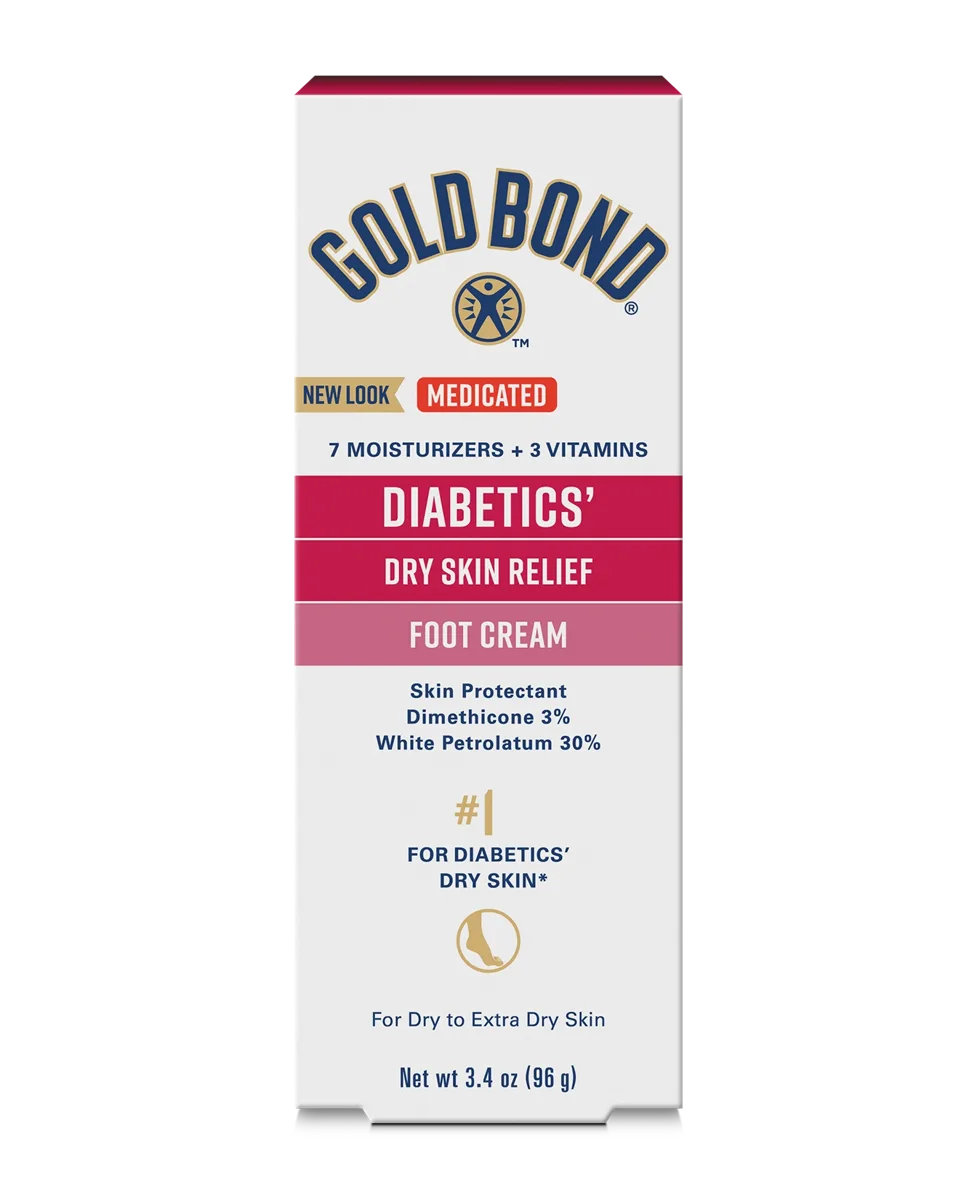
Diabetics Dry Skin Relief Foot Cream
Diabetic Foot Care Staple
 Verified reviewer
Pros & cons.
- +FDA-regulated OTC drug with 30% petrolatum skin protectant, not just a cosmetic moisturizer
- +Ceramide NG addresses the specific barrier dysfunction found in diabetic skin
- +Fragrance-free and hypoallergenic formula appropriate for sensitized diabetic skin
- +Noticeable softening within hours of first application with lasting moisture
- +Listed in the American Diabetes Association Consumer Guide for added clinical credibility
- +Dual occlusive system of petrolatum and dimethicone balances protection with wearable texture
- +Affordable price point under twelve dollars for a specialized medical-grade foot cream
- −Only available in a small 3.4 oz tube that depletes quickly with twice-daily use
- −Contains DMDM Hydantoin, a formaldehyde-releasing preservative some consumers prefer to avoid
- −Not paraben-free, which may deter ingredient-conscious buyers
- −Gradual results for severely cracked heels may frustrate those expecting rapid transformation
- −Slight waxy film from high petrolatum content can feel noticeable on warmer days
The full review.
There is a quiet crisis happening below the ankles of roughly 37 million Americans living with diabetes, and it has nothing to do with blood sugar monitors or insulin pens. Diabetic skin — particularly on the feet — loses moisture differently. Reduced circulation alters lipid metabolism, the skin barrier thins, and what starts as dry patches can progress to cracks that become entry points for infection. It is a mundane problem with potentially serious consequences, and most foot creams on the shelf were not designed with this specific physiology in mind.
Gold Bond’s Diabetics’ Dry Skin Relief Foot Cream was. And the first thing worth noting is what it legally is: not a cosmetic moisturizer, but an over-the-counter drug product with two registered active ingredients. The 30% white petrolatum and 3% dimethicone carry official skin protectant designations, which means their efficacy claims are FDA-regulated rather than marketing department aspirations. That distinction matters when the stakes extend beyond aesthetics.
The formula builds outward from those two occlusive layers. Beneath the petrolatum seal sits ceramide NG, a lipid that mirrors what diabetic skin is progressively losing — the structural component of the moisture barrier itself. Aloe vera, positioned high in the ingredient list, provides immediate anti-inflammatory soothing. Allantoin promotes cell turnover in skin that heals slowly due to compromised circulation. And then there is palmitoyl hexapeptide-12, a signal peptide that adds a regenerative nudge to what is otherwise a straightforward barrier-protection strategy.
The texture is exactly what you would expect from a cream built around 30% petrolatum — rich, dense, and unapologetically protective. It is not the kind of product that vanishes on contact. You apply it, and you know it is there, forming a subtle occlusive film that is doing precisely what it should: sealing moisture into skin that cannot hold onto it on its own. That said, the dimethicone does admirable work preventing the formula from feeling like petroleum jelly straight from the jar. The finish is more satin than slick, and it absorbs into foot skin more cooperatively than the ingredient list might suggest.
Fragrance-free is non-negotiable for this category, and Gold Bond honors that. The cream has a faint, neutral base scent and nothing more. For diabetic skin that may already be sensitized, even mild fragrance can be an unnecessary provocation. The hypoallergenic certification adds another layer of reassurance.
Performance is where this cream earns its keep. Most users report noticeably softer skin within hours of the first application — not the sort of transformative overnight miracle that belongs in advertising copy, but the kind of genuine, tangible improvement that tells you the formula is doing its job. Within three to five days of consistent use, cracked skin begins to smooth. By the two-week mark, feet that were rough enough to catch on socks start feeling like they belong to someone who has been taking care of them all along. The cotton-socks-at-night technique, which Gold Bond recommends, genuinely accelerates results by preventing the petrolatum from rubbing off onto bedding.
Honesty requires acknowledging what this cream is not. It is not a rapid solution for deeply fissured heels — those require consistent application over weeks, and severe cases may need professional attention. The 3.4-ounce tube is the only available size, and at twice-daily application to both feet, you will be replacing it every four to six weeks. At roughly eleven dollars per tube, that is manageable but not negligible for an ongoing care product. A larger format would be welcome.
The preservative system deserves transparency as well. DMDM Hydantoin is a formaldehyde-releasing preservative that, while considered safe at cosmetic concentrations by the FDA, has become a point of concern for some consumers. Methylparaben and propylparaben round out the preservative roster. These are well-studied and widely used, but if you are committed to a paraben-free routine, this is not your product.
The American Diabetes Association Consumer Guide listing lends this product a credibility that most drugstore foot creams cannot claim. Combined with the dermatologist-tested designation and Better Choices for Life certification, there is a meaningful institutional backing behind the formula. Gold Bond itself has been formulating medicated skin products since 1882 — this is not a brand pivoting to a trending condition for market share.
At its core, this foot cream does something simple extremely well: it protects compromised skin with pharmaceutical-grade occlusion while quietly repairing the underlying barrier. It does not need to be exciting. For the millions of people managing diabetic skin, it needs to be reliable. And on that count, it delivers.
Formula
Texture
The texture is exactly what you would expect from a cream built around 30% petrolatum — rich, dense, and unapologetically protective. It is not the kind of product that vanishes on contact. You apply it, and you know it is there, forming a subtle occlusive film that is doing precisely what it should: sealing moisture into skin that cannot hold onto it on its own. That said, the dimethicone does admirable work preventing the formula from feeling like petroleum jelly straight from the jar. The finish is more satin than slick, and it absorbs into foot skin more cooperatively than the ingredient list might suggest.
Scent
Fragrance-free is non-negotiable for this category, and Gold Bond honors that. The cream has a faint, neutral base scent and nothing more. For diabetic skin that may already be sensitized, even mild fragrance can be an unnecessary provocation. The hypoallergenic certification adds another layer of reassurance.
Performance
Performance is where this cream earns its keep. Most users report noticeably softer skin within hours of the first application — not the sort of transformative overnight miracle that belongs in advertising copy, but the kind of genuine, tangible improvement that tells you the formula is doing its job. Within three to five days of consistent use, cracked skin begins to smooth. By the two-week mark, feet that were rough enough to catch on socks start feeling like they belong to someone who has been taking care of them all along. The cotton-socks-at-night technique, which Gold Bond recommends, genuinely accelerates results by preventing the petrolatum from rubbing off onto bedding.
Common Complaints
Honesty requires acknowledging what this cream is not. It is not a rapid solution for deeply fissured heels — those require consistent application over weeks, and severe cases may need professional attention. The 3.4-ounce tube is the only available size, and at twice-daily application to both feet, you will be replacing it every four to six weeks. At roughly eleven dollars per tube, that is manageable but not negligible for an ongoing care product. A larger format would be welcome.
The preservative system deserves transparency as well. DMDM Hydantoin is a formaldehyde-releasing preservative that, while considered safe at cosmetic concentrations by the FDA, has become a point of concern for some consumers. Methylparaben and propylparaben round out the preservative roster. These are well-studied and widely used, but if you are committed to a paraben-free routine, this is not your product.
Pairs Well With
The American Diabetes Association Consumer Guide listing lends this product a credibility that most drugstore foot creams cannot claim. Combined with the dermatologist-tested designation and Better Choices for Life certification, there is a meaningful institutional backing behind the formula. Gold Bond itself has been formulating medicated skin products since 1882 — this is not a brand pivoting to a trending condition for market share.
Best for
At its core, this foot cream does something simple extremely well: it protects compromised skin with pharmaceutical-grade occlusion while quietly repairing the underlying barrier. It does not need to be exciting. For the millions of people managing diabetic skin, it needs to be reliable. And on that count, it delivers.
Ingredient analysis.
Full INCI list
Active Ingredients: Dimethicone 3% (Skin Protectant), White Petrolatum 30% (Skin Protectant). Inactive Ingredients: Water, Glycerin, Glyceryl Stearate, Distearyldimonium Chloride, Aloe Barbadensis Leaf Juice, Polyethylene, Stearyl Alcohol, Cetearyl Alcohol, Behentrimonium Methosulfate, Methyl Gluceth-20, Steareth-2, Steareth-21, Allantoin, Cetyl Alcohol, Tocopheryl Acetate, Butyrospermum Parkii (Shea) Butter Extract, PEG-10 Phytosterol, Polysorbate 60, Ceramide NG, Stearamidopropyl PG-Dimonium Chloride Phosphate, Jojoba Esters, DMDM Hydantoin, Magnesium Ascorbyl Phosphate, Butylene Glycol, Methylparaben, Palmitoyl Hexapeptide-12, Propylene Glycol, Hydrolyzed Jojoba Esters, Propylparaben, EDTA, Potassium Hydroxide, Tribehenin, C12-15 Alkyl Benzoate, Retinyl Palmitate
Skin match.
The science.
The Science
This formula relies on petrolatum's proven occlusive properties. At sufficient concentrations, petrolatum reduces transepidermal water loss (TEWL) by approximately 99%, making it the gold standard occlusive agent. A landmark study in the Journal of the American Academy of Dermatology (Draelos, 2018) confirmed petrolatum-based formulations outperform many modern alternatives for barrier repair in compromised skin.
Diabetic skin presents unique challenges that justify this aggressive occlusion strategy. Research in Diabetes/Metabolism Research and Reviews (Sakai et al., 2005) shows diabetic patients have significantly reduced ceramide levels in the stratum corneum, which impairs barrier function regardless of glycemic control. The inclusion of ceramide NG addresses this deficit—ceramides make up approximately 50% of stratum corneum lipids, and supplementing them improves barrier integrity in multiple clinical contexts.
The dual-protectant approach combining petrolatum with dimethicone uses complementary mechanisms: petrolatum integrates into the stratum corneum lipid matrix while dimethicone forms a breathable, hydrophobic film on the skin surface. A study in Contact Dermatitis (Zhai & Maibach, 2001) found that combining occlusive agents provides superior barrier protection compared to either agent alone.
Allantoin adds a keratolytic dimension, promoting desquamation of rough, thickened skin and stimulating cell proliferation—properties documented in the International Journal of Cosmetic Science. This matters for diabetic feet, where reduced circulation often impairs natural desquamation.
References
- The role of petrolatum in skin barrier repair — Journal of the American Academy of Dermatology (2018)
- Skin ceramide content in diabetic patients — Diabetes/Metabolism Research and Reviews (2005)
- Effect of skin occlusion on percutaneous absorption — Contact Dermatitis (2001)
Dermatologist Perspective
Dermatologists often note that foot care is a frequently overlooked part of diabetes management. Board-certified dermatologists say reduced circulation, autonomic neuropathy, and altered lipid metabolism create a perfect storm for xerosis and fissuring on diabetic feet. Clinicians commonly recommend products with high-concentration petrolatum and ceramide supplementation because they meet both the occlusive and barrier-repair needs of this population. The OTC drug classification of this product gives dermatologists an accessible recommendation with regulatory assurance beyond typical cosmetic moisturizers. Foot specialists typically advise patients to apply this type of cream immediately after bathing, while skin is still slightly damp, to maximize hydration capture.
Where it fits in your routine.
Apply a thick layer to clean, dry feet, targeting heels, soles, and cracked areas. For best absorption, apply right after bathing while skin is damp. Use twice daily — morning and evening. At night, wear cotton socks after application to increase penetration and stop the cream from staining bedding. Do not apply between toes, as excess moisture promotes fungal growth. Consult a healthcare provider before use if skin is severely cracked or broken.
At roughly eleven dollars for 3.4 ounces, this foot cream costs a fair price for a specialized OTC drug product. The cost per ounce exceeds Gold Bond's body lotions, but the concentrated foot formula with ceramide NG, peptide, and 30% petrolatum justifies the premium over standard moisturizers. No larger size exists for the foot cream specifically, which raises long-term costs for daily users needing a repurchase every four to six weeks. Compared to prescription diabetic foot treatments and specialty podiatric products, this remains a budget-friendly option that delivers clinical-grade barrier protection at a drugstore price.
This fragrance-free, FDA-regulated cream is affordable and contains barrier-repair ingredients for diabetic dry skin on feet. It works well for rough, dry, or cracking feet and has the American Diabetes Association seal.
Avoid this if you strictly skip parabens or formaldehyde-releasing preservatives like DMDM Hydantoin. This cream is insufficient for feet with deep fissures, open wounds, or signs of infection — see a podiatrist or dermatologist for clinical intervention.
Product details.
Thick cream that is dense but spreads and absorbs well without a heavy, greasy residue. It is heavier than a typical body lotion but not ointment-thick.
Fragrance-free with a very mild, neutral cream scent from the base ingredients.
3.4 oz white squeezable tube with a screw cap. Gold and dark brown branding features the Gold Bond logo. This size works for travel.
The cream feels thick and protective on first application but is not uncomfortably heavy. Most users see softer skin within hours. The petrolatum creates a subtle occlusive film that locks in moisture; this is intentional and shows the product works. Expect no adjustment period, tingling, or purging.
4-6 weeks with twice-daily application to both feet
12 months
All Year
The backstory.
Gold Bond developed its Diabetics' line to address a gap in the mass-market foot care aisle — most foot creams aren't formulated with the specific dermatological needs of diabetic skin in mind. The product earned a spot in the American Diabetes Association Consumer Guide, signaling clinical recognition beyond typical drugstore fare.
About Gold Bond
Legacy Brand (20+ years)Rhode Island physicians developed Gold Bond in 1882. It has been a pharmacy staple for over 140 years. Sanofi owns the brand via Chattem. Gold Bond produces OTC medicated skincare products found in most drugstores. The Diabetics' line is dermatologist-tested and appears in the American Diabetes Association Consumer Guide.
Common myths.
Any thick moisturizer works the same for diabetic feet
Altered lipid metabolism and reduced circulation compromise diabetic skin barrier function. This formula uses ceramide NG for barrier repair and 30% petrolatum for pharmaceutical-grade occlusion rather than just cosmetic moisturization.
Petrolatum-based products clog pores and cause problems
Pore-clogging matters little on the feet. Petrolatum is a highly effective, well-studied occlusive agent. At 30%, it creates a protective seal suitable for the thick, dry skin of the feet.
FAQ.
Is Gold Bond Diabetics Foot Cream safe for people with diabetes?
Yes — this product is specifically formulated and dermatologist-tested for people living with diabetes. Its fragrance-free, hypoallergenic formula with 30% petrolatum and ceramide NG addresses the unique barrier impairment and dryness that diabetic skin experiences. It's also listed in the American Diabetes Association Consumer Guide.
How often should I apply Gold Bond Diabetics Foot Cream?
Apply twice daily — morning and evening — to clean, dry feet for best results. Wear cotton socks after application, especially at night, to increase absorption and protect bedding. Consistent twice-daily use shows noticeable improvement within 3-5 days.
Does Gold Bond Diabetics Foot Cream contain fragrance?
This product is fragrance-free and hypoallergenic. It works for the sensitive skin common in diabetic patients. However, it contains DMDM Hydantoin and parabens as preservatives, which some users avoid.
Can I use this foot cream on other parts of my body?
This cream is safe for other body areas, but its 30% petrolatum concentration targets thick, dry foot skin. Gold Bond offers a separate Diabetics' Dry Skin Relief Moisturizing Lotion, which has a lighter texture for body-wide use.
How does this compare to regular Gold Bond lotions?
The Diabetics' Foot Cream has 30% petrolatum as an active ingredient, which is much higher than regular Gold Bond lotions. It also adds ceramide NG and palmitoyl hexapeptide-12 to repair the barrier. This is an OTC drug product, not a cosmetic, so the FDA regulates its skin-protectant claims.
What the community says.
"Effectively softens and heals cracked, dry feet within days"
"Non-greasy feel despite rich petrolatum-based formula"
"Fragrance-free and gentle enough for sensitive diabetic skin"
"Absorbs well and provides lasting moisture through the day"
"Affordable compared to specialty diabetic foot care products"
"Trusted pharmacy brand with long track record"
"Small 3.4 oz tube runs out quickly with regular use"
"Not available in larger sizes for the foot cream specifically"
"Contains DMDM Hydantoin which some users prefer to avoid"
"Can feel slightly waxy or filmy due to high petrolatum content"
"Gradual results may not satisfy those with severely cracked heels"