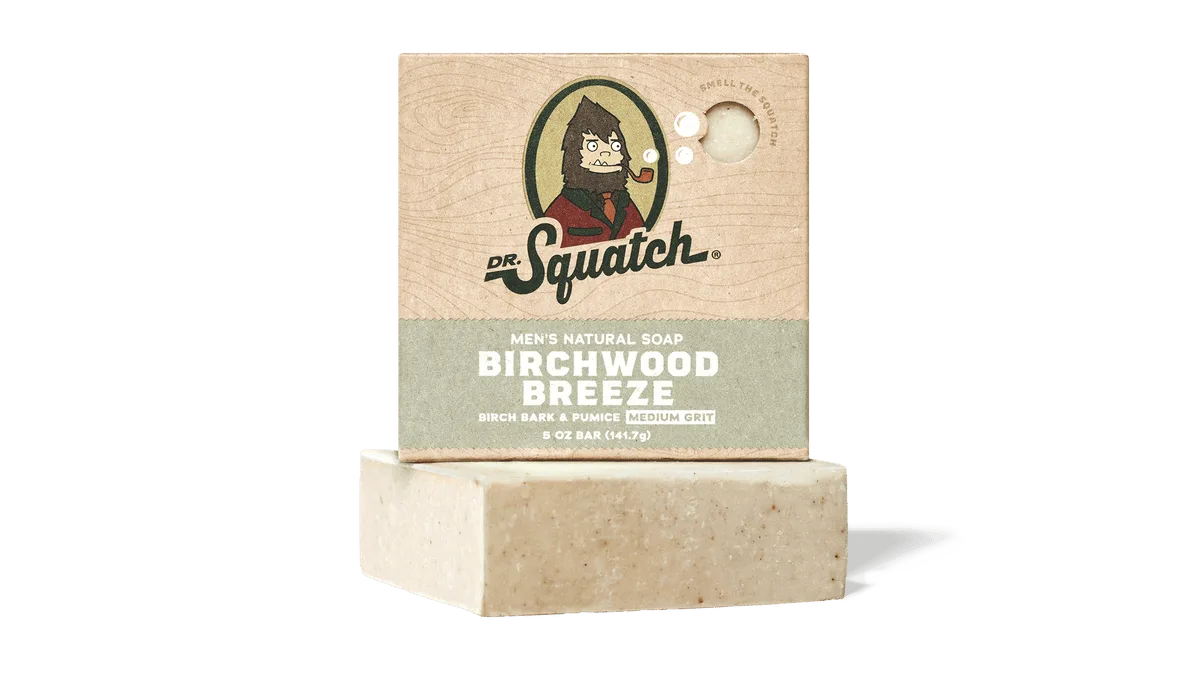
Birchwood Breeze Natural Bar Soap
Cold-Process Shower Staple
 Verified reviewer
Pros & cons.
- +Olive-oil-based cold-process formulation lathers creamier than most natural bars
- +Meaningful shea butter inclusion leaves skin less stripped than typical cold-process soaps
- +Fresh woodsy birch-cedar-bergamot scent more wearable than heavier Dr. Squatch variants
- +No synthetic fragrance, parabens, sulfates, or petrochemical surfactants
- +Fully plastic-free kraft paper packaging
- +Transparent ingredient disclosure from an established natural grooming brand
- −Essential oil fragrance contains known allergens limonene and linalool
- −High pH around 9-10 is less barrier-friendly than syndet body washes
- −Expensive at $8 per 5-ounce bar compared to drugstore alternatives
- −Bar dissolves noticeably faster than commercial synthetic soaps
- −Unsuitable for facial use, sensitive skin, or compromised skin barriers
The full review.
There is a particular category of shopper who will read this review, and that shopper already owns at least three Dr. Squatch bars. If that’s you, here’s the quick take: Birchwood Breeze is one of the more wearable scents in the lineup, less aggressive than Pine Tar and more versatile than the cologne-strong options, and the formulation underneath that fragrance is the standard Dr. Squatch cold-process build that’s kept the brand in business since 2013. For everyone else — the people who’ve seen the YouTube ads a hundred times and are wondering what all the fuss is about — a longer conversation is in order.
Cold-process natural soap is a genuinely different product from what most people call ‘soap’ in 2026. When you pick up a drugstore bar or a body wash, you’re usually getting a synthetic surfactant system engineered to clean at a skin-friendly pH around 5.5, formulated to rinse cleanly and leave minimal residue. When you pick up a Dr. Squatch bar, you’re getting saponified vegetable oils — olive, coconut, sustainable palm, castor, shea — turned into actual soap through the traditional lye reaction, sitting at a pH around 9 or 10. The tradeoff is real and worth understanding. On the positive side, you get a dense creamy lather, meaningful fatty-acid conditioning from the unsaponifiables in the oils, and a product you can actually pronounce. On the negative side, that alkaline pH is less compatible with the skin’s acid mantle than a well-formulated syndet, and that tradeoff matters more the drier or more sensitive your skin is.
The Birchwood Breeze formulation itself is genuinely well-constructed for what it is. The oil blend leads with olive oil rather than the coconut-heavy builds that dominate the budget cold-process category, which means the bar lathers with more creaminess and less squeaky stripping. There’s a meaningful amount of shea butter in there — not a token splash — which survives saponification and leaves a mild emollient film after rinsing. Kaolin clay contributes to the dense lather and a very subtle oil-adsorbing finish. Compared to the $3 bars you’ll find at a hippie co-op, this one feels noticeably more polished on the skin.
The scent is where this variant earns its specific identity. Birch bark extract, cedar oil, and bergamot combine into something that reads fresh-woodsy rather than overtly cologne-strong. It’s less divisive than Pine Tar (which smells like a campfire) and less assertive than Wood Barrel Bourbon (which smells like a leather chair at a speakeasy). Birchwood Breeze is the kind of scent you could wear to an office without your cubicle neighbor having opinions about it. The scent throw is moderate — you’ll smell it for a few hours post-shower, but it’s not going to replace your cologne.
Now the honest limitations. Eight dollars for a five-ounce bar is genuinely expensive. Cold-process bars also dissolve faster than commercial synthetic bars, so that five ounces will be gone in four to six weeks of daily use, and only if you store it in a well-draining dish and let it dry between showers. If you leave it sitting in a puddle, you’ll watch it melt. The essential oil fragrance contains known allergens — limonene and linalool are part of the bergamot and cedar oils — which means this is not a safe bet for people with sensitive skin, eczema, or a compromised barrier. Dr. Squatch’s own Cool Fresh Aloe is a significantly gentler option from the same lineup if fragrance sensitivity is a concern. And while this is a perfectly fine body bar, it should absolutely not be used on facial skin, where the alkaline pH and essential oil load will cause problems most people don’t want.
The brand-level conversation is worth having briefly. Dr. Squatch is not a dermatologist-developed brand and makes no clinical claims. What it does well is take a traditional product format, apply moderately thoughtful formulation choices, and deliver it in packaging and marketing that made the category exciting again for men who hadn’t thought about what they were washing with since college. The viral YouTube ads are part of why the bars cost eight dollars, and that’s a fair thing to weigh when you’re deciding whether to subscribe to the monthly bar delivery or not.
Who’s this for?
Normal or combination skin types who enjoy a fresh woodsy shower scent and appreciate the experience of a traditional cold-process bar over a body wash. People who like the ritual of an actual bar of soap and don’t mind paying a premium for quality ingredients and a good smell.
Who should skip it?
Anyone with sensitive or barrier-compromised skin — the essential oils and alkaline pH will not be your friends. Anyone who prefers unscented products. Anyone who wants a dermatologist-tested product for a skin condition. And honestly, anyone on a tight budget — there are perfectly good drugstore body washes for a third of the price that will clean your skin just as effectively, even if they won’t make you feel like a rugged outdoorsman in the process.
Ingredient analysis.
Full INCI list · pH 9.5
Saponified Oils of: Elaeis Guineensis (Sustainable Palm) Oil, Cocos Nucifera (Coconut) Oil, Olea Europaea (Olive) Oil, Butyrospermum Parkii (Shea) Butter; Aqua, Sodium Lactate, Kaolin, Pumice, Betula Alba (Birchwood) Powder, Fragrance (Natural Essential Oils including Pine, Clove, Cinnamon, and Citrus), Tocopherol
Skin match.
The science.
The Science
Centuries of chemistry explain cold-process soap. Saponification uses sodium hydroxide to perform alkaline hydrolysis on triglycerides, creating glycerin and sodium salts of fatty acids (the soap molecules). The oil blend dictates the bar's properties: olive oil provides oleic acid for conditioning lather; coconut oil uses lauric acid for cleansing and bubbles; castor oil adds ricinoleic acid for stable, creamy foam; and shea butter adds unsaponifiable lipids that stay on skin after washing. Traditional soap has a pH of 9-10, much higher than the skin's natural pH of about 5.5. Research in the International Journal of Dermatology and standard dermatological reviews shows syndet (synthetic detergent) cleansers at skin-compatible pH disrupt the stratum corneum less than alkaline soaps, especially with repeated use on dry, sensitive, or atopic skin. Kaolin clay adds mild adsorptive cleansing without abrasion. Birch bark extract contains betulin and betulinic acid, which show astringent and anti-inflammatory activity in vitro, though a rinse-off soap at these concentrations has modest real-world effects. The essential oils — bergamot, cedar — contain fragrance allergens (limonene, linalool, and bergapten in non-FCF bergamot) that are documented sensitizers under EU cosmetics labeling rules. This formulation is a textbook cold-process bar with standard benefits and limitations.
Dermatologist Perspective
Decades of research show alkaline cleansers disrupt the stratum corneum more than pH-adjusted formulations, so dermatologists generally recommend pH-balanced syndet cleansers over traditional alkaline bar soaps for patients with dry, sensitive, or eczema-prone skin. Cold-process natural bars like this one are not typically contraindicated for healthy, normal skin on the body, but dermatologists generally do not recommend them for facial cleansing or for patients with active inflammatory skin conditions. Essential oil fragrance is another concern; dermatologists note natural fragrances cause contact dermatitis as easily as synthetic ones, especially in atopic patients. For the target user — a normal-skinned adult male seeking an enjoyable shower experience — these bars are generally fine for occasional or daily use, though applying body moisturizer afterward is a good idea, especially in winter.
Where it fits in your routine.
Wet the bar. Lather it directly on damp skin or build a creamy lather in your hands or on a washcloth first. Apply from the neck down, but avoid the face. Rinse well with warm water. Do not leave the bar in standing water. Use a well-draining soap dish, ideally one with a raised platform, so the bar dries fully. Use a body moisturizer after, especially during dry winter months or if you have dry skin. One bar lasts 4-6 weeks with daily use.
At roughly $8 per 5-ounce bar, Dr. Squatch is a premium natural product, not a budget cleanser. The per-ounce cost is several times higher than drugstore alternatives and higher than other natural soap brands at health food stores. Single-variety purchases offer no larger size or multi-pack discount, though subscription bundles lower the per-bar cost slightly. The formulation quality is real, not just hype, but value depends on how much you value the specific scent experience and the traditional soap format. This isn't the answer for shoppers seeking clean, effective body cleansing at the best price. For shoppers who enjoy the ritual and will pay for it, the price is defensible.
Normal or combination skin types who like fresh, woodsy shower scents and prefer a traditional cold-process bar over synthetic body washes. Users seeking a premium men's grooming experience with plastic-free packaging who pay for quality ingredients and a long scent throw.
People with sensitive skin, eczema, or a compromised skin barrier will react to the essential oils and alkaline pH. Budget-conscious shoppers need effective cleansing at the best price. This suits people who prefer unscented products or react to natural fragrance allergens like limonene and linalool.
Product details.
Dense cold-process bar with a creamy, moderately rich lather
A woodsy mix of pine, clove, cinnamon, and citrus — warm, fresh, and moderately strong
Recycled kraft paper box with matte printing — no plastic
The first use produces a creamy lather for a cold-process bar. A birch-and-cedar scent stays on the skin for a few hours. The bar is slightly softer than commercial synthetic soaps and needs a well-draining dish to last. There is no purging or adjustment period.
2-3 weeks with daily full-body use if stored in a draining soap dish
12 months
spring summer
The backstory.
Dr. Squatch was founded in 2013 by Jack Haldrup in California after he became disillusioned with drugstore body washes full of synthetic fragrance and detergents. The brand grew explosively through viral YouTube advertising in the late 2010s and has become one of the best-known direct-to-consumer men's grooming brands in the US. The Birchwood Breeze variant was added in a later expansion of the scent lineup.
About Dr. Squatch
Established Brand (5–20 years)Dr. Squatch launched in 2013 as a natural men's grooming brand using cold-process soap-making. The brand lacks dermatologist development and clinical credentials, but the company has a large following and discloses all bar ingredients transparently.
FAQ.
What does Dr. Squatch Birchwood Breeze smell like?
Birchwood Breeze has a fresh woodsy scent of birch bark and cedar with a bright bergamot top note. It is less aggressive than heavier Dr. Squatch scents like Pine Tar or Wood Barrel Bourbon. Birchwood Breeze smells clean-outdoorsy rather than cologne-strong.
Can I use this bar on my face?
Not recommended. The high pH of traditional cold-process bars and the essential oil fragrance in this specific variant are too harsh for facial skin. Use a dedicated facial cleanser instead and use this bar from the neck down.
Is this soap safe for sensitive skin?
Unlikely. The essential oils in Birchwood Breeze contain fragrance allergens like limonene and linalool. The alkaline cold-process base also disrupts a compromised skin barrier. For eczema or sensitive skin, Dr. Squatch's Cool Fresh Aloe is a gentler option from the same brand.
How long does a Dr. Squatch bar last?
Daily full-body use takes 4-6 weeks. Cold-process bars dissolve faster than commercial synthetic soaps. Use a well-draining soap dish and let the bar dry between uses to extend its lifespan.
Why is it $8 for one bar of soap?
Cold-process natural soaps use expensive oils, real essential oils rather than synthetic fragrance, and labor-intensive small-batch production. These factors and direct-to-consumer marketing drive the premium price over drugstore bars.
Is it okay during pregnancy?
The formula lacks retinoids or hormone-related actives. Bergamot essential oil is photosensitizing, and some pregnant users avoid strong essential-oil fragrance. Ask your OB if you have concerns.
---
What the community says.
"Long-lasting fresh scent throw"
"Doesn't feel stripping like other natural soaps"
"Dense creamy lather"
"Masculine birchwood fragrance"
"Bar dissolves faster than synthetic soaps"
"Essential oil fragrance too strong for some"
"Premium price for the size"