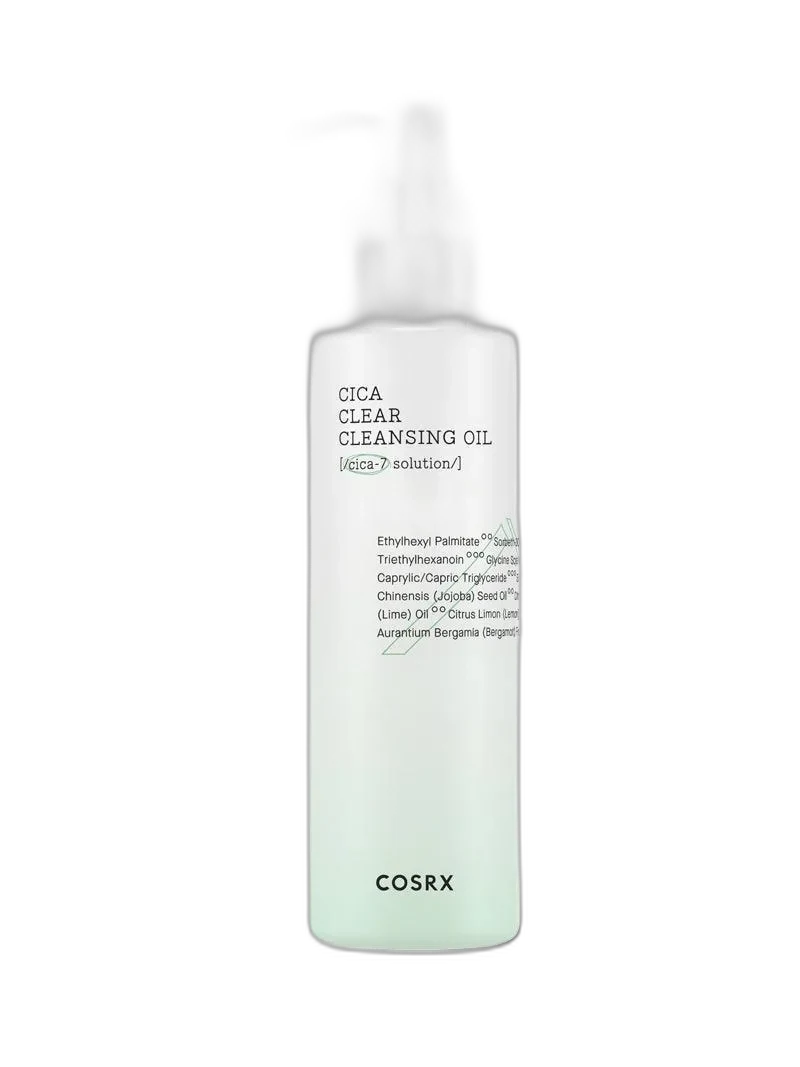
Pure Fit Cica Clear Cleansing Oil
Cica-Powered First Cleanser
 Verified reviewer
Pros & cons.
- +CICA-7 Complex with seven centella ingredients is far more comprehensive than competitors
- +Eleven plant-derived oils provide diverse fatty acid conditioning during cleansing
- +Lightweight texture that oily and combination skin types find non-greasy
- +Emulsifies cleanly and rinses without heavy residue or film
- +Pine bark extract adds unusual antioxidant protection to the cleansing step
- +Good value at approximately $14-15 for 200 mL with premium ingredients
- +50 mL mini size available for trial before committing
- −Three citrus essential oils contradict the sensitive-skin positioning and add real irritation risk
- −Bergamot, lime, and lemon oils are documented photosensitizers
- −Thinner texture provides less massage slip than richer cleansing oils
- −Struggles with waterproof mascara and heavy-duty eye makeup
- −Pump dispenses more product than needed, leading to waste
The full review.
Putting seven centella-derived soothing ingredients in a formula with lime, lemon, and bergamot essential oils is ironic. It is like installing a state-of-the-art fire suppression system and then leaving scented candles burning. The COSRX Pure Fit Cica Clear Cleansing Oil is an ambitious but contradictory product.
The ambition lies in its formulation. Launched in 2021 as part of COSRX’s expanded Pure Fit Cica cleansing lineup, this oil uses the proprietary CICA-7 Complex. This complex contains seven centella asiatica-derived ingredients: three plant extracts (whole plant, leaf, and root) and four isolated active compounds (asiaticoside, asiatic acid, madecassoside, and madecassic acid). This is not just adding centella extract to a generic base. It is a full-spectrum centella approach using both whole-plant phytochemicals and purified actives. Most competing cleansing oils only include a single extract, often at the bottom of the ingredient list. COSRX committed to the concept.
The oil base is also well-designed. Eleven plant-derived oils—soybean, jojoba, sunflower, oat kernel, olive, evening primrose, avocado, sweet almond, plus lighter esters—create a diverse fatty acid profile to condition the skin barrier. The jojoba oil mimics human sebum, so it dissolves sebum-based impurities and makeup without disrupting the skin’s natural lipid structure. Evening primrose oil adds gamma-linolenic acid, an anti-inflammatory fatty acid that supports barrier repair. Pine bark extract adds proanthocyanidin antioxidants. This is an unusual addition for a rinse-off product, suggesting COSRX intends for this oil to neutralize environmental free radicals during cleansing.
Texture
The texture differs from cleansing oil conventions. It is thinner and more watery than the thick consistency many associate with this category. If you use a thick cleansing balm or a heavy cleansing oil, this feels serum-like. This thinness has trade-offs: it spreads fast and does not feel greasy, which helps oily skin, but it provides less massage slip and requires more pumps to cover the face. The pump is generous and dispenses more per press than most people need.
Emulsification is clean. Add water, massage briefly, and the oil turns milky white before rinsing with minimal residue. Most reviewers say skin feels soft, hydrated, and non-tight after rinsing; the eleven-oil blend conditions the skin without a heavy film. It performs well on sunscreen, regular makeup, and daily grime. It struggles with waterproof mascara and heavy-duty eye makeup, which require more time and effort due to the thin consistency.
The contradiction is the citrus essential oils—lime, lemon peel, and bergamot fruit oil. They sit mid-INCI list, meaning they are present at a meaningful concentration. These are established photosensitizers and potential irritants. Bergamot oil contains bergapten (a furanocoumarin) unless it is de-furocoumarinized, and the label does not specify this. Lime and lemon oils are also documented irritants. Including them in a product marketed for soothing, sensitivity testing, and centella-powered barrier support is confusing.
The reason is likely fragrance. The citrus oils create a fresh, grassy-citrus scent that is quite noticeable. Some users find it pleasant; others find it strong or slightly artificial. COSRX chose natural essential oils for scent instead of synthetic fragrance, which many K-beauty consumers reject. However, “natural” does not mean “non-irritating.” For the sensitive skin population this product targets, citrus essential oils can be more problematic than well-formulated synthetic fragrances.
If you do not react to citrus oils, this is a good cleansing oil. The centella complex adds therapeutic value to the first-cleanse step, the oil blend is skin-compatible, and the price—typically around fourteen to fifteen dollars for 200 mL—is fair for the ingredients. It fits COSRX’s model of clinical thinking at accessible prices.
But for the sensitive-skin audience the marketing targets, the citrus oils prevent a full recommendation. You cannot put “cica” and “sensitive” on a label and include lime, lemon, and bergamot essential oils without risking irritation. If COSRX released a fragrance-free reformulation, it would be an easy recommendation. As it stands, it is a good cleansing oil with an asterisk.
Ingredient analysis.
Full INCI list
Ethylhexyl Palmitate, Sorbeth-30 Tetraoleate, Triethylhexanoin, Glycine Soja (Soybean) Oil, Caprylic/Capric Triglyceride, Simmondsia Chinensis (Jojoba) Seed Oil, Citrus Aurantifolia (Lime) Oil, Citrus Limon (Lemon) Peel Oil, Citrus Aurantium Bergamia (Bergamot) Fruit Oil, Tocopherol, Helianthus Annuus (Sunflower) Seed Oil, Caprylyl Glycol, Ethylhexylglycerin, Avena Sativa (Oat) Kernel Oil, Olea Europaea (Olive) Fruit Oil, Oenothera Biennis (Evening Primrose) Oil, Persea Gratissima (Avocado) Oil, Prunus Amygdalus Dulcis (Sweet Almond) Oil, Water, 1,2-Hexanediol, Centella Asiatica Extract, Centella Asiatica Leaf Extract, Centella Asiatica Root Extract, Pinus Pinaster Bark Extract, Asiaticoside, Asiatic Acid, Madecassoside, Madecassic Acid
Skin match.
The science.
The Science
The CICA-7 Complex drives this formulation, using a full-spectrum centella approach backed by research.
Research extensively covers centella asiatica's four primary triterpene actives — asiaticoside, asiatic acid, madecassoside, and madecassic acid — for wound-healing and anti-inflammatory properties. A 2015 review in the Journal of Ethnopharmacology catalogued centella's mechanisms, including collagen type I synthesis stimulation, inhibition of inflammatory mediators IL-1β and TNF-α, and increased antioxidant enzyme activity. The review found that combining centella's triterpenes creates synergistic effects compared to single compounds, justifying the use of all four actives together.
Madecassoside shows potent anti-inflammatory activity in multiple models. Research in Planta Medica (2010) showed madecassoside inhibited UV-induced inflammation via NF-kB and MAPK pathways, offering protection against environmental stress — a factor for a cleansing oil that removes environmental pollutants.
The oil blend supports the barrier through fatty acid diversity. Evening primrose oil contains gamma-linolenic acid (GLA), an omega-6 fatty acid the body converts to anti-inflammatory prostaglandins. A study in the International Journal of Cosmetic Science (2010) showed topical GLA application improved skin barrier function and reduced transepidermal water loss. Even with limited contact time in a rinse-off product, this brief exposure provides measurable conditioning.
The citrus essential oils require scrutiny. Bergamot oil contains bergapten (5-methoxypsoralen), a phototoxic furanocoumarin that a Photodermatology, Photoimmunology & Photomedicine study (2001) linked to photosensitization at concentrations as low as 0.0075%. Lime and lemon peel oils contain similar furanocoumarins. While rinsing a cleansing oil reduces exposure, using three citrus oils increases the cumulative furanocoumarin load — a concern for sensitive skin.
References
- Centella asiatica in cosmetology: a review — Journal of Ethnopharmacology (2015)
- Madecassoside, a novel triterpenoid saponin from Centella asiatica, inhibits UV-induced inflammation — Planta Medica (2010)
Dermatologist Perspective
Dermatologists view cleansing oils as effective first-step cleansers that dissolve oil-based impurities using the 'like dissolves like' principle. Board-certified dermatologists note the CICA-7 Complex in this formula uses a more sophisticated approach to centella than most consumer products, combining isolated triterpenes with whole-plant extracts for synergistic anti-inflammatory effects. However, dermatologists flag citrus essential oils as potential photosensitizers and contact irritants, especially bergamot oil unless labeled bergapten-free. For patients with sensitive, reactive, or rosacea-prone skin, most dermatologists recommend a fragrance-free cleansing oil alternative despite the centella complex. The brief contact time of a rinse-off product reduces but does not eliminate irritation risk.
Where it fits in your routine.
Dispense 2-3 pumps onto dry hands and apply to a dry face. Massage gently for 30-60 seconds, targeting areas with makeup, sunscreen, or excess sebum. The oil dissolves impurities on contact. Add a little lukewarm water and massage; the oil emulsifies and turns milky white. Rinse thoroughly with lukewarm water. Follow immediately with a water-based gel or foam cleanser for the second step of double cleansing. Use once daily in the evening.
At roughly fourteen to fifteen dollars for 200 mL, this cleansing oil has good ingredient quality for the price. The CICA-7 Complex alone uses four isolated centella actives and usually costs more. The eleven-oil blend also includes evening primrose and oat kernel oils. A 50 mL mini size costs about eight to ten dollars for trials. COSRX's track record supports the value, but the citrus oil inclusion lowers the premium positioning because many educated consumers avoid those ingredients.
Normal, combination, or oily skin types wanting a lightweight first cleanser with barrier-supporting centella ingredients will like this. It suits K-beauty enthusiasts who double cleanse and want a first step that soothes instead of just dissolving. It works best for people who do not react to citrus essential oils.
Patch-test carefully if you have sensitive, reactive, or rosacea-prone skin. The three citrus essential oils are documented irritants. Skip this if you want fragrance-free products, need heavy waterproof makeup removal, or prefer a thicker, more cushiony cleansing oil texture.
Product details.
This cleansing oil is thinner and more watery than most. It flows easily from the pump and spreads fast across the face. It has less viscosity than balm-like or thick cleansing oils, so it offers less resistance during massage and a lighter, more refreshing feel.
Lime, lemon peel, and bergamot essential oils create a distinct grassy citrus aroma. The scent is fresh and bright but noticeable; this is not for users who prefer unscented cleansers.
200 mL clear plastic pump bottle. Standard COSRX minimalist design. Also available in a 50 mL mini size for travel. The pump dispenses generously — start with 2 pumps rather than 3 to avoid waste.
The first use feels light for a cleansing oil, similar to a serum-oil hybrid. The citrus scent is immediate. It emulsifies quickly with water and rinses clean. No adjustment period is needed; skin feels soft and conditioned after the first use.
2-3 months with once-daily evening use
12 months
All Year
The backstory.
Launched in 2021 as part of COSRX's expanded Pure Fit Cica cleansing line alongside a foam cleanser and cleansing balm, this oil was designed to bring the brand's signature centella expertise into the first-cleanse step. The idea was that even the makeup-removal phase could actively support barrier health rather than just dissolving impurities.
About COSRX
Established Brand (5–20 years)COSRX launched in South Korea in 2013. The name combines 'Cosmetics' with 'Rx' to signal a clinical K-beauty approach. The brand has 135+ global beauty awards and sells in 146+ countries. It uses well-researched actives to build its reputation for effective, no-frills formulations.
Common myths.
Cleansing oils clog pores and cause breakouts
Ethylhexyl palmitate and light plant oils form this formula's base; they emulsify and rinse away with water. Using this as a first cleanse before a water-based second cleanser leaves no oil residue to clog pores. Most oily skin users who reviewed this product report no breakouts.
Products with 'cica' are always safe for sensitive skin
The seven centella ingredients in this formula soothe skin, but the three citrus essential oils (lime, lemon, bergamot) are known irritants and photosensitizers. Sensitive skin users must patch-test despite the cica-forward marketing.
FAQ.
Does COSRX Cica Cleansing Oil remove waterproof makeup?
It removes regular makeup, sunscreen, and daily impurities, but fails against waterproof mascara and long-wear eye makeup. For heavy eye makeup, hold a saturated cotton pad against the eye area for 10-15 seconds before wiping, or use a dedicated eye makeup remover first.
Is COSRX Cica Cleansing Oil safe for sensitive skin?
Despite the cica-forward marketing and seven centella ingredients, this formula contains three citrus essential oils (lime, lemon, bergamot) that are known irritants and photosensitizers. If you have sensitive or reactive skin, patch-test on your inner arm first. The centella complex provides genuine soothing benefits, but the citrus oils may counteract those for the most sensitive skin types.
Do I need a second cleanser after this cleansing oil?
This is a first-step cleanser for a double-cleansing routine. It rinses relatively clean for a cleansing oil, but a water-based gel or foam cleanser removes all emulsified residue, remaining sunscreen, and traces of the oil.
What is the CICA-7 Complex?
COSRX uses a proprietary complex of seven centella asiatica-derived ingredients: three plant extracts (whole plant, leaf, and root) and four isolated active compounds (asiaticoside, asiatic acid, madecassoside, and madecassic acid). This full-spectrum approach combines the broad phytochemical profile of whole-plant centella with the targeted anti-inflammatory activity of its purified actives.
Can I use this cleansing oil in the morning?
You can, but it works best in the evening to remove makeup, sunscreen, and environmental debris. For morning cleansing, a simple water-based cleanser or micellar water is usually enough and more practical.
What the community says.
"Lightweight watery texture feels refreshing and non-greasy"
"Effectively dissolves sunscreen, makeup, and daily sebum"
"Emulsifies well and rinses clean without heavy residue"
"Skin feels soft and hydrated after cleansing, not stripped"
"Good value for 200 mL at the typical price point"
"Citrus essential oils cause irritation for some sensitive skin users"
"Strong citrus fragrance that some find overpowering"
"Struggles with waterproof mascara and heavy eye makeup"
"Thinner texture provides less massage slip than richer cleansing oils"
"Pump dispenses more product than needed per use"
People also looked at.