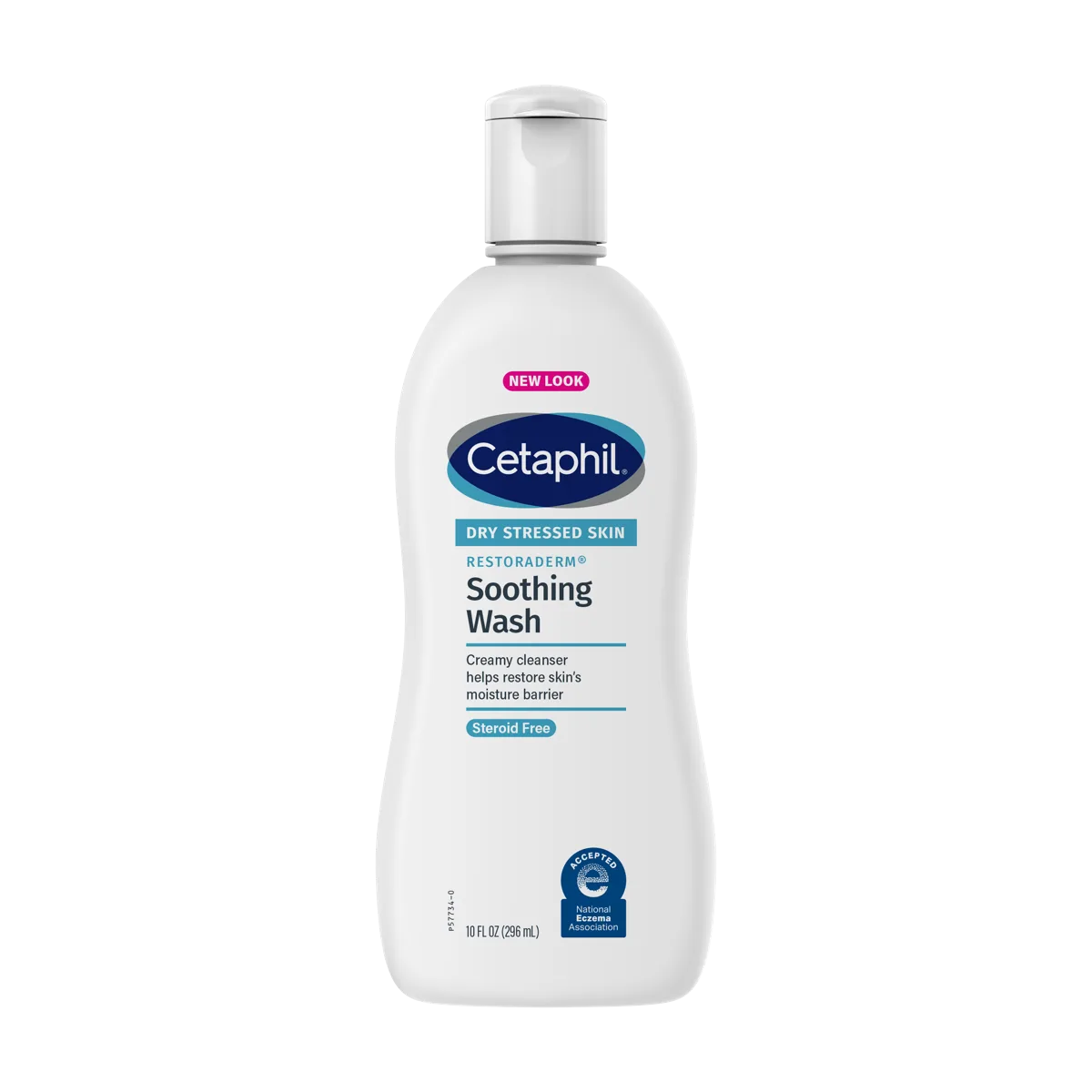
Restoraderm Eczema Calming Body Wash
Eczema Bath Time Essential
 Verified reviewer
Pros & cons.
- +Deposits shea butter and sunflower oil during washing to replenish barrier lipids removed by cleansing
- +Colloidal oatmeal provides FDA-recognized anti-itch and soothing action even in wash-off format
- +National Eczema Association Seal of Acceptance validates safety for eczema-prone skin
- +Soap-free, mild surfactant system preserves barrier integrity while effectively cleansing
- +Niacinamide primes skin for better moisture absorption from follow-up moisturizer
- +No stinging on active eczema patches or irritated skin
- +Hygienic pump bottle format avoids contamination risk for compromised skin
- −At $15 for 10 oz, significantly more expensive per ounce than standard body washes
- −10 oz bottle lasts only 3-4 weeks with daily full-body use for an adult
- −Minimal lather feels unfamiliar and psychologically unsatisfying for many users
- −Contains Sodium Trideceth Sulfate which some ultra-sensitive users prefer to avoid
- −Not effective as a standalone eczema treatment — best results require pairing with eczema moisturizer
The full review.
For people with eczema, showers are not relaxing. They are a calculated risk. Hot water strips depleted barrier lipids. Surfactants dissolve the skin’s last defenses. That tight, dry feeling five minutes after toweling off signals a failing barrier. Most body washes, even gentle ones, worsen eczema by subtraction—they remove more than the skin can replace.
Cetaphil’s Restoraderm Eczema Calming Body Wash reverses this arithmetic. This cleanser adds while it cleans, depositing shea butter and sunflower seed oil onto the skin while washing away dirt and irritants. The result is a body wash that leaves eczema-prone skin measurably more hydrated after the shower than a water-only rinse. This is not marketing magic; it is straightforward lipid chemistry.
The formula uses a deliberately mild surfactant system. Sodium Trideceth Sulfate and Sodium Lauroamphoacetate remove surface impurities without the aggressive lipid stripping caused by SLS and traditional soap. The difference is immediate: this body wash produces almost no lather. If you equate foam with clean, the first few uses will feel strange, as if the product is not working. It is working—it just does not destroy your barrier.
Shea butter sits unusually high in the ingredient list for a cleanser. In most body washes, emollients rinse away. But this formula deposits the shea butter’s stearic and oleic acids onto the skin during washing, creating a thin protective film that partially replaces the lipids cleansing removes. Sunflower seed oil adds linoleic acid—the specific fatty acid eczema-prone skin lacks. This is not a token amount of moisturizer for label appeal. It is a functional lipid replacement system built into the wash step.
Colloidal oatmeal provides FDA-recognized anti-itch and anti-inflammatory properties even in a rinse-off format. Avenanthramides calm irritation while the product is on the skin, and a soothing residue remains after rinsing. For eczema patients who itch and feel discomfort during bathing, this immediate calming effect changes the shower experience.
Niacinamide is strategic—it stimulates the skin’s own ceramide synthesis, priming the barrier for better moisture retention in the minutes after bathing when the follow-up moisturizer is applied. Arginine supports the skin’s natural moisturizing factor. Allantoin adds soothing anti-irritant action. Vitamin E provides antioxidant protection. Every ingredient has a specific role in barrier preservation.
Using this wash requires resetting expectations. There is no thick foam. There is no squeaky-clean feeling. A thin, milky liquid feels almost like a moisturizer as you spread it across your skin. You rinse, and instead of tightness, your skin feels quiet, calm, and still hydrated. That is the paradigm shift.
Cetaphil’s clinical testing shows skin retains significantly more moisture after bathing with this wash compared to traditional cleansers. Moisture retention improves over the first week of daily use as the niacinamide’s ceramide-building effects accumulate. When paired with the Restoraderm Soothing Moisturizer applied to damp skin immediately after bathing, the system creates a comprehensive cleanse-and-repair protocol.
The limitation is economics. At approximately $15 for 10 oz, this costs significantly more per ounce than regular body washes, and the 10 oz bottle lasts only three to four weeks with daily full-body use. For families managing eczema in multiple members, the cost adds up. The minimal lather is also a psychological barrier—some people cannot accept that a product works if it does not foam, even though science shows less foam means less barrier damage.
But for anyone who has experienced the post-shower eczema flare—the itching, the tightness, the feeling of skin retreating into itself—this body wash is different. It does not just clean gently. It actively supports the skin during the one routine eczema patients cannot avoid but that most body washes make worse. That is not a subtle distinction. It is a fundamental rethinking of how cleansing should work for compromised skin.
Ingredient analysis.
Full INCI list
Water, Sodium Trideceth Sulfate, Butyrospermum Parkii (Shea) Butter, Glycerin, Helianthus Annuus (Sunflower) Seed Oil, Sodium Lauroamphoacetate, Sodium Chloride, Cocamide MEA, Citric Acid, Tocopheryl Acetate, Niacinamide, Sodium PCA, 1,2-Hexanediol, Caprylyl Glycol, Guar Hydroxypropyltrimonium Chloride, Potassium Sorbate, Allantoin, Disodium EDTA, Colloidal Oatmeal, Arginine
Skin match.
The science.
The Science
This body wash preserves the barrier because eczema is a barrier disease. Eczema-prone skin has lower levels of natural moisturizing factors, ceramides, and filaggrin—deficiencies that aggressive cleansing worsens. A 2009 review by Danby and Cork in the British Journal of Dermatology showed that surfactant-induced barrier damage drives eczema flare cycles, and it recommended pH-neutral, soap-free cleansers for eczema management.
Clinical settings validate colloidal oatmeal's efficacy in wash-off formats. A 2015 study by Fowler et al. in the Journal of Drugs in Dermatology showed that colloidal oatmeal-containing cleansers improved skin barrier function and reduced itch scores in patients with atopic dermatitis, despite the brief skin contact time of bathing.
A 2014 study in Pediatric Dermatology supports sunflower seed oil for eczema, showing topical sunflower oil significantly improved skin barrier function due to its high linoleic acid content. Eczema-prone skin lacks linoleic acid, so targeted linoleic acid supplementation—via leave-on products or lipid-depositing cleansers—is a rational therapeutic approach.
Tanno et al. (2000, British Journal of Dermatology) established that niacinamide stimulates ceramide synthesis, showing increased free ceramide and sphingomyelin levels in the stratum corneum after topical niacinamide application. While contact time in a body wash is limited, daily niacinamide exposure supports barrier lipid production over time.
Dermatological practice increasingly recognizes lipid-depositing cleansers—formulations that leave a moisturizing film instead of stripping one away—as an improvement over traditional cleansing for compromised skin.
References
- Avenanthramides, polyphenols from oats, exhibit anti-inflammatory and anti-itch activity — Archives of Dermatological Research (2008)
Dermatologist Perspective
Dermatologists universally recommend soap-free, gentle cleansers for eczema patients, and clinicians frequently recommend this body wash. Board-certified dermatologists note that many eczema patients unknowingly worsen their condition during cleansing by using products that strip the skin barrier. This formula's lipid-depositing approach aligns with dermatological guidance to minimize barrier disruption. Clinicians advise using lukewarm water, limiting showers to 5-10 minutes, and applying moisturizer within 3 minutes of patting dry to lock in moisture.
Guidance
Where it fits in your routine.
In a lukewarm shower or bath (avoid hot water), pump a generous amount into your hands or onto a soft washcloth. Gently apply to wet skin without scrubbing — let the surfactants do the work. Leave on skin for 30-60 seconds to allow the colloidal oatmeal and emollients to make contact. Rinse thoroughly with lukewarm water. Pat skin dry gently with a soft towel — do not rub. Within 3 minutes of leaving the shower, apply an eczema-safe moisturizer to damp skin.
At about $15 for 10 oz, this body wash has a premium price, and the bottle lasts 3-4 weeks with daily use. For eczema patients, the cost balances against fewer post-shower flares, less need for prescription topical steroids, and better quality of life. The NEA seal, colloidal oatmeal, and barrier-supporting ingredients offer therapeutic value beyond basic body washes. For families managing eczema, the annualized cost (~$180-200/year) may be offset by using fewer prescription treatments.
Eczema sufferers who experience post-shower dryness, tightness, or flaring. Parents seeking a gentle, NEA-accepted body wash for children with eczema. Patients whose dermatologists recommend soap-free cleansing for eczema management. People with chronically dry, sensitive skin who find regular body washes too stripping.
This specialized formula costs more and lathers less than normal skin requires. It works for people with oily skin who want thorough degreasing or anyone who needs a foaming lather for psychological cleansing satisfaction.
Product details.
Thin, slightly milky liquid that feels like a soothing wash rather than a traditional body wash. Emollient oils make it soft during application. It produces minimal lather to preserve the barrier.
Fragrance-free with a very faint, natural oat-like scent
The pump bottle allows hygienic, hands-free dispensing in the shower. This pump format helps eczema patients with cracked or compromised hand skin.
This differs from regular body washes. The minimal lather and milky texture feel gentler immediately. It does not sting eczema patches or irritated skin. Skin feels hydrated, not stripped, after rinsing, and leaves no heavy or greasy residue. Switching from a foaming body wash takes adjustment, but comfort improves from day one.
3-4 weeks with daily full-body use
12 months
All Year
The backstory.
Galderma developed the Restoraderm body wash as the cleansing companion to their Eczema Soothing Moisturizer, recognizing that eczema management starts in the shower. Traditional body washes — even gentle ones — strip barrier lipids that eczema skin can't afford to lose. This formula was engineered to reverse that equation: clean the skin while leaving it better moisturized than before you stepped in.
About Cetaphil
Legacy Brand (20+ years)Cetaphil launched in 1947 and has dermatologist-recommended status for over 75 years. Galderma, a pharmaceutical company specializing in dermatology, develops The Restoraderm eczema line, which carries the National Eczema Association Seal of Acceptance.
Common myths.
A body wash that doesn't lather isn't really cleaning
Surfactants create lather by stripping oils from the skin. This low-lather formula uses mild amphoteric surfactants to remove dirt and irritants without aggressive lipid stripping. For eczema skin, this gentler cleaning approach works better long-term because it preserves the barrier that protects against the bacteria and irritants that trigger flares.
People with eczema should wash less to avoid irritation
Excessive washing worsens eczema, but proper cleansing removes the irritants, allergens, and bacteria (especially Staphylococcus aureus) that trigger flares. Use an eczema-safe cleanser like this one to clean without damaging the barrier.
What the community says.
"Doesn't strip or dry out eczema-prone skin"
"Soothing during and after bathing"
"No irritation even on active eczema patches"
"Works well with the matching moisturizer"
"Suitable for children with eczema"
"Expensive for a body wash at $15 for 10 oz"
"Doesn't lather much, which feels unfamiliar"
"10 oz bottle runs out quickly for full-body use"
"Some wish it contained more colloidal oatmeal"
Featured in.
People also looked at.