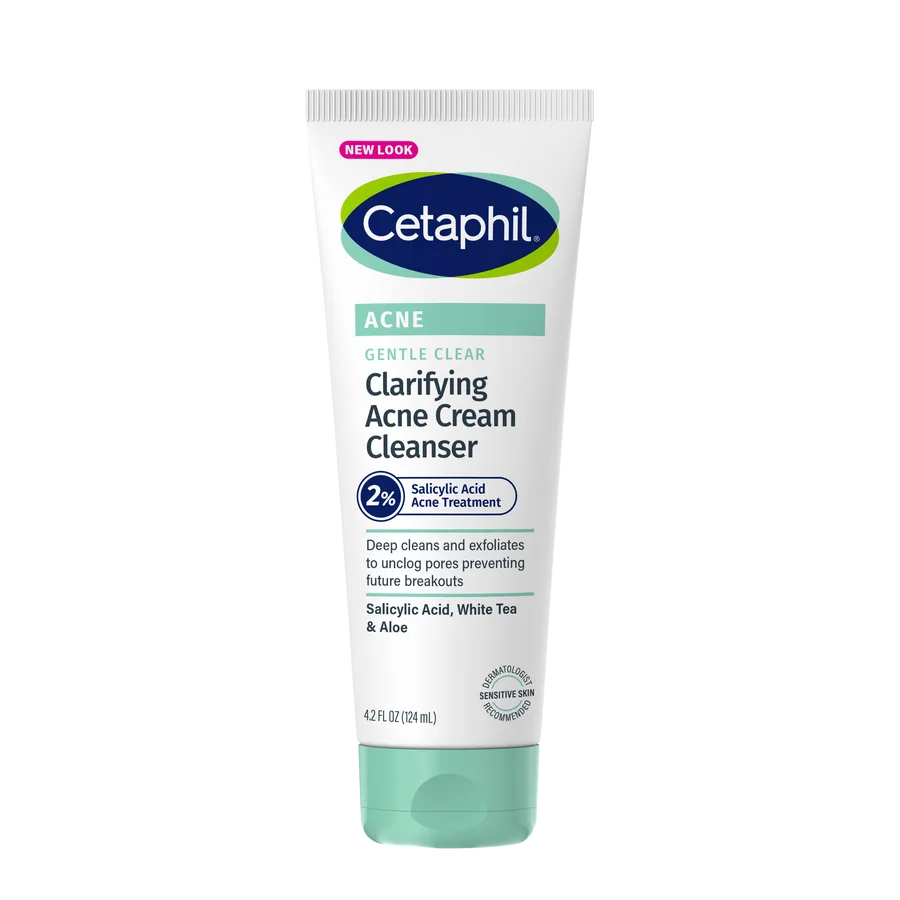
Gentle Clear Clarifying Acne Cream Cleanser
Sensitive Skin Acne Fighter
 Verified reviewer
Pros & cons.
- +2% salicylic acid at maximum OTC strength effectively clears pores and reduces breakouts
- +Sulfate-free surfactant system cleans without stripping the skin barrier or triggering rebound oil
- +Cream-to-lather texture is noticeably gentler than typical foaming acne washes
- +Aloe and white tea provide meaningful soothing action during twice-daily use
- +Fragrance-free, hypoallergenic, and non-comedogenic — triple-tested for sensitive skin
- +Backed by Cetaphil's 75+ years of dermatologist-recommended sensitive skin expertise
- +Very affordable at approximately $11 for a clinically formulated acne cleanser
- −4.2 oz tube is small and lasts only 4-6 weeks with twice-daily facial use
- −Cream texture may feel too heavy for very oily skin types who prefer gel washes
- −Not potent enough as a standalone treatment for moderate-to-severe cystic acne
- −Minimal lather can feel psychologically unsatisfying for those accustomed to foaming cleansers
- −Contains a small amount of isopropyl alcohol low in the ingredient list
The full review.
People with sensitive, acne-prone skin face a specific frustration. Effective acne cleansers often irritate the skin, while gentle cleansers fail to treat breakouts. For years, dermatologists recommended Cetaphil’s original Gentle Skin Cleanser as a compromise—it is mild and well-tolerated, but it does not fight acne.
The Gentle Clear Clarifying Acne Cream Cleanser solves this compromise. It is a useful tool: a cleanser from a trusted sensitive skin brand that contains an active acne-fighting ingredient.
The formula uses 2% salicylic acid—the maximum OTC concentration—in a cream base that turns into a soft lather with wet hands. Salicylic acid is a beta-hydroxy acid. Because it is oil-soluble, it penetrates sebum-filled pores to dissolve the dead-cell-and-oil plugs that cause blackheads and pimples. At 2%, even a brief wash-off contact time provides measurable pore-clearing action.
The salicylic acid is not the only important factor, as many cleansers use 2% salicylic acid. The surfactant system matters more. Cetaphil uses Cocamidopropyl Betaine and Sodium Methyl Cocoyl Taurate. These are mild, non-ionic or amphoteric surfactants that clean without the aggressive lipid stripping caused by sulfates. This protects the skin barrier. When cleansers strip the barrier, skin overproduces sebum, which fuels acne. A gentle surfactant breaks this cycle.
Aloe vera juice and white tea extract (Camellia sinensis) soothe the skin alongside the salicylic acid. Aloe vera provides anti-inflammatory polysaccharides to calm acne-related redness and irritation. White tea provides polyphenol antioxidants to address oxidative stress from inflammation. While neither ingredient alone changes skin texture, their combined effect during twice-daily use prevents the sensitization that causes users to stop acne routines.
Texture
The texture differs from typical acne cleansers. This is not a clear gel that foams heavily and leaves skin feeling squeaky. It is a white cream, similar to a gentle lotion, that you massage onto damp skin before rinsing. The lather is minimal. While some associate foam with cleanliness, the lack of aggressive foaming is intentional. Your face should feel clean and calm after rinsing, not tight or stripped. This cleanser meets that goal.
Results
Results follow a standard salicylic acid timeline. The first two weeks involve adjustment: skin receives consistent BHA exposure, pores clear from within, and new breakouts may appear as congestion reaches the surface. Weeks three through four usually show the first improvements: fewer new pimples, smaller blackheads, and less oiliness. By week six to eight, most users see clearer skin.
Common Complaints
The limitations are clear. At 4.2 ounces, this tube is small for twice-daily use and lasts only four to six weeks. The cream format also feels heavy to users with very oily skin who prefer foaming washes. Finally, for moderate-to-severe acne, a salicylic acid cleanser alone is insufficient; it works best as one step in a routine including leave-on treatments.
Value
The value is high. At roughly $11, this is an affordable, clinically backed acne cleanser from a trusted brand. Cetaphil uses 75-plus years of sensitive-skin expertise to balance active treatment with gentle care.
This cleanser does not cause peeling or skin shock. It does not feel like a chemistry experiment. It consistently clears pores while respecting the skin barrier. For sensitive-skinned acne sufferers burned by harsher products, this restraint is the goal.
Ingredient analysis.
Full INCI list
Active Ingredient: Salicylic Acid 2.0%. Inactive Ingredients: Water, Cocamidopropyl Betaine, Distearyl Phthalic Acid Amide, Sodium Methyl Cocoyl Taurate, Sodium Chloride, Cetyl Alcohol, Stearyl Alcohol, PEG-120 Methyl Glucose Dioleate, Phenoxyethanol, Sodium Hydroxide, Caprylyl Glycol, Ethylhexylglycerin, Hexylene Glycol, Disodium EDTA, Isopropyl Alcohol, Aloe Barbadensis Leaf Juice, Butylene Glycol, Camellia Sinensis Leaf Extract
Skin match.
The science.
The Science
Salicylic acid has treated acne for decades, and dermatological literature documents its efficacy. Its mechanism differs from other acne ingredients: as a lipophilic beta-hydroxy acid, it dissolves in sebum and enters the follicular unit where comedones (clogged pores) form. It exfoliates dead keratinocytes and sebum plugs from inside the pore instead of the skin surface.
A study in the Journal of the American Academy of Dermatology used a double-blind, placebo-controlled trial to test a 2% salicylic acid cleanser. It found statistically significant reductions in both inflammatory and non-inflammatory acne lesions compared to vehicle cleanser alone. The study shows that 2% salicylic acid delivers clinically meaningful pore-clearing effects, even in a wash-off format with limited contact time.
A 2025 study in the Journal of Cosmetic Dermatology evaluated a novel 2% salicylic acid cleanser. It found significant reductions in acne lesions starting at week 4, with lower skin irritation markers and no disruption to the lipid barrier. This applies to this Cetaphil formula, which also prioritizes barrier integrity alongside acne treatment.
Research on cleanser-barrier interactions supports this sulfate-free formulation. A 2020 review in the International Journal of Cosmetic Science confirmed that amphoteric surfactants like Cocamidopropyl Betaine cause significantly less barrier disruption than anionic sulfates. This maintains stratum corneum integrity while providing adequate cleansing efficacy. For acne-prone skin, this barrier preservation is clinically significant: barrier disruption triggers inflammatory cascades and compensatory sebum production that perpetuate the acne cycle.
Multiple studies document Aloe vera's anti-inflammatory properties in topical formulations. A 2008 systematic review in the British Journal of General Practice noted its effectiveness in reducing skin inflammation by inhibiting cyclooxygenase and prostaglandin synthesis pathways.
References
- Novel 2% Salicylic Acid Cleanser With Polymeric Cleansing Technology Treats Acne Without Compromising Skin Barrier — Journal of Cosmetic Dermatology (2025)
- Comparison of a salicylic acid cleanser and a benzoyl peroxide wash in the treatment of acne vulgaris — Clinical Therapeutics (1989)
Dermatologist Perspective
Dermatologists often recommend this cleanser for patients with mild-to-moderate acne who find harsher acne washes irritating or drying. Board-certified dermatologists note the sulfate-free formulation is a key differentiator; barrier-stripping cleansers can worsen acne by triggering inflammation and compensatory sebum production. The 2% salicylic acid concentration is the sweet spot for OTC acne treatment—strong enough for meaningful pore clearing but gentle enough for twice-daily use. Clinicians typically use this as the cleansing step in a comprehensive acne regimen, pairing it with leave-on treatments like benzoyl peroxide or retinoids for more significant acne.
Where it fits in your routine.
Wet your face with lukewarm water. Apply a small amount to fingertips, a cotton pad, or a soft cloth. Massage into skin using circular motions for 60-90 seconds, targeting acne-prone areas like the T-zone, chin, and jawline. Rinse well with lukewarm water and pat dry. Use twice daily — morning and evening. Apply a lightweight, oil-free moisturizer after. In the morning, use broad-spectrum SPF 30 or higher because salicylic acid increases sun sensitivity. ### Value Assessment At about $11 for 4.2 oz, this cleanser is an excellent value for a dermatologist-recommended acne treatment. The cost per use stays low, despite the small tube size for a twice-daily cleanser. Cetaphil provides the same 2% salicylic acid maximum strength and a gentler surfactant system as prestige acne cleansers that cost $25-40. The Galderma pharmaceutical heritage gives this formulation clinical credibility most drugstore acne cleansers lack. The main value drawback is the 4-6 week repurchase cycle — a larger size would improve the per-ounce economics. ### Who Should Buy People with mild-to-moderate acne and sensitive skin who found harsher acne cleansers too irritating. Teenagers and adults needing a gentle daily cleanser that treats breakouts without causing dryness. Anyone seeking an affordable, dermatologist-backed first step in an acne routine. ### Who Should Skip Those with moderate-to-severe cystic acne needing prescription-strength treatment — this cleanser alone is not enough. People with very dry or eczema-prone skin who find even gentle salicylic acid too exfoliating for daily use. Anyone who prefers a rich, foaming lather from their cleanser.
Product details.
This opaque, creamy cleanser turns into a gentle lather with water. It is thicker than typical gel cleansers and feels like a cream wash. It rinses clean without residue or a stripped feeling.
Fragrance-free with minimal detectable scent
Squeezable tube with a flip-top cap. It is compact and travel-friendly, but the 4.2 oz size is small for a daily cleanser.
Most users feel immediate cleanliness and freshness without the tightness or stinging typical of acne cleansers. The thick cream texture differs from harsh foaming washes. Skin feels calm and not stripped after rinsing. New breakouts may continue for the first 1-2 weeks before improvement shows.
4-6 weeks with twice-daily facial use
12 months
All Year
The backstory.
Cetaphil launched the Gentle Clear line to address a gap in their portfolio: acne treatment for sensitive skin. For decades, Cetaphil was the cleanser dermatologists recommended when everything else irritated your skin — but that same gentleness meant the original Gentle Skin Cleanser couldn't treat acne. This product brings Cetaphil's sensitive-skin expertise to the acne category, backed by Galderma's pharmaceutical-grade dermatology research.
About Cetaphil
Legacy Brand (20+ years)A Texas pharmacist created Cetaphil in 1947. Dermatologists have recommended Cetaphil for over 75 years. Galderma, a global dermatology company, now owns Cetaphil, which is one of the most widely prescribed skincare brands in clinical settings worldwide.
Common myths.
Acne cleansers must foam aggressively and feel 'squeaky clean' to work.
A squeaky-clean feeling indicates lipid stripping. This damages the barrier and triggers compensatory oil production. This cream cleanser's mild surfactant system cleans effectively without stripping. This is why dermatologists increasingly recommend gentle cleansers even for acne-prone skin.
Salicylic acid in a wash-off cleanser lacks enough contact time to work
Leave-on products provide more sustained exposure, but studies show 2% salicylic acid cleansers work in 60-90 seconds to clear pores and reduce acne. The lipophilic nature of salicylic acid allows it to penetrate sebaceous follicles rapidly.
FAQ.
How long does it take for Cetaphil Gentle Clear to clear acne?
Most users see fewer new breakouts within 2-4 weeks of consistent twice-daily use. Overall acne severity improves at 6-8 weeks. Blackheads and clogged pores improve faster, within 3-4 weeks, because salicylic acid dissolves sebum plugs.
Can I use Cetaphil Gentle Clear with retinol?
Yes, but introduce it carefully. Use this cleanser first, then apply retinol once your skin is dry. If the combination causes dryness or irritation, use the salicylic acid cleanser in the morning and retinol at night, with a gentle non-active cleanser before the retinol. Always moisturize between steps.
Is Cetaphil Gentle Clear Acne Cleanser sulfate-free?
Yes — this formula uses Cocamidopropyl Betaine and Sodium Methyl Cocoyl Taurate as its primary surfactants instead of sulfates like SLS or SLES. These milder cleansing agents create a gentle lather that removes oil and impurities without stripping the skin's natural moisture barrier.
Can I use Cetaphil Gentle Clear Acne Cleanser on my body?
The 2% salicylic acid works on body acne areas like the chest and back, even though it is formulated for the face. However, the 4.2 oz tube is small for body use and runs out fast. Use this product for facial acne and choose a larger-format salicylic acid body wash for body acne.
What's the difference between Cetaphil Gentle Clear Cream Cleanser and Pore Clearing Cleanser?
Both contain 2% salicylic acid but differ in format and feel. The Cream Cleanser has a thick, cream-to-lather texture for sensitive skin that finds foaming washes too stripping. The Pore Clearing Cleanser uses a foaming gel format in a larger 8 oz pump bottle. Use the cream for sensitivity and the gel for oilier skin.
Is Cetaphil Gentle Clear Acne Cleanser pregnancy-safe?
Dermatologists debate the safety of salicylic acid during pregnancy. Many consider low-concentration topical salicylic acid in a wash-off format low-risk, but some healthcare providers advise avoiding it. Consult your OB-GYN or dermatologist for personalized guidance during pregnancy.
What the community says.
"Gentle on sensitive skin while still treating acne"
"No drying or tight feeling after washing"
"Cream texture feels luxurious for an acne cleanser"
"Noticeable reduction in breakouts within weeks"
"Affordable and widely available"
"Small 4.2 oz tube runs out quickly with twice-daily use"
"May not be strong enough for severe acne"
"Some users prefer a foaming texture"
"Cream format can feel heavy for very oily skin"
Featured in.
People also looked at.