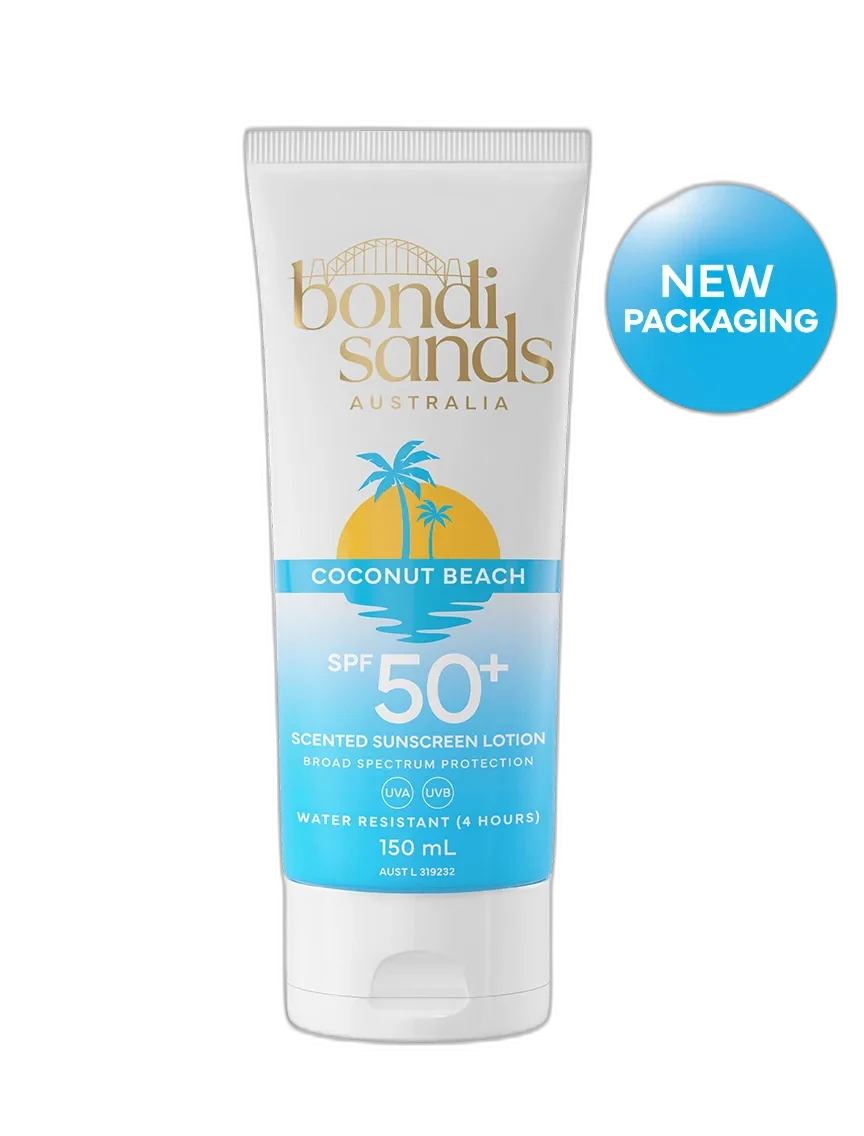
SPF 50+ Body Sunscreen Lotion Coconut Beach
Classic Coconut Beach SPF
 Verified reviewer
Pros & cons.
- +Nostalgic coconut-vanilla fragrance reminiscent of classic beach lotions
- +TGA-tested Australian Gold Standard broad-spectrum protection
- +EWG Verified status for ingredient transparency
- +Lightweight non-greasy finish on skin
- +No white cast on any skin tone
- +Widely stocked at US drugstores and big-box retailers
- +500ml family size available for strong per-milliliter value
- −Fragrance makes it unsuitable for sensitive or reactive body skin
- −Coconut scent is polarizing — strong love or strong dislike
- −Not fungal-acne safe due to fatty esters and silicones
- −Older US-approved filter set versus European alternatives
- −150ml size runs through quickly during beach or pool days
The full review.
There are basically two kinds of sunscreen shoppers in the world. The first wants their sunscreen to smell like nothing — a neutral base, a quiet application, skin that’s protected without any olfactory announcement. The second wants their sunscreen to smell like summer. Specifically, like the summer of 1995, when a bottle of coconut-scented SPF 30 was basically a sensory rite of passage for any kid whose family owned a beach towel. Bondi Sands built the Coconut Beach variant of its SPF 50+ Body Sunscreen Lotion for the second group, and if you recognize yourself in that description, this bottle is going to scratch an itch you may not have realized you had.
The formula itself is identical to the fragrance-free version of the same product — avobenzone 3%, homosalate 10%, octisalate 5%, octocrylene 8%, all sitting in a base of water, aloe, glycerin, a touch of silicone, and the Australian brand’s signature hydration supports. Same TGA sunscreen testing, same Australian Gold Standard broad-spectrum certification, same 80-minute water resistance under US FDA testing, same EWG Verified seal. The only real difference between this and the fragrance-free sibling is a single line on the INCI list: fragrance (parfum). Everything else about the protection profile is unchanged.
What the fragrance does is transform the sensory experience. On first application, the coconut hit is pronounced — warm, slightly vanilla-tinged, unmistakably tropical. It’s not a subtle cosmetic note but a full commitment to the beach-lotion aesthetic, and for about thirty seconds after application you’re going to smell like a vacation regardless of where you actually are. Once the lotion absorbs, the intensity fades to a much softer sweet background note that lingers through the day. The brand has gotten the fragrance engineering right: it’s strong enough to register as the classic coconut experience without becoming the kind of synthetic blast that gives you a headache by noon.
Texture is where the lotion keeps its Bondi Sands advantages. Despite the 10% homosalate and fatty-ester base that usually makes US drugstore body SPFs feel heavy, this one rubs in within thirty seconds and leaves a non-greasy satin finish. There’s no white cast — the fully chemical filter set means the lotion goes clear on every skin tone — and it doesn’t transfer heavily to swimwear or beach towels after it sets. For a body sunscreen at this price, the feel is noticeably better than the Banana Boat and Coppertone products on the neighboring shelf, and the scent is what most users will remember rather than the texture.
The real question with this sunscreen is whether you want fragrance on your body in a daily application. For anyone with reactive, sensitive, or rosacea-prone body skin, the answer is probably no, and the fragrance-free version exists specifically to solve that problem. For anyone with eczema, hand dermatitis, or any history of reacting to scented body products, fragrance-free is the clear clinical choice. But for the majority of users with tolerant body skin, the parfum is a non-issue — body skin is generally less reactive than facial skin, and most people tolerate fragranced body SPFs without problems. If you fall into that camp, the Coconut Beach is genuinely pleasant to wear and makes sunscreen feel more like a summer ritual and less like a chore.
The limitations are real but minor. Like the fragrance-free sibling, this isn’t fungal-acne safe due to the fatty esters and silicones — if you manage body malassezia, skip it. The 150ml bottle empties quickly on beach or pool days, so a 500ml family size bottle is the smarter value pick for any household that goes through sunscreen at any real volume. The filter technology is the standard US-approved four-pack rather than anything next-generation, so this isn’t the body SPF to buy if you’ve already discovered ethylhexyl triazone and can import European sunscreens. And the fragrance, while well-engineered, is a polarizing element — you either love it or you want it gone.
What you’re really buying with Coconut Beach is a sensory experience attached to a perfectly competent broad-spectrum body sunscreen at a drugstore price. It’s one of the few US body SPFs that makes applying sun protection feel like a pleasant ritual rather than a task, and for the people who love coconut-scented lotions, that pleasantness translates into higher adherence, which translates into better real-world photoprotection. For everyone else, the fragrance-free version is right there on the same shelf for the same price.
Formula
Ingredient analysis.
Full INCI list
Actives: Avobenzone 3%, Homosalate 10%, Octisalate 5%, Octocrylene 8%. Inactive: Water, Aloe Barbadensis Leaf Juice, Glycerin, Cetearyl Alcohol, Isopropyl Palmitate, Cyclopentasiloxane, Cyclohexasiloxane, Ceteareth-20, Carbomer, Fragrance (Parfum), Hydroxyacetophenone, Saccharide Isomerate, Phenoxyethanol, Benzyl Alcohol, Sodium Stearoyl Glutamate, Triethanolamine, Tocopheryl Acetate, Sodium Chloride, Citric Acid
Skin match.
The science.
The Science
This lotion uses a standard US chemical filter blend: 10% homosalate and 5% octisalate as UVB absorbers, 3% avobenzone as the only UVA absorber, and 8% octocrylene as a UVB booster and photostabilizer for avobenzone.
Unstabilized avobenzone loses much of its UV-absorbing capacity within one hour of sun exposure. This makes the octocrylene pairing mandatory for any long-wear chemical sunscreen using avobenzone. Recent research suggests octocrylene degrades into benzophenone in older or heat-exposed products, but at the 8% concentration used here in fresh bottles, the degradation risk is modest.
The testing standard, not the filter set, differentiates the Bondi Sands' product line, including this Coconut Beach variant. Australia's AS/NZS 2604 sunscreen monograph requires SPF 50+ claims to meet a UVA protection factor of at least one-third the labeled SPF value and a minimum critical wavelength of 370 nm. The US FDA sunscreen monograph lacks an equivalent UVA-PF requirement. Therefore, a TGA-certified SPF 50+ body lotion like this one provides stronger broad-spectrum protection than most US-only drugstore equivalents with the same label value.
The fragrance in this version matters dermatologically. Fragrance is a common source of contact dermatitis in skincare, and even 'natural' fragrance blends can contain limonene, linalool, geraniol, and other terpenes that sensitize skin over time. Users with reactive body skin should choose the fragrance-free variant of this same lotion. For tolerant body skin, fragrance exposure is low-risk and the pleasant application is a benefit.
Dermatologist Perspective
Dermatologists usually recommend fragrance-free sunscreens for patients with sensitive, reactive, eczema-prone, or rosacea-prone skin because fragrance causes contact dermatitis. However, board-certified dermatologists note that fragrance is less problematic on body skin than facial skin for most patients. They also note that patient adherence to daily sunscreen use is the strongest predictor of real-world photoprotection outcomes. For patients with tolerant body skin who enjoy the nostalgic beach-lotion scent, a pleasant-smelling sunscreen they actually use is clinically better than an unscented one left unused in a drawer. In that context, the Coconut Beach variant is a common, affordable, and widely available suggestion.
Where it fits in your routine.
Apply two to three tablespoons generously to all exposed body skin 15 minutes before sun exposure. Reapply every two hours in direct sun and immediately after swimming, towel drying, or heavy sweating. One morning application works for casual outdoor wear like commuting or yard work. Store the bottle away from direct sunlight and heat to minimize octocrylene degradation, and replace the bottle annually. Use the fragrance-free variant in the same formula family if you have fragrance sensitivity.
At $12.99 for 150ml at Target and around $22 for the 500ml family size, the Coconut Beach variant is priced identically to the fragrance-free sibling and remains one of the strongest drugstore body SPF values on US shelves. The 500ml bottle offers meaningfully better per-milliliter economics and is the smart pick for multi-person households or anyone planning a full beach week. For context, competing drugstore body sunscreens from Banana Boat and Coppertone hit similar price points but lack the TGA certification, EWG Verified status, and textural refinement of this lotion. Premium European face sunscreens with newer filter technology cost 2–3 times as much. For cost-conscious body protection with a pleasant scent, the math is favorable.
This sunscreen suits shoppers with tolerant body skin who want a classic coconut beach fragrance. It is a reliable, affordable, and widely available US drugstore body sunscreen with TGA-standard broad-spectrum protection. It works well for beach days, pool trips, and budget-friendly family sun protection.
Choose the fragrance-free Bondi Sands variant if you have sensitive, reactive, eczema-prone, or rosacea-prone body skin. Avoid this if you have fungal-acne-prone skin because it contains fatty esters and silicones. Users who dislike strong coconut fragrances will prefer a neutral-scented alternative.
Product details.
Lightweight cream lotion that rubs out quickly to a satin body finish
Warm vanilla-tinged coconut reminiscent of classic beach tanning lotions
Cream and gold squeeze bottle with flip cap in Bondi Sands' signature branding
First application releases a strong coconut scent that mellows as the lotion absorbs. Texture rubs in within 30 seconds and leaves a non-greasy satin finish. Most users find the fragrance fades to a soft sweetness within a few minutes of application.
One 150ml bottle lasts for about 8–12 full body applications. A larger 500ml bottle also exists for heavy beach or family use.
12 months
spring summer
The backstory.
When Bondi Sands launched its sunscreen range in Australia and then the US, the coconut scent was chosen to hook buyers who associated body sunscreens with the classic Hawaiian Tropic and Banana Boat beach lotions of the 1990s. The brand's self-tanning origins leaned into tropical-beach marketing, and the Coconut Beach body SPF became the flagship that translated that aesthetic into a modern TGA-tested chemical sunscreen.
About Bondi Sands
Established Brand (5–20 years)The Coconut Beach variant is Bondi Sands' flagship scented body sunscreen. This 'classic' version launched the brand into US drugstores around 2020. It is EWG Verified, TGA-tested, and sold at Target, Walmart, Amazon, and Ulta. This bottle built the brand's mainstream US reputation.
Common myths.
A strong coconut scent means the sunscreen contains real coconut oil, which clogs pores.
Fragrance compounds in the parfum blend create the coconut scent, not coconut oil. The formula uses the same four-filter chemical system as the fragrance-free version — the scent is purely olfactory and not a functional ingredient.
Fragrance-free sunscreens outperform scented sunscreens.
Fragrance-free is objectively better for reactive and sensitive skin because it removes a common irritant. For most users with tolerant body skin, a scented version provides identical protection and a sensory experience — neither is categorically superior.
FAQ.
Does Bondi Sands Coconut Beach actually contain coconut oil?
No. The coconut scent comes from the parfum's fragrance blend, not coconut oil in the formula. The lotion uses the same chemical filter set as the fragrance-free version; the coconut is only for scent.
Is the coconut scent strong?
Yes — the first application has a pronounced, unmistakably coconut-tropical scent. The smell softens to a faint sweet note as the lotion absorbs within a few minutes. Users who love the scent call it nostalgic; others find it too strong for daily wear.
Is this sunscreen chemical or mineral?
Chemical. The active filters are avobenzone, homosalate, octisalate, and octocrylene—the standard US-approved chemical sunscreen quartet. It lacks zinc oxide or titanium dioxide.
Is it EWG Verified?
Yes, the Coconut Beach body lotion carries EWG Verified status despite containing fragrance, because it meets the program's criteria for excluded ingredients of concern and transparent labeling standards.
How is this different from the fragrance-free Bondi Sands body SPF?
The filter set and water resistance are identical; only the fragrance differs. The Coconut Beach version suits users who like a classic tropical beach scent. The fragrance-free version works best for sensitive or reactive body skin.
What sizes are available?
Most US retailers stock the Coconut Beach variant in 150ml and 500ml sizes. The 500ml bottle has a better per-milliliter value and works well for families or heavy beach use.
What the community says.
"Nostalgic coconut scent reminiscent of vintage sun lotions"
"Lightweight non-greasy finish for a high-homosalate body SPF"
"No white cast on any skin tone"
"Widely stocked at US drugstores and big-box retailers"
"Coconut scent is divisive — some love it, some find it overpowering"
"Fragrance not suitable for sensitive or reactive body skin"
"Older US-approved filter set compared to European options"
"Not fungal-acne safe"