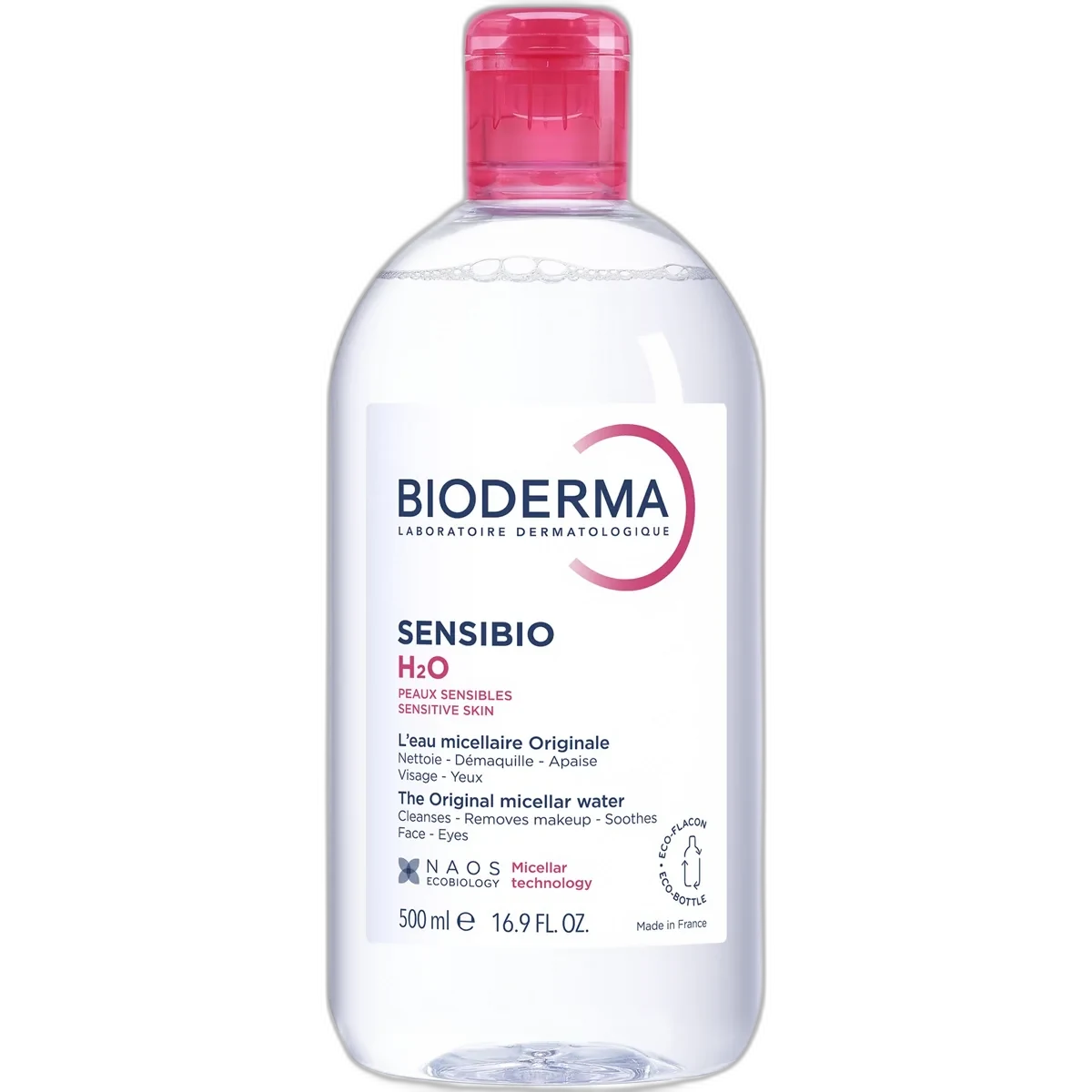
Sensibio H2O Micellar Water
The Original Micellar Water
 Verified reviewer
Pros & cons.
- +Only 10 ingredients — one of the shortest INCI lists in commercial skincare
- +Genuinely fragrance-free with zero detectable scent
- +Biomimetic micelle technology designed to mimic cell membrane structure
- +D.A.F. prebiotic complex actively supports skin tolerance beyond passive gentleness
- +No-rinse formula safe for rosacea, post-procedure, and compromised barrier skin
- +Fungal acne safe with no comedogenic ingredients
- +Available in multiple sizes from travel to jumbo for flexible purchasing
- +Three decades of dermatological validation and professional backstage use
- −Cannot fully remove waterproof mascara or heavy long-wear makeup alone
- −Flip-top cap dispenses product faster than intended on standard bottle
- −Moderately more expensive than mass-market micellar water alternatives
- −Very dry skin types may still need a follow-up moisturizer after use
- −Counterfeit products from unauthorized online sellers are a documented problem
The full review.
Before micellar water was a category, before every drugstore brand had one on the shelf, before the phrase ‘no-rinse cleanser’ entered the skincare lexicon, there was a clear bottle with a pink label sitting behind the counter at French pharmacies. You had to ask for it. Sometimes you needed a prescription. The year was 1995, and pharmacist-biologist Jean-Noël Thorel had just solved a problem that most skincare brands didn’t even know existed: how do you cleanse reactive skin without making it more reactive?
The answer turned out to be deceptively simple. Take purified water. Add a single, gentle surfactant — PEG-6 Caprylic/Capric Glycerides — that forms micelles mimicking the phospholipid structure of actual cell membranes. Include a proprietary blend of prebiotics (the D.A.F. complex) that doesn’t just avoid irritation but actively raises the skin’s tolerance threshold. Then stop. Don’t add fragrance. Don’t add unnecessary preservatives. Don’t add anything that doesn’t serve the mission. The result is a 10-ingredient formula in an era when most cleansers have 25 to 40.
That restraint is Sensibio H2O’s superpower. The ingredient list reads less like a cosmetic product and more like a pharmaceutical formulation — which, technically, it was. Every component earns its place. The fructooligosaccharides, mannitol, xylitol, and rhamnose that make up the D.A.F. complex aren’t just filler sugars; they’re prebiotics that feed beneficial skin bacteria and humectants that ensure the cleansing step hydrates rather than strips. Cucumber extract provides a subtle soothing layer. And that’s it. There’s a reason dermatologists still recommend this to patients with rosacea, post-procedure sensitivity, and compromised barriers — it’s one of the very few cleansers that genuinely cannot make things worse.
Using it is almost anticlimactic. You saturate a cotton pad, sweep it across your face, and your makeup is gone. There’s no foam, no tingle, no satisfying lather to make you feel like something is happening. It feels like water. It looks like water. But the cotton pad tells a different story — foundation, sunscreen, the accumulated grime of a day, all captured by those biomimetic micelles. For everyday makeup and sunscreen, two or three pads will leave you clean. For a full face of heavy makeup, you might want to follow with a cream or gel cleanser, because waterproof mascara and long-wear formulas can challenge even the most determined micellar technology.
Texture
The texture — or rather, the lack of it — deserves mention. There is no viscosity, no slip, no gel-like quality. It is genuinely water-weight. This makes it extraordinarily comfortable on irritated or sensitized skin, where even the gentlest foam cleanser might provoke a reaction. It also makes it ideal for mornings when a full cleanse feels excessive but you want to refresh your skin before applying serums and sunscreen.
About
What separates Sensibio H2O from the hundreds of micellar waters it inspired isn’t any single ingredient — it’s the formulation philosophy. Most micellar waters on the market today contain 15 to 25 ingredients, often including fragrance, multiple surfactants, and various botanical extracts. Bioderma’s version has 10. This isn’t laziness; it’s pharmaceutical discipline. Every ingredient that isn’t in the formula is one less potential irritant, one less variable for reactive skin to contend with.
Packaging
The product’s journey from pharmacy counter to fashion week backstage is its own kind of validation. Pat McGrath reportedly won’t let another cleanser near her clients. Makeup artists across the industry keep bottles in their kits because it removes product without disrupting whatever skin prep they’ve already done. Victoria Beckham’s long-standing devotion culminated in a limited-edition bottle collaboration for the product’s 30th anniversary in 2025 — not bad for something that looks like it belongs in a hospital rather than on a vanity.
Common Complaints
There are genuine limitations. If you wear heavy, waterproof, or long-wear makeup daily, this alone won’t cut it as your only cleansing step — you’ll want a double-cleanse approach. The flip-top cap on the standard bottle can dispense product faster than intended, which is a minor annoyance that Bioderma has partially addressed with pump-top versions. And at roughly $21 for 500 mL, it costs more than a Garnier micellar water, though the price gap is smaller than it appears when you factor in the pharmaceutical-grade formulation and the sheer volume you get.
Best for
The value equation becomes clearer with context. A bottle lasts three to four months with twice-daily use. That’s roughly $5 to $7 per month for a cleanser that dermatologists prescribe, fashion professionals swear by, and 35,000+ reviewers have rated at 4.6 stars. For sensitive skin in particular, the cost of trying a cheaper alternative that causes a flare-up — the irritation, the recovery time, the replacement products — far exceeds the modest premium.
Works for
Thirty years on, Sensibio H2O remains the micellar water that micellar waters want to be when they grow up. It doesn’t have the flashiest marketing, the prettiest packaging, or the longest ingredient list. What it has is three decades of proof that sometimes the most sophisticated thing a skincare product can do is get out of the way and let your skin be skin.
Ingredient analysis.
Full INCI list · pH 5.5
Aqua/Water/Eau, PEG-6 Caprylic/Capric Glycerides, Fructooligosaccharides, Mannitol, Xylitol, Rhamnose, Cucumis Sativus (Cucumber) Fruit Extract, Propylene Glycol, Cetrimonium Bromide, Disodium EDTA
Skin match.
The science.
The Science
Sensibio H2O works via two mechanisms: micellar technology and the D.A.F. complex, which sets it apart from simpler formulas.
Micelles are spherical surfactant structures in water with a hydrophilic exterior and a lipophilic core. On the skin, the lipophilic core attracts and traps sebum, makeup, and impurities, lifting them away without the mechanical disruption or barrier damage caused by foaming surfactants. Bioderma engineered these micelles using PEG-6 Caprylic/Capric Glycerides—fatty acid esters that resemble cell membrane phospholipids, making them biocompatible with skin.
A 2017 study in the Journal of the American Academy of Dermatology used corneosurfametry to test micellar water tolerability. It found no difference in irritation potential between micellar water and a plain water control, while showing an immediate increase in skin hydration—confirming this format cleanses without disrupting the barrier.
A 2021 study in PMC tested micellar solution on subjects with sensitive skin. Unpleasant skin sensations improved by 47.7% at Day 2, 57.9% at Day 14, and 62.7% at Day 28 of consistent use, showing that benefits compound over time.
The D.A.F. complex is central to the formula. Fructooligosaccharides act as prebiotics to nourish beneficial skin microbiota. Xylitol decreases transepidermal water loss (TEWL), turning cleansing into a hydrating step. Mannitol provides antioxidant activity, and rhamnose shows anti-inflammatory properties in vitro. This combination aims to raise what Bioderma calls the skin's 'tolerance threshold'—the point where skin reacts to external stimuli.
Guertler et al. (2020) in the Journal of Cosmetic Dermatology showed that micellar water is safe and effective for rosacea-prone skin, a group at high risk for irritation during cleansing.
References
- Efficacy and safety results of micellar water, cream and serum for rosacea in comparison to a control group — Journal of Cosmetic Dermatology (2020)
Dermatologist Perspective
Dermatologists often recommend Sensibio H2O as a first-line cleanser for patients with rosacea, contact dermatitis, and post-procedure skin—cases where mild foaming cleansers can trigger flares. Board-certified dermatologists note the micellar format avoids the barrier disruption seen in surfactant-heavy cleansers. This makes it useful during tretinoin initiation or after chemical peels when the skin barrier is temporarily compromised. The fragrance-free, minimal-ingredient formulation is a benchmark for sensitive skin cleansing in dermatological literature. Its history as a prescription product gives it clinical credibility most over-the-counter cleansers lack.
Where it fits in your routine.
Soak a cotton pad with Sensibio H2O until it is visibly wet, not damp. Sweep it gently across the face, eyes, and lips without rubbing or pressing. Use a fresh pad for each area (one for each eye, one for the rest of the face) until the pad stays clean. No rinsing is required; leave the formula on the skin. For heavy or waterproof makeup, use Sensibio H2O as a first cleanse step before a gentle cream or gel cleanser. Use morning and evening. Store at room temperature away from direct sunlight.
At approximately $21 for 500 mL, Sensibio H2O costs more than mass-market micellar waters but much less than prestige cleansers. One bottle lasts 3-4 months using it twice daily, costing roughly $5-7 per month. For sensitive skin, the value goes beyond the price — the pharmaceutical-grade formulation reduces reactive flare-up risks that cheaper alternatives with longer ingredient lists cause. Sizes range from 100 mL travel ($6) to 850 mL jumbo ($35) for flexible purchasing. Nearly 30 years of dermatological heritage and a formula that requires no reformulation justify the modest premium over drugstore competitors.
This cleanser works for sensitive, reactive, or rosacea-prone skin that requires a formula that won't cause irritation. It is ideal for post-procedure care, tretinoin users with irritation, and anyone wanting a simple morning cleanse without water. Makeup artists and professionals also use it as a universally tolerated backstage cleanser.
If you wear heavy waterproof makeup daily and want single-step removal, this alone is not enough; you need a double-cleanse approach. Those on a tight budget may find drugstore micellar waters adequate for non-sensitive skin, but formulation quality differs.
Product details.
The consistency is water-like with no viscosity or gel texture. It soaks into a cotton pad instantly and glides across the skin without friction.
Fragrance-free. No detectable scent whatsoever.
Clear plastic bottle with a blue flip-top cap and pink Sensibio branding. Sizes include travel (100 mL), standard (250 mL), large (500 mL), and jumbo (850 mL). A pump-top version and limited-edition Victoria Beckham bottle also exist.
No adjustment period is needed. Skin feels clean and refreshed after the first use. The product is gentle; most users report no sensation. It feels like cleansing with water that removes makeup.
One 500 mL bottle lasts 3-4 months with twice-daily use, using about 2-3 cotton pads per session.
12 months
All Year
The backstory.
Created in 1995 when pharmacist-biologist Jean-Noël Thorel wanted to develop a cleanser gentle enough for prescription use on the most reactive skin. Originally dispensed only through French pharmacies and dermatologist offices, it became a backstage beauty industry secret before eventually reaching mainstream retail. A bottle is reportedly sold every second worldwide.
About Bioderma
Legacy Brand (20+ years)Pharmacist-biologist Jean-Noël Thorel founded Bioderma in 1977 in Aix-en-Provence, France. The brand created the micellar water category in 1995 with this exact product, which doctors originally prescribed. Nearly five decades of pharmacy-channel distribution and dermatological validation build the brand's credibility.
Common myths.
Micellar water does not clean skin; it only moves dirt.
The micelles in this formula use a lipophilic core to attract and encapsulate oil, makeup, and impurities. The micelle sphere traps debris and lifts it from the skin onto the cotton pad. Clinical testing shows 93% elimination of microparticles.
You always need to rinse off micellar water afterward.
This formula is designed to stay on the skin; the ingredients are gentle enough to skip rinsing. The D.A.F. complex supports skin tolerance after application. Rinsing is a personal preference and does not change efficacy.
FAQ.
Do you need to rinse off Bioderma Sensibio H2O?
You do not need to rinse. This formula stays on the skin; the 10-ingredient formulation is gentle and leaves no residue. The D.A.F. prebiotic complex supports skin tolerance after application. Rinsing is a personal preference and does not change the product's cleansing efficacy.
Can Bioderma Sensibio H2O remove waterproof mascara?
It removes everyday makeup, sunscreen, and non-waterproof mascara. Heavy waterproof formulas may need multiple passes or an oil-based remover first. For full-face heavy makeup, use Sensibio H2O as a first cleanse then a gentle cream cleanser.
Is Bioderma Sensibio H2O safe for rosacea?
Yes — dermatologists frequently recommend this cleanser for rosacea-prone skin. The fragrance-free, 10-ingredient formula uses biomimetic micelles to cleanse without the mechanical disruption or surfactant irritation that triggers rosacea flares. A 2020 study in the Journal of Cosmetic Dermatology confirmed micellar water is safe and effective for rosacea.
What is the difference between Bioderma Sensibio and Sebium micellar water?
Sensibio H2O is fragrance-free and uses cucumber extract to soothe sensitive and reactive skin. Sebium H2O contains a light fragrance and uses zinc gluconate and copper sulfate to purify and control sebum in oily and acne-prone skin. Both use the same biomimetic micelle technology and D.A.F. complex.
Is Bioderma Sensibio H2O fungal acne safe?
Yes. The minimalist 10-ingredient formula has no oils, fatty acids, esters, or ingredients that feed Malassezia yeast. It scores zero on fungal acne trigger assessments and is one of the safest cleansing options for fungal acne-prone skin.
How long does a bottle of Bioderma Sensibio H2O last?
The 500 mL bottle lasts 3-4 months if used twice daily on the face with 2-3 saturated cotton pads per session. The product has a 12-month period after opening; even the 850 mL bottle fits within this shelf life.
Why is Bioderma Sensibio H2O more expensive than other micellar waters?
The premium price covers a pharmaceutical-grade formulation with only 10 ingredients, Bioderma's proprietary D.A.F. prebiotic complex, biomimetic micelle technology, and nearly 30 years of dermatological validation. At roughly $5-7 per month of use, the cost gap compared to drugstore alternatives is small, especially for sensitive skin where cheaper products cause expensive flare-ups.
What the community says.
"Extremely gentle — does not sting eyes or irritate sensitive skin"
"Removes everyday makeup and sunscreen effectively"
"No residue or greasy feeling"
"Fragrance-free and feels like water"
"Minimalist 10-ingredient formula"
"No rinsing required"
"Struggles with waterproof mascara and heavy makeup"
"Flip-top cap can dispense too quickly"
"Can feel slightly drying for very dry skin without follow-up moisturizer"
"Higher price than drugstore micellar waters"
"Counterfeit products prevalent from unauthorized sellers"
People also looked at.