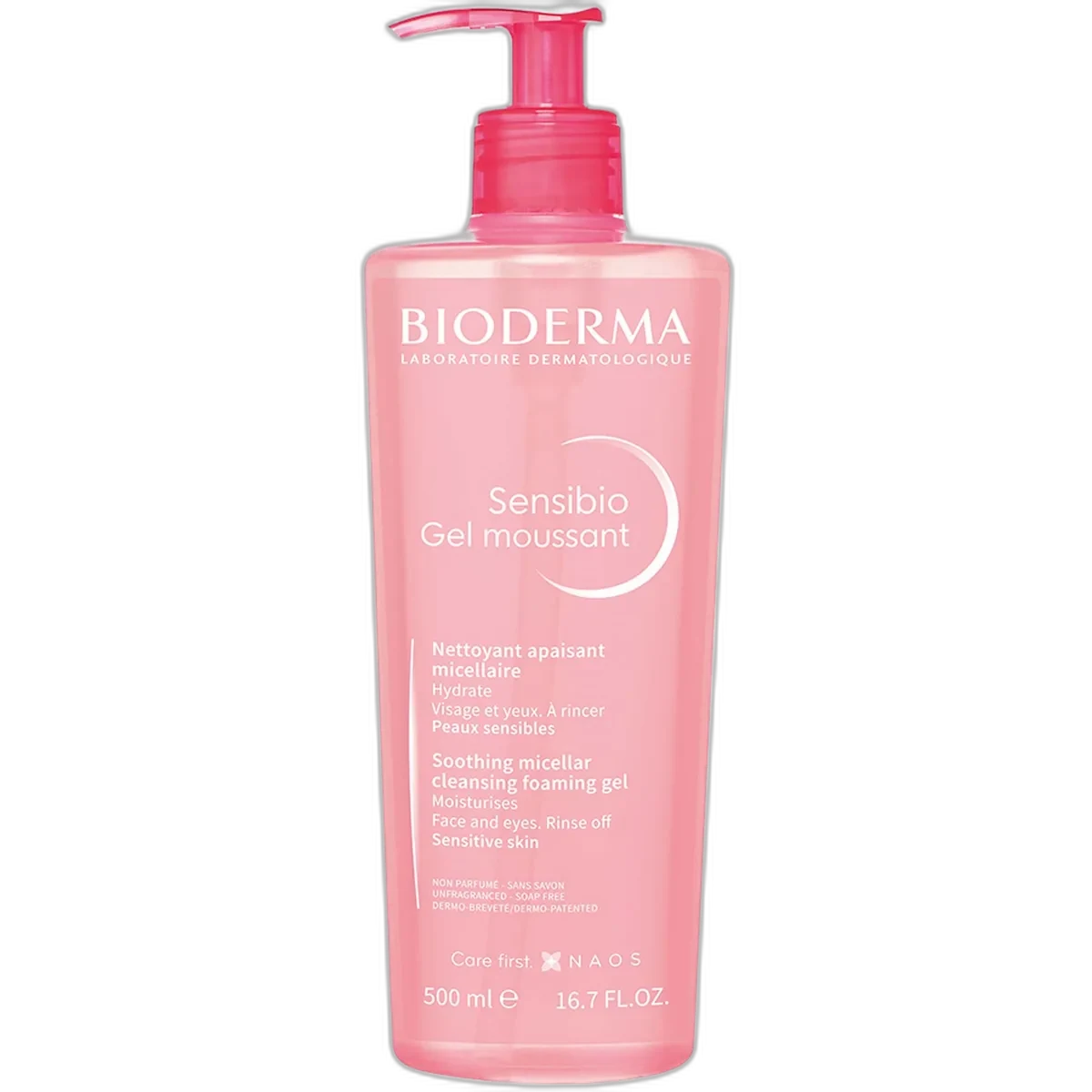
Sensibio Gel Moussant Micellar Foaming Gel
Sensitive Skin Staple Cleanser
 Verified reviewer
Pros & cons.
- +Ultra-minimal 18-ingredient formula — one of the cleanest ingredient lists in the cleanser category
- +Amphoteric and glucoside surfactants are clinically among the gentlest available
- +D.A.F. patent actively raises skin tolerance threshold during cleansing
- +Prebiotic fructooligosaccharides protect the skin microbiome while washing
- +Glyceryl oleate replenishes lipids during cleansing — measurable hydration increase after 14 days
- +500 ml pump bottle offers 4-6 months of use at excellent per-ounce value
- +Gentle enough to use around the eyes without stinging
- −Light, airy lather may feel insufficiently cleansing for users accustomed to rich foams
- −Struggles with heavy waterproof makeup — best as second step in a double cleanse
- −Not fungal acne safe due to glyceryl oleate and other lipid-based ingredients
- −Very oily skin types may find it too gentle for adequate daily oil control
- −6-month PAO means the large 500 ml bottle needs consistent twice-daily use to finish in time
The full review.
Eighteen ingredients. That’s it. While facial cleansers often list thirty-five to forty components, Bioderma’s Sensibio Gel Moussant reads like a haiku. Every ingredient has a purpose; nothing is decorative. The product is intentional about what it includes and what it leaves out.
This minimalism follows Bioderma’s ecobiology philosophy: working with skin biology rather than against it. Cleansing is the routine step most likely to damage skin. Every surfactant-based wash trades impurity removal against the stripping of lipids and proteins that maintain the barrier. The Gel Moussant’s formulation strategy minimizes that trade-off.
The surfactant system starts with sodium cocoamphoacetate, an amphoteric surfactant derived from coconut. Amphoteric surfactants are among the gentlest categories. In the Cosmetic Ingredient Review safety assessment, this ingredient was neither an irritant nor a sensitizer at 10% concentration during repeated insult patch testing. A 2010 study in Contact Dermatitis confirmed amphoteric surfactants ranked among the most tolerated surfactants across eight categories. It pairs with coco-glucoside, a sugar-based secondary surfactant that boosts cleansing without increasing irritation. Clinical data shows coco-glucoside has significantly lower irritation potential than sulfates, even at high concentrations.
The cleansing experience reflects this chemistry. The clear, transparent gel transforms into a light, airy foam when it touches water. If you use SLS-based cleansers with dense, thick lather, this will feel different—lighter, more dissolvable, and less foamy. Some users think this means it doesn’t cleanse well, but a cotton pad test after rinsing confirms it removes makeup and daily grime. The foam does not need to be theatrical to work.
Glyceryl oleate separates this from other gentle cleansers. It mimics the skin’s lipid structure to deposit lipids during the cleansing step. It functions like simultaneously withdrawing and depositing funds in a bank account, resulting in a net positive. This keeps skin hydrated rather than tight. Bioderma’s biometrology testing showed a 13% hydration improvement after 14 days of use. A cleanser that increases hydration is a significant achievement.
The D.A.F. patent—mannitol, xylitol, and rhamnose—adds Bioderma’s tolerance-threshold technology. In a cleanser, the rinsing process becomes actively protective rather than just neutral. Rhamnose has anti-inflammatory properties. A 2019 study in the International Journal of Cosmetic Science showed its effects on the papillary dermis, and a 2014 randomized controlled trial showed rhamnose-rich polysaccharides reduced inflammation in atopic eczema patients.
The prebiotic component—fructooligosaccharides—selectively feeds beneficial Staphylococcus epidermidis while suppressing pathogenic bacteria. A 2022 study in Scientific Reports confirmed this selective microbiome support. While some question if a rinse-off product has time to work, brief contact provides benefit. Crucially, it means surfactants do not undo the microbiome’s balance during every wash.
The experience is straightforward. Pump a small amount into wet hands, massage a damp face for thirty seconds, and rinse. The foam is gentle enough for the eye area without stinging; multiple users confirm this, which is notable since many gentle cleansers still burn the eyes. It removes daily wear and light-to-moderate makeup effectively. Heavy waterproof makeup requires a first-step oil cleanser or micellar water, making this ideal as a second cleanse in a double-cleanse routine.
The 500 ml pump bottle is the best format. At $24.99, it costs roughly $1.48 per ounce and lasts four to six months with twice-daily use. The 100 ml tube at $10.99 ($3.25/oz) works for travel or testing, but the larger size offers better economics.
The fragrance-free, SLS-free, soap-free, and paraben-free profile is standard for sensitive skin, but the silicone-free and oil-free formulation further reduces potential irritants. The physiological pH of approximately 5.5 prevents acid-mantle disruption.
The one caveat is fungal acne. Glyceryl oleate, PEG-90 glyceryl isostearate, and other lipid-based ingredients are potential Malassezia triggers. If pityrosporum folliculitis is a concern, do not use this cleanser.
For those with sensitive, reactive, or barrier-compromised skin, this solves the cleansing step. It does not promise transformation like a new serum. It promises that the most potentially damaging step in your routine becomes restorative. After years of cleansers that compromise skin, the Gel Moussant raises the standard for sensitive skin cleansers.
Ingredient analysis.
Full INCI list · pH 5.5
Aqua/Water/Eau, Sodium Cocoamphoacetate, Propanediol, Sodium Lauroyl Sarcosinate, Citric Acid, Coco-Glucoside, Glyceryl Oleate, Sodium Citrate, PEG-90 Glyceryl Isostearate, Mannitol, Xylitol, Laureth-2, Rhamnose, Fructooligosaccharides, Tocopherol, Hydrogenated Palm Glycerides Citrate, Lecithin, Ascorbyl Palmitate
Skin match.
The science.
The Science
The Sensibio Gel Moussant uses two of the gentlest surfactant categories in cleanser chemistry. Sodium cocoamphoacetate is the primary surfactant; the Cosmetic Ingredient Review safety assessment found it is neither an irritant nor a sensitizer at 10% concentration in repeated insult patch testing. A 2010 study by Löffler et al. in Contact Dermatitis (PubMed: 20920412) compared eight surfactant categories and confirmed amphoteric surfactants rank among the most tolerated. Coco-glucoside is the secondary surfactant. This sugar-based cleanser has clinical data showing lower irritation potential than sulfates even at higher concentrations, while it preserves barrier integrity and prevents excessive transepidermal water loss.
The D.A.F. complex's rhamnose component has independent clinical support. A 2019 study by Boisnic et al. in the International Journal of Cosmetic Science (PubMed: 30845349) shows beneficial effects on the papillary dermis and dermal-epidermal junction, including increased collagen IV and procollagen I production and reduced IL-6 and IL-8 inflammatory markers. A randomized, placebo-controlled trial of 107 children with atopic eczema (Veraldi et al., 2014, PMC4260143) confirmed that rhamnosoft — a rhamnose-rich polysaccharide — has anti-inflammatory and anti-bacterial adhesion properties.
The prebiotic fructooligosaccharides use a 2022 study in Scientific Reports (PMC9188601) showing selective enhancement of S. epidermidis growth while suppressing C. acnes and S. aureus — confirming this ingredient provides microbiome support even in a rinse-off format. Bioderma's testing on 22 volunteers showed +13% hydration improvement after 14 days of use, which supports the claim that this cleanser increases skin hydration.
References
- Irritant and sensitizing potential of eight surfactants commonly used in skin cleansers — Contact Dermatitis (2010)
- Potentially beneficial effects of rhamnose on skin ageing: an in vitro and in vivo study — International Journal of Cosmetic Science (2019)
- Local rhamnosoft, ceramides and L-isoleucine in atopic eczema: a randomized, placebo controlled trial — Giornale Italiano di Dermatologia e Venereologia (2014)
- Effects of short chain fructo-oligosaccharides on selected skin bacteria — Scientific Reports (2022)
Dermatologist Perspective
Dermatologists say the cleansing step is where most sensitive skin patients make their biggest mistake — using harsh surfactants that strip the barrier and perpetuate the cycle of sensitivity. Board-certified dermatologists note this cleanser's amphoteric surfactant system is the gold standard for gentle cleansing, and the physiological pH of 5.5 ensures no disruption to the acid mantle. Dermatologists frequently recommend this as a first-line cleanser for patients with rosacea, eczema, and post-procedure skin. The short ingredient list is advantageous for patch-testing and identifying sensitivities.
Where it fits in your routine.
Wet your face with lukewarm water. Put a small amount of gel into damp hands and massage it across your face in circular motions for 30-60 seconds. The gel turns into a light foam. Rinse well with lukewarm water and pat dry. Use morning and evening. To remove makeup, use this as the second step after a micellar water or oil-based first cleanser. Avoid hot water; it can increase sensitive skin reactivity.
The 500 ml pump bottle at $24.99 ($1.48/oz) offers good value for a pharmacy-grade sensitive skin cleanser and lasts 4-6 months with twice-daily use. The 100 ml tube at $10.99 ($3.25/oz) works for trials but has poor value for ongoing use. At the 500 ml price point, this costs less annually than many drugstore cleansers in smaller formats. Multiple size options let budget-conscious consumers choose: buy the 100 ml to test compatibility, then buy the 500 ml for long-term value.
This cleanser works for sensitive, reactive, rosacea-prone, or barrier-compromised skin needing a daily wash that won't aggravate the condition. It also works well for post-procedure cleansing and for anyone tired of cleansers that claim gentleness but leave skin tight and dry.
Use this for very oily skin types needing stronger oil control. Skip if you have fungal acne—the glyceryl oleate and other lipid-based ingredients can trigger Malassezia. Use a simpler, lipid-free cleanser if pityrosporum folliculitis is a concern.
Product details.
Clear, transparent gel turns into a light, airy foam when it hits water. The lather is a gentle, dissolvable mousse, not a dense or creamy one.
Fragrance-free — no detectable scent
It comes in a 100 ml squeeze tube, a 200 ml pump bottle, and a 500 ml pump bottle with a lockable mechanism. The white packaging uses pink Sensibio line branding. It is 100% recyclable.
This feels different from SLS-based cleansers immediately. The lather is lighter and airier, and rinsing leaves no tightness or dryness. Users used to "squeaky clean" may wonder if it cleans effectively, but a cotton pad test confirms thorough cleansing. It needs no adjustment period.
The 500 ml pump bottle lasts 4-6 months if used twice daily. The 100 ml tube lasts about 1-1.5 months. A small amount lasts a long time.
6 months
All Year
The backstory.
Developed as the rinse-off counterpart to Bioderma's iconic Sensibio H2O micellar water — the product that invented the micellar water category in 1995. For consumers who prefer the ritual of a traditional wash-off cleanser but need the same ultra-gentle approach that made Sensibio H2O a global phenomenon, the Gel Moussant applies micellar technology and D.A.F. patent protection in a foaming format.
About Bioderma
Established Brand (5–20 years)Pharmacist-biologist Jean-Noël Thorel founded Bioderma in 1977 in Aix-en-Provence, France. The brand invented micellar water technology in 1995 with Sensibio H2O. Bioderma operates under the NAOS group and has over 80 patent families. Pharmacies across Europe dispense Bioderma products, and dermatologists recommend them internationally.
Common myths.
A cleanser needs to foam richly to clean effectively
Foam volume does not correlate with cleansing efficacy. This product uses amphoteric and glucoside surfactants to clean via micelle-based emulsification instead of aggressive foaming. The lighter lather shows gentler surfactant chemistry—a feature, not a limitation.
All foaming cleansers strip the skin barrier and cause dryness
SLS-based foaming cleansers strip the barrier. This formula uses sodium cocoamphoacetate and coco-glucoside, surfactant categories that clinical testing shows preserve barrier integrity. Glyceryl oleate replenishes lipids during cleansing. Bioderma's own testing showed +13% hydration improvement after 14 days of use.
FAQ.
Is Bioderma Sensibio Gel Moussant good for rosacea?
Yes — the fragrance-free, SLS-free, soap-free formula has a physiological pH of 5.5 and works for rosacea-prone skin. The D.A.F. complex raises the skin's tolerance threshold. Amphoteric surfactants are among the least irritating cleanser categories in clinical testing. Many rosacea sufferers use this as their daily cleanser without triggering flare-ups.
Myth
Reality
How to Use
Who Should Buy
Best for
Works for
Not ideal for
Common Praise
Common Complaints
Pairs Well With
Conflicts With
AM routine
PM routine
Can Bioderma Sensibio Gel Moussant remove makeup?
It removes light-to-moderate makeup and mascara. For heavy or waterproof makeup, use it as the second step in a double-cleanse routine. First, remove makeup with Bioderma Sensibio H2O micellar water or an oil cleanser, then use Gel Moussant for a thorough, gentle cleanse.
Texture
Scent
Packaging
Best Season
Is Bioderma Sensibio Gel Moussant safe during pregnancy?
Yes — the ingredient list lacks retinoids, salicylic acid, or other pregnancy-flagged ingredients. The citric acid acts as a pH adjuster at a negligible concentration, not an exfoliant. Because this rinse-off product uses mild surfactants, it is safe for use during pregnancy and breastfeeding.
About Bioderma Sensibio Gel Moussant
What size Bioderma Sensibio Gel Moussant should I buy?
The 500 ml pump bottle ($24.99) offers the best value at approximately $1.48/oz compared to $3.25/oz for the 100 ml tube. If you're trying the product for the first time, the 100 ml tube ($10.99) lets you test compatibility before committing to the larger size.
Is Bioderma Sensibio Gel Moussant fungal acne safe?
No — the formula contains glyceryl oleate, PEG-90 glyceryl isostearate, hydrogenated palm glycerides citrate, and ascorbyl palmitate, which trigger Malassezia. If you have fungal acne, use a cleanser with a simpler, lipid-free formula.
Why doesn't Bioderma Sensibio Gel Moussant foam very much?
The light, airy lather is intentional. It uses amphoteric and glucoside surfactants instead of SLS/SLES. These gentler surfactant categories produce less foam but clean equally well via micelle-based emulsification. Less foam indicates a more skin-friendly formulation.
Community
What the community says.
"Extremely gentle — does not strip, dry, or leave skin tight after washing"
"Effectively removes makeup including mascara without irritating eyes"
"Minimal 18-ingredient list inspires confidence for sensitive skin users"
"Fragrance-free, SLS-free, soap-free — checks every gentle-cleanser box"
"The 500 ml pump bottle offers excellent value and lasts months"
"Light, airy lather may not feel 'cleansing enough' for those who prefer a rich foam"
"May struggle with heavy waterproof makeup without a first-step oil cleanser"
"Not fungal acne safe due to glyceryl oleate and other lipid-based ingredients"
"Price per ounce on the small 100 ml tube is notably higher than the 500 ml"
"Very oily skin types may find it too gentle for adequate oil control"
Featured in.
People also looked at.