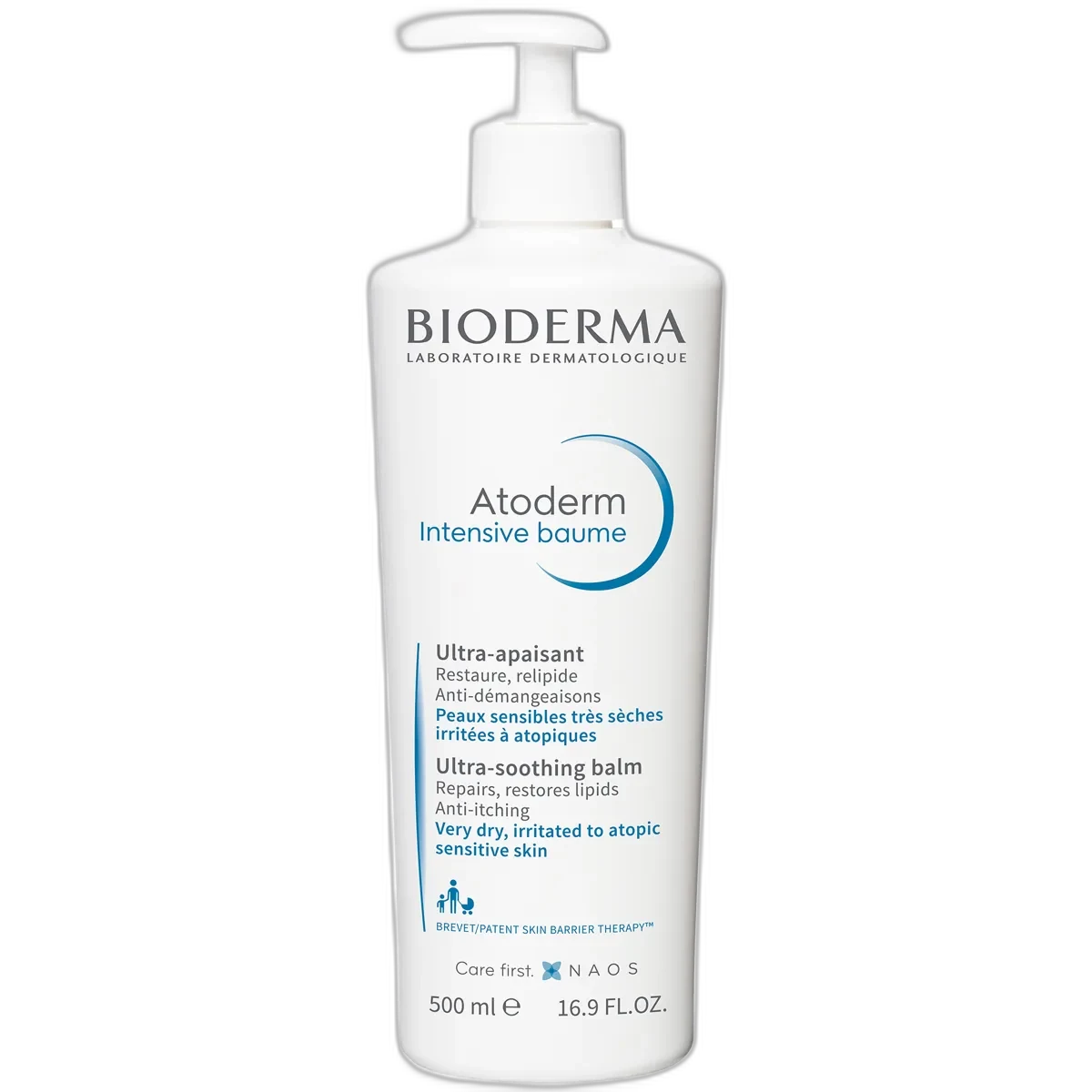
Atoderm Intensive Baume
Eczema Warrior's Arsenal
 Verified reviewer
Pros & cons.
- +Triple ceramide complex (NP, AP, EOP) with phytosphingosine for both supplementation and endogenous stimulation
- +Patented Skin Barrier Therapy prevents S. aureus adhesion — unique in the OTC eczema category
- +PEA anti-itch active targets neurogenic itch pathways for 80% reported itch reduction
- +130-patient RCT showed 76% of users remained flare-free over 6 months
- +D-Phase technology allows faster absorption than typical heavy eczema balms
- +NEA Seal of Acceptance with 10 studies across 2,000+ patients
- +Excellent value at $30 for 500 ml with the whole-family 3-6-9 dosing system
- −36-ingredient formula is complex compared to minimalist competitors
- −Contains mineral oil which some consumers philosophically prefer to avoid
- −Not fungal acne safe — multiple Malassezia-feeding ingredients present
- −Too heavy and occlusive for oily or combination facial skin types
- −Slight initial greasiness before full absorption may be impractical for some
The full review.
Eczema involves three distinct issues: a lipid-deficient barrier that loses moisture, a microbiome colonized by Staphylococcus aureus that drives inflammation, and a neurogenic itch cycle that causes scratching and damage. Most OTC eczema emollients target only the first issue. The Bioderma Atoderm Intensive Baume targets all three, and clinical evidence shows this multi-front strategy works.
Lipogenium handles the lipid front. This Bioderma ceramide complex uses three specific subtypes—NP, AP, and EOP—to match the ceramide profile of healthy human skin. This is a formulation choice to replace the specific lipids atopic skin underproduces, not a generic ceramide claim. Phytosphingosine acts as both a ceramide precursor and an antimicrobial, stimulating the skin’s own lipid production and managing bacteria. Cholesterol completes the lipid architecture.
The microbiome front differentiates this balm. Sucrose stearate—Bioderma’s Skin Barrier Therapy technology—creates a molecular environment that prevents S. aureus from adhering to the skin surface. This patented mechanism has no direct equivalent in competing eczema emollients. Clinically, S. aureus colonizes up to 90 percent of atopic skin and correlates with flare severity. Preventing adhesion reduces the colonization density that triggers immune responses without killing bacteria.
Palmitamide MEA addresses the itch front. This endocannabinoid-like molecule acts on neurogenic itch pathways. Unlike the soothing of colloidal oatmeal or passive emollience, PEA targets the specific neurological signaling that causes the urge to scratch. Clinical data across the Atoderm Intensive line shows an 80 percent reduction in itchiness.
A pivotal 2013 study—a randomized, double-blind, placebo-controlled trial of 130 pediatric patients over six months—produced rare OTC data. Seventy-six percent of patients had no eczema flare-ups during treatment. When flares occurred, the interval between them increased from 39 days (control) to 59 days, and intensity dropped by 49 percent. For a product costing thirty dollars at Target, these outcomes are significant.
Bioderma’s D-Phase Technology solves the heaviness common in therapeutic balms. The emulsion is ultra-concentrated in lipids but uses a fine dispersion that absorbs faster than the thick, white texture suggests. It leaves a sheen for a minute or two, but it is more wearable than many competing eczema balms that require ten minutes before applying clothing.
The texture is thick. Dry, cracked, itching skin needs substantial occlusion, which the mineral oil-glycerin-sunflower oil base provides. Fragrance is absent. The 500 ml pump bottle allows hygienic, economical use. Bioderma’s 3-6-9 dosing guide (three pumps for babies, six for children, nine for adults) makes application practical for families.
Complexity is a limitation. The thirty-six ingredients increase the theoretical surface area for sensitivity in reactive skin. This is not a minimalist formula. Mineral oil may alienate consumers avoiding petroleum derivatives. The formula also contains fungal acne triggers—sunflower oil, canola oil, and polysorbate 60—so it is unsuitable for Malassezia folliculitis.
This balm is too heavy, too occlusive, and too rich for oily skin that produces enough lipids. Some dry skin users find the initial sheen impractical under makeup on the face. The product excels for body application, covering large areas of atopic skin with therapeutic-grade protection.
The value at $30 for 500 ml is strong, costing roughly $0.35-$0.50 per day with twice-daily full-body application. The 75 ml travel size at $11 allows for a trial. With this level of clinical validation, technological sophistication, and an NEA Seal of Acceptance, the price shows serious eczema care does not require a dermatologist’s price tag.
The Atoderm Intensive Baume shows what happens when a pharmacy brand treats eczema as a multi-pathology condition rather than a moisturizing deficit. Three fronts, three technologies, ten studies, and 2,000 patients back it. The science is impressive and the price is accessible. For those managing atopic skin, these two facts matter most.
Texture
The texture is thick. Dry, cracked, itching skin needs substantial occlusion, which the mineral oil-glycerin-sunflower oil base provides.
Scent
Fragrance is absent.
Packaging
The 500 ml pump bottle allows hygienic, economical use. Bioderma’s 3-6-9 dosing guide (three pumps for babies, six for children, nine for adults) makes application practical for families.
Common Complaints
Complexity is a limitation. The thirty-six ingredients increase the theoretical surface area for sensitivity in reactive skin. This is not a minimalist formula. Mineral oil may alienate consumers avoiding petroleum derivatives. The formula also contains fungal acne triggers—sunflower oil, canola oil, and polysorbate 60—so it is unsuitable for Malassezia folliculitis.
Not ideal for
This balm is too heavy, too occlusive, and too rich for oily skin that produces enough lipids. Some dry skin users find the initial sheen impractical under makeup on the face.
Best for
The product excels for body application, covering large areas of atopic skin with therapeutic-grade protection.
Works for
The value at $30 for 500 ml is strong, costing roughly $0.35-$0.50 per day with twice-daily full-body application. The 75 ml travel size at $11 allows for a trial. With this level of clinical validation, technological sophistication, and an NEA Seal of Acceptance, the price shows serious eczema care does not require a dermatologist’s price tag.
About
The Atoderm Intensive Baume shows what happens when a pharmacy brand treats eczema as a multi-pathology condition rather than a moisturizing deficit. Three fronts, three technologies, ten studies, and 2,000 patients back it. The science is impressive and the price is accessible. For those managing atopic skin, these two facts matter most.
Ingredient analysis.
Full INCI list
Aqua/Water/Eau, Glycerin, Paraffinum Liquidum/Mineral Oil, Helianthus Annuus (Sunflower) Seed Oil, Behenyl Alcohol, Sucrose Stearate, Canola Oil, Hydroxyethyl Acrylate/Sodium Acryloyldimethyl Taurate Copolymer, Pentylene Glycol, Beta-Sitosterol, Xylitol, Zinc Gluconate, Acrylates/C10-30 Alkyl Acrylate Crosspolymer, Palmitamide MEA, 1,2-Hexanediol, Caprylyl Glycol, Sodium Citrate, Mannitol, Rhamnose, Sodium Lauroyl Lactylate, Sodium Hydroxide, Polysorbate 60, Sorbitan Isostearate, Tocopherol, Phytosphingosine, Ceramide NP, Ethylhexylglycerin, Ceramide AP, Cholesterol, Carbomer, Xanthan Gum, Fructooligosaccharides, Caprylic/Capric Triglyceride, Laminaria Ochroleuca Extract, Citric Acid, Ceramide EOP
Skin match.
The science.
The Science
The Atoderm Intensive Baume has unusually robust clinical evidence for an OTC emollient. A pivotal 2013 study — a randomized, double-blind, placebo-controlled trial of 130 children with moderate atopic dermatitis conducted by Dermscan in Poland — shows that twice-daily application over 6 months resulted in 76% of patients having no eczema flare-ups. For patients who did flare, the interval between episodes grew from 39 to 59 days, and flare intensity dropped by 49%. These outcomes make this balm one of the most clinically validated non-prescription eczema treatments available.
The Lipigenium ceramide complex targets the specific lipid deficiency found in atopic skin. Ceramides NP, AP, and EOP match the three ceramide subtypes most reduced in eczema-affected stratum corneum, per multiple studies including a 2021 review in the Journal of Clinical Medicine. Phytosphingosine acts as a precursor for ceramide synthesis via the serine palmitoyltransferase pathway, providing immediate lipid supplementation and long-term stimulation of endogenous production.
The Skin Barrier Therapy technology targets the microbiome dimension of atopic dermatitis. S. aureus colonizes up to 90% of AD lesional skin, and its presence correlates with disease severity. The sucrose stearate-based anti-adhesion mechanism reduces bacterial colonization density without antibiotic action, interrupting the colonization-inflammation-barrier damage cycle that drives eczema flares.
Palmitamide MEA's anti-pruritic mechanism works through the endocannabinoid system. As a fatty acid amide, PEA modulates mast cell activation and downregulates neurogenic inflammation, addressing itch at its neurological source instead of through surface anesthesia or counterirritant effects. Data from 10 clinical studies with 2,000+ patients shows an 80% reduction in itchiness and 94% improvement in children's sleep quality.
References
- Ceramide-containing cleanser and moisturizer regimen in patients with atopic dermatitis — Cutis (2014)
- Ceramide Abnormalities in Atopic Dermatitis — Journal of Clinical Medicine (2021)
Dermatologist Perspective
Dermatologists view the Atoderm Intensive Baume as one of the most therapeutically substantive OTC eczema emollients available. Board-certified dermatologists note its multi-mechanism approach — lipid replacement, microbiome management, and neurogenic itch modulation — reflects current understanding that effective eczema management requires more than simple emollience. The 6-month RCT data showing 76% flare-free outcomes is frequently cited as evidence that well-formulated emollients can meaningfully reduce corticosteroid dependence. Pediatric dermatologists value the birth-safe formulation and the practical dosing system that guides parents through appropriate application amounts.
Where it fits in your routine.
Apply one to two times daily to clean, slightly damp skin on the face and body. Use Bioderma's 3-6-9 system: 3 pumps for babies, 6 pumps for children, and 9 pumps for adults for full face and body coverage. Apply right after bathing to seal in moisture. Use it with prescription topical treatments by applying the prescription product first, letting it absorb, then applying the balm. For severe dryness or flare-ups, apply liberally to affected areas as needed throughout the day.
At $30 for 500 ml, this balm has high science-to-price value. Applying it twice daily across the full body costs about $0.35-$0.50 per day. This price is low for a formula with triple ceramides, a patented anti-adhesion technology, a dedicated anti-itch active, and a 2,000-patient clinical portfolio. The 75 ml travel size at $11 offers a low-risk entry point. Dermstore's subscription at $25.49 and Ulta's at $28.49 increase the value. For families managing childhood eczema — where compliance and whole-body coverage are critical — the 500 ml pump with the 3-6-9 dosing guide is economical.
This is for anyone managing atopic dermatitis or severe chronic dryness who needs a multi-mechanism emollient to address barrier repair, bacterial colonization, and itch at once. It works well for families with eczema-prone children, adults seeking a steroid-sparing daily treatment, and anyone wanting clinical-grade eczema care without a prescription price tag.
Oily, combination, or fungal acne-prone skin types should skip this balm; it is too thick and has multiple Malassezia triggers. The 36-ingredient list is too long for consumers wanting minimal-ingredient formulas. Those who avoid mineral oil need an alternative, even though clinical evidence shows it works as an effective, non-sensitizing occlusive.
Product details.
Unfragranced with no detectable scent. A faint pharmaceutical note from the base ingredients exists but is essentially imperceptible. This is one of the most neutral-smelling eczema balms available.
White pump bottle (500 ml) features blue Bioderma branding and an orange Atoderm Intensive accent stripe. 200 ml and 75 ml squeeze tubes also exist. The 500 ml pump is hygienic and gives consistent amounts — Bioderma's 3-6-9 pump system guides dosing for babies, children, and adults. All packaging is 100% recyclable.
The balm feels soothing on first application — the PEA anti-itch agent provides relief within the first use. D-Phase technology helps the thick texture spread easily, and the initial sheen settles into a comfortable protective layer within minutes. It has no stinging, no fragrance, and no adjustment period. Users with active eczema flares report the most dramatic immediate improvement.
2-3 months with twice-daily full-body application for the 500 ml size
12 months
fall winter
The backstory.
The Atoderm Intensive Baume emerged from Bioderma's recognition that effective eczema management requires addressing multiple pathologies simultaneously: barrier lipid deficiency, microbiome imbalance, and neurogenic itch. The pivotal 2013 study — a 130-patient, 6-month randomized trial — demonstrated that 76% of patients remained flare-free during treatment, a remarkable outcome for an OTC emollient. The formula's Skin Barrier Therapy technology, which prevents S. aureus adhesion, was developed in response to research showing that bacterial colonization is both a consequence and a driver of eczema flares.
About Bioderma
Legacy Brand (20+ years)Pharmacist-biologist Jean-Noël Thorel founded Bioderma in 1977. Nearly five decades of dermatological research back the brand. 10 clinical studies on 2,000+ patients support The Atoderm Intensive Baume. It uses three proprietary technologies: Lipigenium ceramide complex, Skin Barrier Therapy anti-adhesion patent, and D-Phase emulsion technology.
Common myths.
All ceramide creams are essentially the same — ceramides work the same way regardless of the surrounding formula.
This balm contains three ceramide subtypes (NP, AP, EOP) that match the skin's natural profile. It uses phytosphingosine to stimulate endogenous production, a patented sucroester to address S. aureus colonization, and PEA for neurogenic itch. The ceramides work as part of a multi-mechanism system, not a standalone ingredient. Most competing ceramide creams lack the anti-adhesion and anti-itch technologies.
Over-the-counter eczema balms do not reduce flare-ups; only prescription treatments work.
A 130-patient randomized double-blind study shows 76% of patients using this balm had no eczema flare-ups over 6 months. When flares occurred, they happened every 59 days compared to every 39 days in the control group, with 49% reduced intensity. OTC emollients with sophisticated formulations make clinically meaningful differences.
FAQ.
What is the difference between Bioderma Atoderm Intensive Baume and Atoderm Crème Ultra?
The Crème Ultra is a daily maintenance moisturizer for normal-to-dry skin. The Intensive Baume is a therapeutic treatment for very dry, eczema-prone skin — it contains triple ceramides, PEA anti-itch agent, and the Skin Barrier Therapy anti-adhesion patent that the Crème Ultra lacks. Choose the Crème Ultra for everyday hydration; choose the Intensive Baume for active eczema management.
Does Bioderma Atoderm Intensive Baume help with itching?
Yes — it contains Palmitamide MEA (PEA), an endocannabinoid-like molecule that targets neurogenic itch. Clinical data shows 80% less itchiness with regular use. This is a targeted anti-itch mechanism, not just the general soothing effect of emollience.
Is Bioderma Atoderm Intensive Baume safe for babies?
Yes. Bioderma markets this for the whole family from birth (except premature infants). The fragrance-free, hypoallergenic formula has been dermatologically tested on babies, children, and adults. Bioderma recommends 3 pumps for babies, 6 for children, and 9 for adults for full-body application.
What is Skin Barrier Therapy in Bioderma Atoderm?
Bioderma uses patented sucrose stearate technology to stop Staphylococcus aureus from sticking to the skin. In atopic dermatitis, S. aureus colonization increases flares and barrier damage. This technology fixes the microbiome imbalance and lipid deficiency—a mechanism unique to Bioderma in the OTC eczema category.
Can I use Bioderma Atoderm Intensive Baume on my face?
Yes, it works for both face and body. But the thick balm texture may feel too heavy on oily or combination facial skin. It works well for daily facial use on dry or eczema-prone skin. For lighter daily moisturizing, use the Atoderm Crème Ultra or Atoderm Intensive Gel-Cream instead.
How does Bioderma Atoderm Intensive Baume compare to CeraVe Moisturizing Cream for eczema?
Both contain ceramides. Bioderma includes three ceramide subtypes (NP, AP, EOP), phytosphingosine to stimulate endogenous lipids, PEA for anti-itch action, and the patented Skin Barrier Therapy against S. aureus. CeraVe uses MVE technology to release ceramides over time. Both work; Bioderma has more eczema-specific clinical data (10 studies, 2,000+ patients) and CeraVe has a lower price point.
Is Bioderma Atoderm Intensive Baume fungal acne safe?
No. Polysorbate 60, sunflower seed oil, and canola oil in the formula can feed Malassezia yeast. If you have fungal acne (Malassezia folliculitis), use a fungal acne-safe alternative.
What the community says.
"Repairs damaged skin barrier rapidly with visible improvement within 1-2 weeks"
"Relieves eczema itching effectively — better than some prescription alternatives for mild cases"
"Non-greasy for a rich balm thanks to D-Phase emulsion technology"
"Excellent value with the large 500 ml pump bottle at $30"
"NEA Seal of Acceptance and strong clinical backing provide eczema sufferers with confidence"
"Contains mineral oil which some consumers prefer to avoid on principle"
"Too heavy and rich for oily facial skin types"
"Not fungal acne safe — multiple triggering ingredients in the formula"
"36 ingredients is complex compared to ultra-minimalist competitors"
"Slight greasiness or residue before full absorption in some users"