SOS Labial Lip Balm
Pharmacy Lip Rescue
 Verified reviewer
Pros & cons.
- +Sucralfate actively promotes tissue repair — a wound-healing ingredient rare in lip care
- +Avène Thermal Spring Water provides clinically backed anti-inflammatory soothing
- +Long-lasting protection requiring only 2-3 daily applications
- +Transparent finish works seamlessly under lipstick or alone
- +Lanolin-free, paraben-free formula with 91% SkinSAFE allergen-free rating
- +Anti-inflammatory stearyl glycyrrhetinate calms irritated lip tissue
- −Very small 4g tube is expensive at $14 — lasts only 3-4 weeks
- −Contains fragrance in a product marketed for sensitive lips
- −Increasingly difficult to find at US retailers — may be discontinued domestically
- −Waxy texture may feel heavy compared to oil-based lip treatments
- −Contains BHT preservative which some consumers prefer to avoid
The full review.
There is a moment — usually in February, usually after a week of wind and central heating — when your lips cross the line from ‘a bit dry’ to ‘actively hostile.’ They crack. They sting. They reject your favorite lip balm like it personally offended them. This is the moment Avène SOS Labial was designed for, and the reason it exists has less to do with beauty and more to do with medicine.
The ingredient that earns this lip balm its ‘SOS’ designation is sucralfate — specifically, aluminum sucrose octasulfate. If that sounds more like something from a pharmacy dispensary than a cosmetics counter, that’s because it is. Sucralfate was originally developed to treat gastrointestinal ulcers, where it promotes tissue repair by increasing the bioavailability of fibroblast growth factor. A systematic review in the Journal of Wound Care examining over 12,000 patients confirmed its wound-healing properties. Pierre Fabre’s innovation was recognizing that the same tissue-repair mechanism could benefit damaged lip skin, which lacks oil glands and is among the most vulnerable tissue on the face.
This is the fundamental difference between Avène SOS Labial and the dozens of lip balms sitting in your nearest drugstore. Most lip products — even good ones — are passive barriers. They lay down a layer of wax, oil, or petroleum and wait for your lips to sort themselves out underneath. This balm does that too, with beeswax and microcrystalline wax forming a protective shield, but the sucralfate adds an active repair dimension. It’s the difference between putting a bandage on a cut and putting a bandage with antibiotic ointment on a cut.
The formula surrounding the sucralfate is solidly constructed. Shea butter provides rich emollience, squalane delivers lightweight moisture that mimics the skin’s own lipids, and Avène’s thermal spring water — backed by over 150 clinical studies — contributes anti-inflammatory and soothing properties from its unique mineral composition. Stearyl glycyrrhetinate, a licorice derivative, adds cortisol-like anti-inflammatory effects without steroidal concerns. Vitamin E (both tocopherol and tocopheryl acetate) provides antioxidant protection. Glyceryl linoleate and linolenate supply essential fatty acids that reinforce the lip’s fragile lipid barrier.
The texture reads as ‘French pharmacy’ in the best sense — substantial without being oppressive. It melts on contact with lip warmth, spreading smoothly without the dragging sensation of thicker wax-based balms. It’s not as immediately glossy or sensorial as a lip oil, and people accustomed to the slip of petroleum jelly may find the waxier consistency takes adjustment. But the trade-off is longevity: two to three applications per day provide all-day coverage, which is notably less frequent than the compulsive reapplication most lip balms demand.
The finish is transparent with a subtle sheen — invisible enough to wear under lipstick and understated enough for anyone who doesn’t want visible product on their lips. The scent is where opinions diverge. The included fragrance produces a faint note that some describe as caramel-vanilla and others find reminiscent of old potpourri. It’s light enough that most users won’t notice after application, but its inclusion in a product marketed for sensitive lips is a valid point of criticism. In a formula this medically oriented, fragrance feels like a concession to consumer expectation rather than a formulation necessity.
Speaking of criticism: the size-to-price ratio demands acknowledgment. Four grams of product for $14 is genuinely steep, even by pharmacy-brand standards. At approximately 60 applications per tube, you’re looking at three to four weeks of use before reaching for your wallet again. The value calculation depends entirely on how you use it. As a daily-driver lip balm for someone with normally comfortable lips, it’s expensive overkill. As an intensive rescue treatment for cracked, wind-damaged, or post-procedure lips — the SOS scenario in its name — the active healing ingredient and pharmaceutical pedigree justify the investment in a way that a $3 Chapstick simply cannot.
The product’s availability in the US market deserves a candid note. It has become increasingly difficult to find at US retailers, with several listing it as out of stock or discontinued. Avène’s US lip care lineup now emphasizes the Cicalfate+ Lips and Cold Cream Lip Balm formulations. European pharmacy channels and international retailers remain reliable sources, but US consumers should be aware they may need to order internationally or seek out remaining stock.
For its intended purpose — genuine lip rescue and repair — Avène SOS Labial delivers in a way that reflects its pharmaceutical parentage. The sucralfate sets it apart from the vast majority of lip care products, and the supporting cast of shea butter, squalane, and thermal spring water ensures that the repair happens in a nourishing, protective environment. It’s not the most luxurious lip product you’ll ever use, and it’s not the best value per gram. But when your lips are staging a revolt, it’s the product that treats the problem rather than just cushioning the symptoms.
Ingredient analysis.
Full INCI list
Paraffinum Liquidum (Mineral Oil), Ricinus Communis (Castor) Seed Oil, Cera Alba (Beeswax), Hydrogenated Castor Oil, Isopropyl Palmitate, Butyrospermum Parkii (Shea) Butter, Cetyl Esters, Cetearyl Ethylhexanoate, Bis-Diglyceryl Polyacyladipate-2, Hydrogenated Vegetable Oil, Squalane, Cera Microcristallina (Microcrystalline Wax), Aluminum Sucrose Octasulfate, Glyceryl Linoleate, Avene Aqua (Avene Thermal Spring Water), Paraffin, BHT, Parfum (Fragrance), Glyceryl Linolenate, Glyceryl Oleate, Glyceryl Palmitate, Glyceryl Stearate, Glycine Soja (Soybean) Oil, Isopropyl Myristate, Stearyl Glycyrrhetinate, Tocopherol, Tocopheryl Acetate
Skin match.
The science.
The Science
Sucralfate (aluminum sucrose octasulfate) is the scientific standout in Avène SOS Labial. It has a large clinical evidence base, though mostly for wound healing rather than cosmetics.
A 2021 systematic review in the Journal of Wound Care examined 21 publications, including randomized controlled trials with over 12,000 patients, and confirmed sucralfate promotes wound healing. The mechanism is clear: sucralfate increases fibroblast growth factor (FGF) bioavailability, which drives tissue repair and angiogenesis. A 2009 study in Medical Hypotheses showed how topical sucralfate application stimulates these growth factors in epithelial tissue—the same tissue type as lip skin.
Avène Thermal Spring Water adds a distinct scientific dimension. A 2011 study in the Journal of the European Academy of Dermatology and Venereology showed Avène Thermal Spring Water has antiradical and anti-inflammatory properties on keratinocytes. Research in the International Journal of Dermatology (2020) showed it protects skin biomechanical and ultrastructural parameters. The water's unique mineral composition—including silicates, bicarbonates, and a specific calcium-to-magnesium ratio—produces these effects. The water filters through Cévennes Mountain dolomite rock for 50 years before emerging at the source.
Stearyl glycyrrhetinate comes from licorice root and provides anti-inflammatory activity that mimics cortisol without steroidal side effects. The International Journal of Toxicology (2007) published a safety assessment confirming the efficacy and safety of glycyrrhetinic acid derivatives in cosmetics.
References
- Avène Thermal Spring Water: an active component with specific properties — Journal of the European Academy of Dermatology and Venereology (2011)
- Protective properties of Avène Thermal Spring Water on biomechanical, ultrastructural and clinical parameters of human skin — International Journal of Dermatology (2020)
- Topical use of sucralfate in epithelial wound healing: clinical evidences and molecular mechanisms of action — Medical Hypotheses (2009)
Dermatologist Perspective
Dermatologists know lip tissue is uniquely vulnerable; it lacks oil glands, has minimal melanin protection, and has a thinner stratum corneum than facial skin. Board-certified dermatologists note that effective lip care needs more than simple occlusion; it needs ingredients that support tissue repair. The sucralfate in this formula meets that need via a well-documented wound-healing mechanism. This allows dermatologists to recommend it with clinical confidence for patients with chronically chapped, cracked, or post-procedure lips. The formula excludes lanolin—a common lip product ingredient that causes contact dermatitis in many users—reflecting dermatological awareness.
Where it fits in your routine.
Twist up a small amount and apply to clean, dry lips. Apply 2-3 times daily for protection, especially before going outdoors in cold or windy conditions. For intensive overnight repair, apply a thick layer before bed. Use it as a primer under lipstick to prevent drying. Reapply after eating or drinking. Store at room temperature; extreme heat softens the balm in the tube.
At $14 for 4g, Avène SOS Labial is expensive per gram. It costs much more than mass-market lip balms and matches or beats luxury alternatives. The value comes from the sucralfate-driven active repair mechanism, which separates this from passive barrier products. It offers poor value for everyday hydration on healthy lips. For the SOS scenario it targets — cracked, wind-damaged, or post-procedure lips needing active healing — the pharmaceutical-grade approach justifies the price. A tube lasts about 3-4 weeks with typical use. Limited US availability increases the effective cost because international shipping adds to the price.
Use this if standard lip balms fail your chronically cracked, chapped, or wind-damaged lips. It works well for post-procedure lip care, harsh winter conditions, or retinoid-irritated lips. The lanolin-free formula suits people with lanolin sensitivity. Use it as a rescue treatment instead of a casual daily lip balm.
This 4g size costs $14, making it impractical for budget-friendly everyday lip balm use. US availability varies. The beeswax content means it is not vegan. It contains parfum at low levels, which affects those sensitive to fragrance in lip products.
Product details.
Thick, creamy, slightly waxy balm melts on contact with lip warmth. It is thicker than most lip balms but lacks a heavy or greasy feel. It creates an enveloping protective layer.
Contains fragrance (Parfum). The light, subtle scent has notes of caramel, vanilla, or floral. Not everyone likes it.
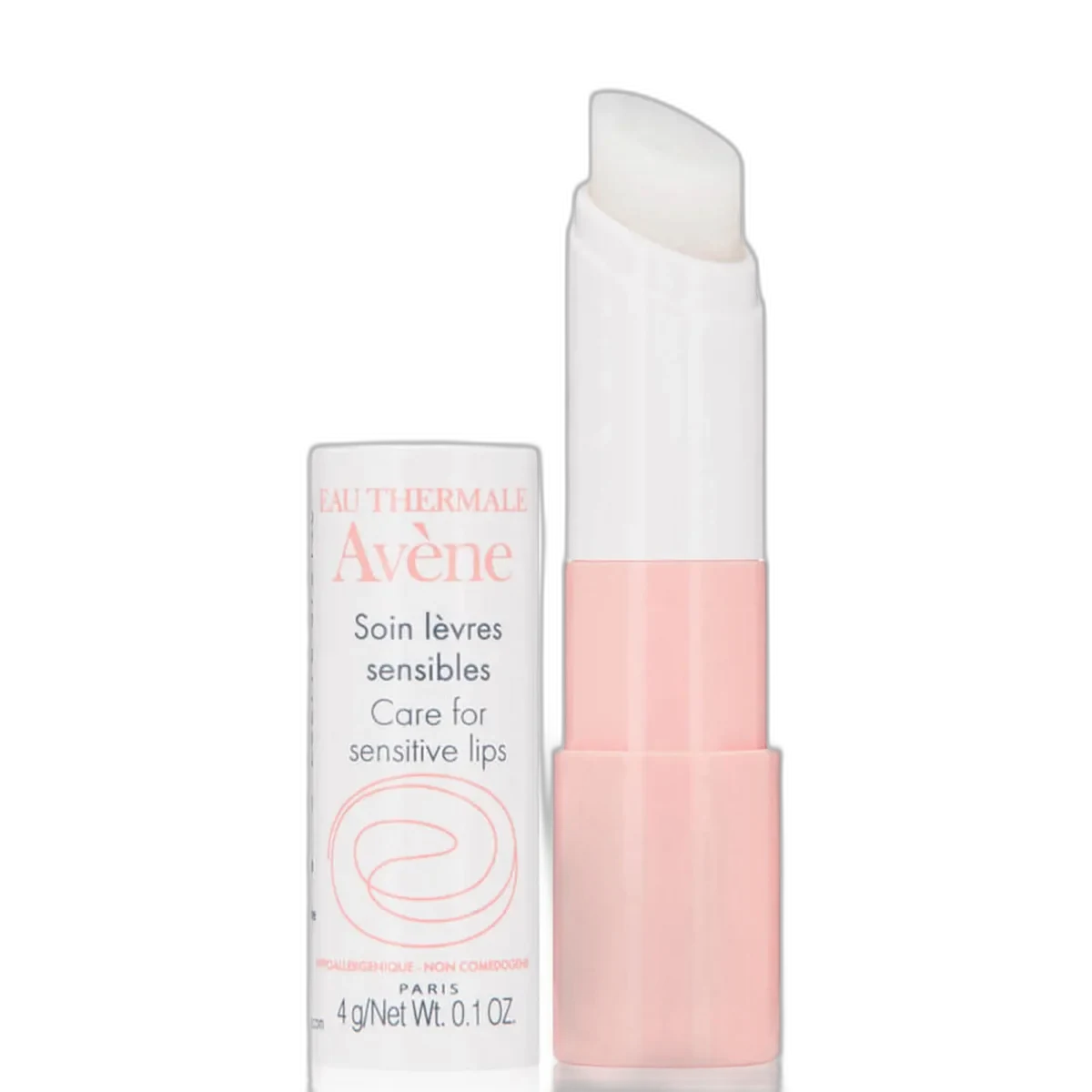
Small white Avène twist-up lip balm stick tube. The cap clicks on securely. It is compact and portable. Transparent application adds no color.
The balm provides immediate comfort and a noticeable protective layer on first application. It melts into the lips smoothly to relieve dryness and tightness instantly. The waxy texture feels different than petroleum jelly or liquid lip oils, but this texture enables the long-lasting protection.
One tube provides about 60 applications. At 2-3 applications daily, one tube lasts 3-4 weeks.
6 months
fall winter
The backstory.
Born from Avène's expertise in sensitive skin care and Pierre Fabre's pharmaceutical background, this lip balm applies the same medical-grade approach used in the brand's Cicalfate line to the specific needs of lip tissue. The sucralfate ingredient connects it to a long history of wound-healing research, repurposed for the unique vulnerability of lip skin.
About Avène
Legacy Brand (20+ years)Pierre Fabre Laboratories launched Avène in 1990, using Avène Thermal Spring Water discovered in 1743. Over 150 clinical studies and 50+ published journal articles back the brand's thermal spring water. Pierre Fabre is France's second-largest private pharmaceutical company.
Common myths.
Lip balm creates dependency — your lips become addicted and dry without it.
Lip balm dependency is a myth. Lips lack oil glands and cannot self-moisturize, so they require external protection. What feels like "addiction" is just noticing natural lip dryness once you stop protecting them. This balm's sucralfate repairs lip tissue and reduces the damage cycle.
Natural and organic lip balms are gentler than pharmaceutical ones.
Many 'natural' lip balms use essential oils, botanical extracts, and fragrances that often sensitize lips. This pharmaceutical-grade formula contains fragrance but scores 91% on the SkinSAFE Top Allergen Free scale and excludes common sensitizers like lanolin and propylene glycol.
FAQ.
What is sucralfate and why is it in a lip balm?
Sucralfate (aluminum sucrose octasulfate) is a wound-healing ingredient first made for gastrointestinal ulcers. It increases fibroblast growth factor bioavailability to promote tissue repair. This lip balm heals cracked, damaged lip tissue instead of just creating a moisture barrier — a pharmaceutical approach to lip care most conventional lip balms lack.
Is Avène SOS Labial the same as Avène Care for Sensitive Lips?
Yes — 'SOS Labial' is the name in the European/French market, and 'Care for Sensitive Lips' is the US name. Both products are the same 4g lip balm stick with identical formulations, including sucralfate and Avène Thermal Spring Water.
Is Avène SOS Labial Lip Balm fragrance-free?
No — the formula contains Fragrance (Parfum). The scent is light, but people with fragrance sensitivities should note its presence. Even with fragrance, the formula scores 91% on the SkinSAFE Top Allergen Free scale.
Can I use Avène SOS Labial under lipstick?
Yes — the balm leaves a transparent, non-greasy finish that works as a lipstick primer. It stops matte lipsticks from drying out your lips and creates a smooth base for color application.
Is Avène SOS Labial Lip Balm vegan?
No — it contains Cera Alba (beeswax), an animal-derived ingredient. The brand is not cruelty-free certified because Pierre Fabre sells products in markets where law requires animal testing.
What the community says.
"Effective for very dry, cracked, and sensitive lips"
"Long-lasting protection — only needs 2-3 applications per day"
"Smooth non-greasy application"
"Transparent finish works well under lipstick"
"Healing properties for damaged lips"
"Some find the texture too waxy or thick"
"Fragrance is divisive — some find the scent unpleasant"
"Very small 4g size for the price"
"Difficult to find in US retail"
"Not as immediately hydrating as oil-based lip treatments"