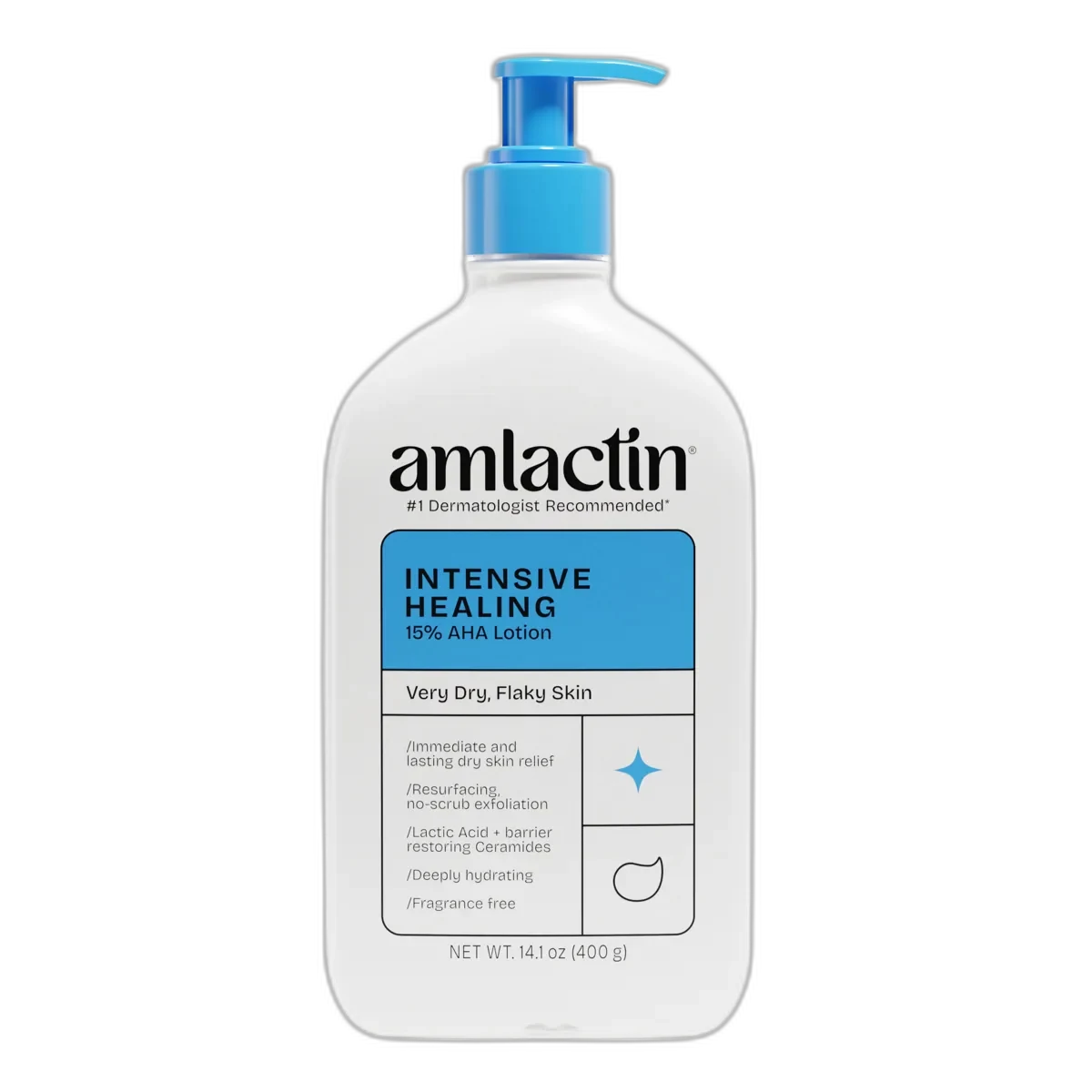
Rapid Relief Restoring Lotion with Ceramides
Barrier Repair Body Pick
 Verified reviewer
Pros & cons.
- +Same proven 15% ULTRAPLEX + ceramide formula as the Intensive Healing — different name, identical product
- +Complete three-ceramide barrier repair system prevents over-drying from the high AHA concentration
- +Fastest-acting AmLactin formula for stubborn keratosis pilaris and severe xerosis
- +Paraben-free reformulation with potassium sorbate preservation
- +Petrolatum occlusion maximizes moisture retention during intensive exfoliation
- +Excellent value for a high-concentration AHA with ceramide barrier technology
- −15% lactic acid produces more stinging than the 12% formula on application
- −Dual naming under 'Rapid Relief' and 'Intensive Healing' causes unnecessary consumer confusion
- −Heavier texture with slight tackiness isn't as cosmetically elegant as the 12% lotion
- −More pronounced lactic acid scent at the higher concentration
- −Too aggressive for sensitive skin or non-problematic body areas
The full review.
AmLactin shoppers face a minor mystery: you will see this product labeled as ‘Rapid Relief Restoring Lotion + Ceramides’ on some shelves and ‘Intensive Healing Lotion with 15% Lactic Acid AHA’ on others. They look and sound different, but they are the same product. The ingredient lists match character for character on both bottles. This rebranding reflects a marketing shift—AmLactin found that leading with lactic acid strength resonated more with consumers seeking KP solutions than leading with the ceramide story.
This distinction matters because dual naming causes confusion. If your dermatologist recommended ‘Rapid Relief with Ceramides’ and you only find ‘15% Intensive Healing,’ buy it. If you thought the ceramide version was discontinued when the packaging changed, it was not. It is the same formula and same results, just a different label.
Now, for the product itself—one of the best-designed OTC body treatments for severe dryness and keratosis pilaris.
The ULTRAPLEX system delivers 15% total lactic acid through three different salt forms, providing the most aggressive chemical exfoliation in the OTC AmLactin range. For skin that did not respond to the standard 12%, this is the step up—it dissolves keratin plugs faster, sheds rough, scaly surface layers more rapidly, and reaches smooth skin quicker.
The formula’s intelligence lies in what happens after exfoliation. Three ceramides—NP, AP, and EOP—immediately replenish the barrier lipids that accelerated exfoliation depletes. Phytosphingosine provides the raw material for additional endogenous ceramide production. Cholesterol enables the ceramides to organize into functional lamellar bilayer structures instead of just sitting on the surface. Petrolatum seals everything in, reducing transepidermal water loss to near-zero while the repair system works.
This clear-and-rebuild approach is pharmacologically sound. Most body lotions either exfoliate or moisturize. A few do both. This one exfoliates, moisturizes, and structurally repairs the barrier—three distinct mechanisms in one product. The ceramide marketing name may have been less catchy than the lactic acid percentage, but it was a more honest description of what makes this formula special.
In practice, the product behaves identically to the 15% Intensive Healing. It has a thick, emollient texture with slight tackiness from the petrolatum. It stings more than the 12% on initial application. Results appear faster—many users report noticeable smoothing within 48 hours on the roughest areas. The lactic acid scent is unavoidable at this concentration but fades within minutes.
The paraben-free preservation system using potassium sorbate is an upgrade from the older Cerapeutic formula, which used methylparaben and propylparaben. This formula addresses concerns from consumers who left AmLactin ceramide products because of parabens while maintaining the same three-ceramide barrier repair technology.
At roughly $17 for 7.9 oz, the value is excellent for a product combining this AHA concentration with a complete ceramide complex. Whether you find the original name or the new one, the formula is the same proven combination of clinical exfoliation and structural barrier repair. It is the strongest AmLactin you can buy without a prescription, and for those who need it, nothing else on the pharmacy shelf delivers this same combination of speed and support.
Ingredient analysis.
Full INCI list · pH 4.5
Water (Aqua), Ammonium Lactate, Glycerin, Sodium Lactate, Potassium Lactate, Mineral Oil, Petrolatum, Steareth-21, Dimethicone, Glyceryl Stearate SE, Stearyl Alcohol, Steareth-2, Tocopheryl Acetate, Sodium Lauroyl Lactylate, Ceramide NP, Ceramide AP, Ceramide EOP, Phytosphingosine, Cholesterol, Xanthan Gum, Carbomer, Potassium Sorbate
Skin match.
The science.
The Science
This product uses the same formula as the Intensive Healing Lotion with 15% Lactic Acid AHA. The science is identical: a triple-lactate system (ammonium, potassium, and sodium lactate salts) totaling 15% AHA with a three-ceramide barrier repair complex.
The marketing focus on ceramides is scientifically sound. Research shows ceramides NP, AP, and EOP are the main structural lipids in the stratum corneum barrier. Chronic xerosis depletes these ceramide levels, and aggressive exfoliation can deplete them further. Exogenous ceramide application integrates into existing lamellar bilayer structures when applied with cholesterol and free fatty acids or their precursors (here, phytosphingosine serves as a fatty acid precursor).
The dual-action mechanism—simultaneous exfoliation and barrier repair—solves a core pharmacological tension in AHA therapy. Keratolytic agents improve surface texture by accelerating desquamation, but this acceleration can temporarily compromise barrier integrity. By including the raw materials for barrier reconstruction in the same formulation, the ceramide complex reduces the barrier trade-off that limits the tolerability of high-concentration AHA products.
Dermatologist Perspective
Dermatologists know this is the same formula regardless of the name on the bottle. Board-certified dermatologists recommend it for the same indications as the Intensive Healing 15%: severe keratosis pilaris, stubborn xerosis, and skin needing maximum-strength OTC exfoliation with barrier protection. Dermatologists who treat patients with barrier-compromised dry skin value the ceramide component, as pure exfoliation without repair can create a cycle of treatment and re-damage.
Where it fits in your routine.
Apply to dry, rough body areas after showering while skin is damp. Target problem zones: upper arms, legs, elbows, knees, and heels. Use every-other-day for the first week, then move to daily or twice-daily as tolerated. Wait 5-10 minutes for absorption before dressing. Avoid broken, inflamed, or freshly shaved skin.
Pricing matches the Intensive Healing 15% — about $17 for 7.9 oz. If 'Rapid Relief with Ceramides' packaging goes on clearance during the name transition, you get the exact same formula for a better value. No other OTC body care offers this ceramide + AHA combination at this price.
This is the 'Rapid Relief with Ceramides' formula, whether labeled Rapid Relief or Intensive Healing. It works for severe KP or stubborn dryness needing maximum-strength exfoliation and built-in barrier protection.
Users of Intensive Healing 15% Lactic Acid will see the same results even if they buy this under a different name. This works for sensitive skin types who find 12% lactic acid too strong. It suits anyone preferring lightweight, fast-absorbing body lotions.
Product details.
Fragrance-free. The 15% lactic acid concentration has a tangy scent that fades 5-10 minutes after application.
Pump bottle comes in 7.9 oz and 14.1 oz sizes. You will see this as 'Rapid Relief Restoring Lotion + Ceramides' or the newer 'Intensive Healing Lotion with 15% Lactic Acid AHA' — the product inside is the same. ***
This formula tingles more than 12% formulas on rough or dry skin. The thick texture provides immediate occlusive comfort. Results show faster than with lower-concentration AmLactin products.
1. 5-2 months with twice-daily targeted application (7.9 oz) ***
24 months ***
fall winter ***
The backstory.
This product was originally launched as the 'Rapid Relief Restoring Lotion with Ceramides,' emphasizing the barrier repair component. AmLactin subsequently rebranded it as the 'Intensive Healing Lotion with 15% Lactic Acid AHA,' shifting the marketing focus from ceramides to the stronger-than-standard AHA concentration. The formula remained identical — the rebranding reflected a strategic shift toward leading with the exfoliation story rather than the repair story.
About Amlactin
Legacy Brand (20+ years)AmLactin launched in 1997 and is the #1 dermatologist-recommended moisturizer brand with lactic acid. This Rapid Relief Restoring Lotion with Ceramides uses the same formula now sold as the Intensive Healing Lotion with 15% Lactic Acid AHA — the new name highlights the AHA concentration over the ceramide component.
Common myths.
The 'with Ceramides' version is a different or better formula than the 15% Lactic Acid version.
These products are the same under different names. The Rapid Relief Restoring Lotion with Ceramides rebranded to the Intensive Healing Lotion with 15% Lactic Acid AHA. The INCI ingredient list is identical. If you see both on shelves, buy whichever is cheaper — the formula is the same regardless of the packaging.
FAQ.
What do the ceramides do in this Amlactin formula?
Ceramides NP, AP, and EOP are skin-identical lipids that repair the moisture barrier alongside the 15% lactic acid exfoliation. This concentration can deplete the barrier faster than the skin replenishes it. The ceramides, phytosphingosine, and cholesterol work together to rebuild the barrier in real-time, preventing the over-drying high-strength AHAs cause.
Can I use Amlactin with Ceramides on eczema?
The ceramide-enriched formula supports barrier integrity for eczema-prone body skin during calm periods. But the 15% lactic acid irritates actively inflamed eczema — do not apply to red, cracked, or flaring areas. Use during maintenance phases only, and consult your dermatologist for guidance specific to your condition.
How does this compare to the regular Amlactin 12%?
This formula has a 25% higher AHA concentration (15% vs 12%) and adds a ceramide-cholesterol-phytosphingosine barrier repair system that the basic 12% formula lacks. It exfoliates faster and more intensively while retaining more moisture. Use it on stubborn problem areas where the 12% lacks results; the standard 12% works better for general body maintenance.
Is this Amlactin paraben-free?
Yes — unlike older AmLactin ceramide formulations (like the original Cerapeutic), the Rapid Relief/Intensive Healing line uses potassium sorbate instead of parabens. The formula is fragrance-free, paraben-free, and dye-free.
What the community says.
"Ceramide addition provides better moisture retention than standard AmLactin"
"Fast-acting on stubborn keratosis pilaris and severe dryness"
"Paraben-free formula with complete barrier repair system"
"Noticeably smoother skin within days of starting use"
"15% concentration stings on initial application"
"Heavier texture leaves slight tackiness compared to the 12% formula"
"More noticeable lactic acid scent than lower-concentration products"
"Too aggressive for sensitive or non-problematic skin"