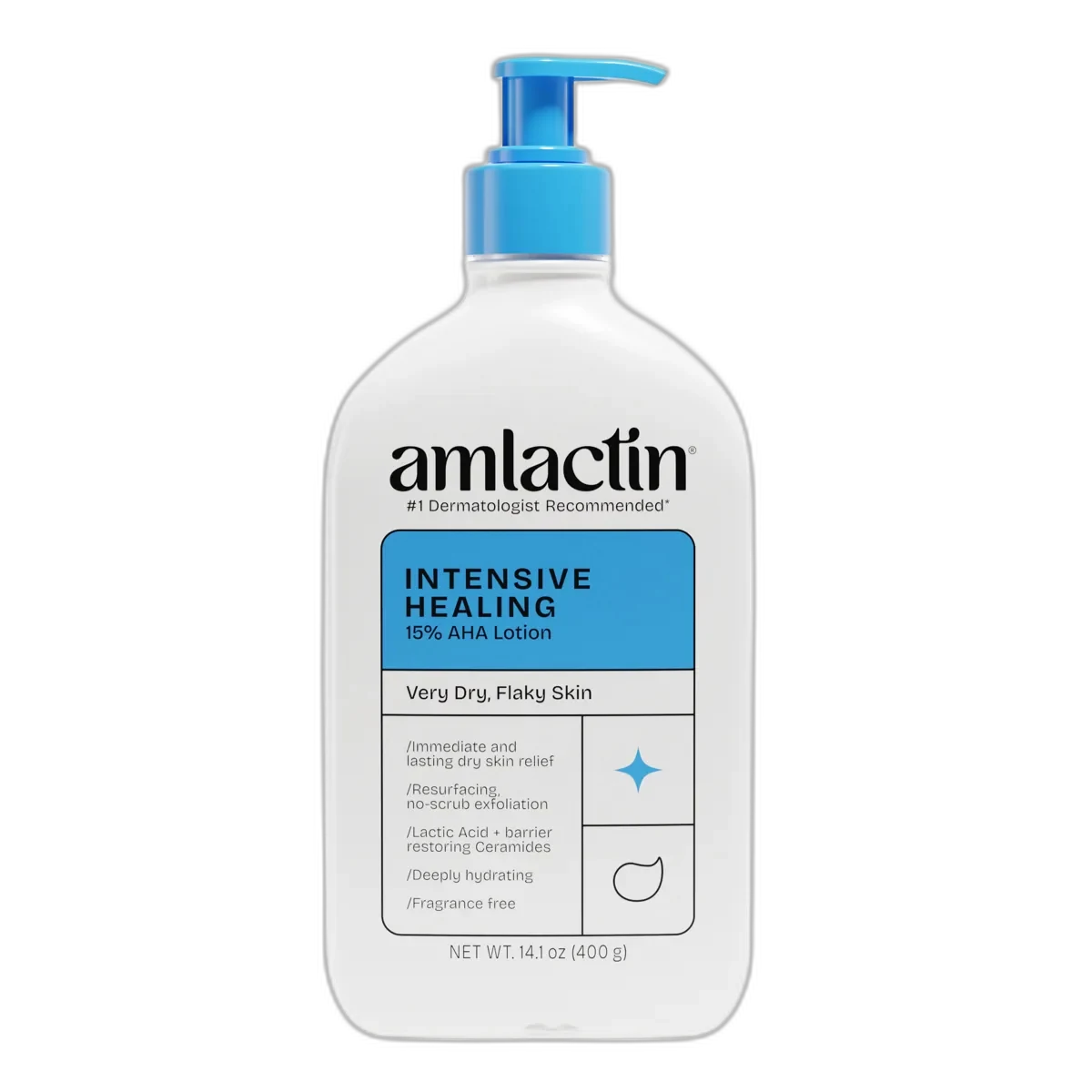
Rapid Relief Restoring Lotion 15% Lactic Acid
Maximum Strength Body Pick
 Verified reviewer
Pros & cons.
- +15% ULTRAPLEX triple-lactate system delivers fastest AHA exfoliation in the AmLactin range
- +Complete ceramide barrier repair complex prevents the over-drying typical of high-strength AHAs
- +Noticeably faster results than 12% — visible improvement in severe KP within 48 hours
- +Paraben-free reformulation uses potassium sorbate preservation
- +Petrolatum occlusion provides maximum moisture-sealing protection on extremely dry skin
- +Reasonable pricing comparable to the 12% formula despite stronger formulation
- −More pronounced stinging on application than the 12% formula — not suitable for sensitive skin
- −Heavier, tackier texture requires more absorption time and feels less elegant
- −Stronger characteristic lactic acid scent during application
- −Too aggressive for general body use on non-problematic skin areas
- −Contains mineral oil and petrolatum, which some consumers prefer to avoid
The full review.
Every dermatology practice has patients whose keratosis pilaris or severe xerosis resists standard 12% AmLactin treatment. The skin stays rough, keratin plugs remain deep, and the regular formula lacks the penetration or exfoliation depth to help. The Rapid Relief Restoring Lotion targets these specific patients.
Moving from 12% to 15% increases keratolytic activity. AmLactin’s ULTRAPLEX system uses three lactic acid salts — ammonium lactate, potassium lactate, and sodium lactate — with different dissociation rates at the formulated pH. This triple-salt approach increases total lactic acid concentration and broadens the activity profile. Different salt forms release free acid at different rates, creating a sustained exfoliation curve instead of a single peak.
The design pairs increased exfoliation with a full ceramide barrier repair complex. Without ceramides, a 15% lactic acid lotion would strip barrier lipids as fast as it removes rough skin, leaving new skin dry and vulnerable. The three ceramides (NP, AP, EOP) with phytosphingosine and cholesterol replenish lamellar lipid structures as quickly as exfoliation depletes them.
The texture matches this goal. This product is thicker than the 12% Daily formula; the petrolatum and mineral oil base provides occlusion, sealing moisture while ceramides integrate into the barrier. Application leaves a slight tackiness that some users dislike and others view as proof the product works. It absorbs slower than the lightweight 12% lotion, so it suits targeted application on problem areas better than quick full-body use.
Stinging is expected. At 15%, the free acid concentration at the skin surface is higher than at 12%, which affects nerve endings. First-time users will feel more tingling for up to ten minutes on very rough or compromised skin. This is normal lactic acid activity, but it surprises users accustomed to the 12% formula. The sensation fades as skin acclimates during the first week.
Results arrive faster than with the 12%. While the standard formula typically smooths skin by day three or four, the Rapid Relief can show visible improvement within 48 hours on the roughest areas. KP bumps flatten faster, scaly patches dissolve quicker, and texture transforms in about half the time. For sandpaper-rough upper arms or scaly shins, this speed improves quality of life.
The paraben-free formulation updates older AmLactin ceramide products. The preservation system uses potassium sorbate instead of methylparaben and propylparaben, addressing concerns that limited the original Cerapeutic formula.
The lactic acid scent is stronger at 15% than at 12% due to the higher ammonium lactate content. The tangy note is clear during application but fades within five to ten minutes, leaving no lingering scent.
Pricing is reasonable. At roughly $17 for 7.9 oz, the per-ounce cost matches the 12% formula despite the higher concentration and added ceramide complex. For targeted use, one bottle lasts six to eight weeks, keeping annual costs manageable even with twice-daily application.
The recommendation is simple: use this on areas where the 12% formula fails, and use the 12% for general body maintenance. The 15% is a targeted tool, not a whole-body replacement. Sensitive skin should start with every-other-day application and increase gradually. Anyone with active eczema or severely compromised barriers should consult their dermatologist before using this concentration.
Ingredient analysis.
Full INCI list · pH 4.5
Water (Aqua), Ammonium Lactate, Glycerin, Sodium Lactate, Potassium Lactate, Mineral Oil, Petrolatum, Steareth-21, Dimethicone, Glyceryl Stearate SE, Stearyl Alcohol, Steareth-2, Tocopheryl Acetate, Sodium Lauroyl Lactylate, Ceramide NP, Ceramide AP, Ceramide EOP, Phytosphingosine, Cholesterol, Xanthan Gum, Carbomer, Potassium Sorbate
Skin match.
The science.
The Science
The ULTRAPLEX system optimizes lactic acid delivery. By combining three lactate salts — ammonium lactate, potassium lactate, and sodium lactate — the formula has a broader keratolytic activity profile than single-salt systems.
Each lactate salt has a different dissociation constant and counter-ion effect at the formulated pH. Free lactic acid releases at varied rates from each salt form, which provides sustained exfoliation instead of a single peak-and-decline pattern. At 15% total lactic acid equivalent, the free acid concentration at pH 4.5 disrupts corneocyte cohesion through desmoglein protein interference.
The ceramide barrier repair component is essential at this concentration. At 15%, the stratum corneum turnover rate exceeds the skin's natural ability to replenish barrier lipids. Ceramides NP, AP, and EOP are the main ceramide subspecies in human stratum corneum, and their exogenous application integrates into existing lamellar bilayer structures. Phytosphingosine works as a ceramide precursor (endogenous enzymes convert it to ceramides) and an antimicrobial agent that helps maintain skin microbiome balance during accelerated exfoliation.
Cholesterol is structurally essential. Ceramides require cholesterol and free fatty acids in an approximately 1:1:1 molar ratio to organize into the ordered lamellar bilayers that form the functional stratum corneum barrier. Without cholesterol, exogenous ceramides cannot form these structures and remain disordered on the skin surface, failing to provide barrier function.
The petrolatum occlusion layer has two purposes: it reduces transepidermal water loss by up to 99% and creates a hydrated microenvironment that helps the ceramide integrate into lamellar structures and supports the lactic acid's humectant activity.
Dermatologist Perspective
Board-certified dermatologists call the Rapid Relief 15% the maximum-strength OTC lactic acid option for patients who have plateaued on the 12% formula. Dermatologists note that adding ceramides at this concentration is clinically important — without barrier repair, daily 15% lactic acid could worsen dryness by stripping barrier lipids faster than the skin replaces them. The formula works for stubborn keratosis pilaris, severe winter xerosis, and as a step-down from prescription ammonium lactate preparations. Dermatologists advise starting with every-other-day application and moving to daily use as tolerated, and they recommend using the 15% only on specific areas rather than whole-body application.
Where it fits in your routine.
Apply to dry, rough, or KP-affected body areas after showering while skin is damp. Target problem zones: upper arms, legs, elbows, knees, and heels. For first-time use, apply every other day to assess tolerance. Use daily or twice daily once skin acclimates. Wait 5-10 minutes for full absorption before dressing. Avoid freshly shaved, broken, or actively inflamed skin. Apply sunscreen to treated areas that will see sun exposure.
At approximately $17 for 7.9 oz, the Rapid Relief provides high value for a 15% AHA body treatment with a complete ceramide complex. The per-ounce cost is nearly the same as the 12% formula, even with the higher concentration and barrier repair ingredients. One bottle lasts 6-8 weeks when used on problem areas, keeping annual costs under $150. This costs less than comparable products that combine high-concentration lactic acid with ceramide barrier repair.
People with severe keratosis pilaris or dry skin that resists 12% lactic acid formulas. Users needing maximum-strength OTC AHA exfoliation with built-in barrier protection. Patients switching from prescription ammonium lactate to an OTC alternative to maintain results.
Users seeing good results from the 12% formula do not need to increase strength if the standard version works. Sensitive skin types find even 12% lactic acid irritating. People with active eczema flares or severely compromised skin barriers should avoid it. This also suits those who dislike heavy, tacky textures on their body.
Product details.
It is fragrance-free, but the higher concentration of lactic acid salts creates a more noticeable scent than the 12% formulas. The scent fades within 5-10 minutes.
Pump bottle comes in 7.9 oz and 14.1 oz sizes. The packaging uses a standard pharmacy style consistent with the AmLactin line. Finish satindewy What to Expect on First Use The tingling is stronger than the 12% formula, especially on rough or compromised skin. This sensation lasts 5-10 minutes. The thick texture is immediate; it feels like a treatment cream, not a light lotion. Results show faster than with lower-concentration AmLactin products. How Long It Lasts 1. 5-2 months using twice-daily targeted application (7.9 oz) Period After Opening 24 months
fall winter
The backstory.
Sandoz launched the Rapid Relief line in 2021 after acquiring AmLactin, recognizing that a segment of patients needed more than the 12% standard formula could deliver. The 15% ULTRAPLEX system with ceramides was designed as the maximum-strength OTC option — one step below prescription ammonium lactate formulations, with the added ceramide technology that prescription versions lack.
About Amlactin
Legacy Brand (20+ years)AmLactin launched in 1997 and is the #1 dermatologist-recommended moisturizer brand with lactic acid. Sandoz launched the Rapid Relief line in 2021, which uses the brand's highest lactic acid concentration and ceramide barrier repair for the most stubborn dry skin conditions.
FAQ.
Is Amlactin 15% better than the 12% for keratosis pilaris?
The 15% delivers faster, stronger results for stubborn KP that the 12% fails to treat. However, 'better' depends on your skin — if the 12% works well without irritation, do not upgrade. The 15% is an escalation product for skin needing intensive treatment, not a replacement for the 12% for all users.
What's the difference between Amlactin Rapid Relief and Intensive Healing?
Both contain 15% lactic acid with ceramides. The Rapid Relief is a lotion in a pump bottle, while the Intensive Healing is a cream in a tub. The lotion absorbs faster and spreads easier; the cream provides more intensive occlusion. The ingredient lists are nearly identical—the difference is mostly texture and packaging format.
Can I use Amlactin 15% on my whole body?
You can, but using the 15% on targeted problem areas (upper arms, legs, elbows, heels) and the 12% formula for general body maintenance is more practical and comfortable. The higher concentration causes unnecessary stinging on areas that do not need intensive treatment.
Why does Amlactin Rapid Relief sting more than regular Amlactin?
The 15% total lactic acid concentration is 25% higher than the standard 12% formula. More free acid at the skin surface interacts with more nerve endings, causing more noticeable tingling or stinging. This sensation subsides within minutes and decreases as skin acclimates. If stinging is severe, use it every-other-day or switch to the 12% formula.
Does Amlactin Rapid Relief contain ceramides?
Yes — ceramides NP, AP, and EOP, phytosphingosine, and cholesterol form a complete barrier repair system. This matters at the 15% concentration, where aggressive exfoliation increases demands on the skin's moisture barrier. The ceramides prevent the over-drying that higher-strength AHAs cause.
What the community says.
"Dramatically improves stubborn keratosis pilaris faster than the 12% formula"
"Ceramide addition provides significantly better moisture retention"
"Noticeable improvement in rough, scaly skin within days"
"Paraben-free reformulation addresses modern consumer preferences"
"15% concentration causes more noticeable stinging on initial application"
"Heavier texture leaves a slight tackiness that some find unpleasant"
"Stronger lactic acid scent than the 12% formula"
"Too aggressive for sensitive or non-problematic skin areas"