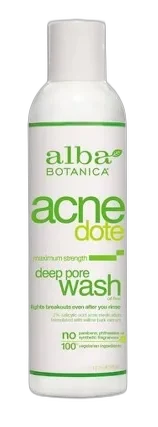
Acnedote Deep Pore Wash
Old-School Drugstore Acne Wash
 Verified reviewer
Pros & cons.
- +2% salicylic acid at the FDA OTC monograph maximum
- +Budget-friendly drugstore pricing
- +Effective for tough oily acne-prone skin
- +Long-standing and widely available
- +Cooling tea tree and eucalyptus sensory experience
- +Visibly reduces sebum and blackheads
- −Contains SLES which is drying on sensitive skin
- −Essential oils are potential irritants and sensitizers
- −Includes methylparaben and propylparaben despite natural branding
- −Synthetic fragrance close to eye area is risky
- −Too harsh for dry, sensitive, or barrier-compromised skin
The full review.
Alba Botanica has occupied American drugstore shelves so long that most shoppers assume it is ‘natural’ without checking. The packaging uses botanical illustrations. The name includes ‘Botanica’. The Acnedote range uses tea tree oil, eucalyptus, and willow bark to follow the natural-acne playbook. You buy it expecting a gentle plant-based alternative to harsh drugstore staples. Then you read the ingredient list: the first surfactant is sodium laureth sulfate, the preservation system uses methylparaben and propylparaben, and synthetic fragrance is at the end. The front of the bottle claims ‘natural’, but the back tells a different story.
This is not a scandal. Parabens are well-studied preservatives that are safe at cosmetic levels. SLES is a standard surfactant that works. Fragrance in a wash-off cleanser rinses away. Alba Botanica is not unethical for keeping these ingredients. However, the product’s shelf position relies on a promise the ingredient list does not keep, and any review ignoring this misses the point.
The formulation is a competent 2008-era drugstore acne wash. Salicylic acid is at the FDA over-the-counter monograph maximum of 2% — the same concentration in Neutrogena Oil-Free Acne Wash and Clean & Clear’s equivalent products. The pH is in the low-to-mid 4 range, where salicylic acid is active. The surfactant system is aggressive: SLES degreases and strips sebum efficiently, cocamidopropyl betaine softens the effect slightly, and sodium lauroyl sarcosinate adds lather. This wash cuts through oil quickly, leaves a clean-and-tight feel, and will over-strip skin that cannot handle it.
Essential oils provide the other main sensory feature. Tea tree leaf oil and eucalyptus globulus oil create the medicinal-herbal tingle that defines this wash. Lemon peel oil adds a photosensitizing citrus note at the bottom of the INCI. Some users like the cooling freshness; it feels like the product is working, which is what drugstore acne shoppers want. Others find the scent overwhelming or the essential oil content irritating; sensitive-skin users can develop dermatitis from this combination. Patch testing is required for this cleanser.
The wash works for tough, oily, acne-prone skin that tolerates aggressive surfactants and essential oils. For that group — mostly younger users with resilient barriers and oily sebum production — the cleanser works at an affordable price. Ten dollars for a 6-ounce bottle that lasts two to three months makes the cost per use negligible. The 2% salicylic acid provides enough decongestion during rinse-off contact time to visibly reduce blackheads and oiliness within a few weeks of consistent use.
For everyone else — sensitive skin, dry skin, rosacea-adjacent complexions, eczema-prone users, or adult acne patients with compromised barriers — this is the wrong cleanser. The drying and essential oil irritation are real, and the harsh surfactant base will hinder anyone with struggling skin. Gentler 2% salicylic acid cleansers exist at this price (Neutrogena’s Clear & Soothe line, for example), and even gentler non-SLS options from CeraVe and Cerave Acne Control cost slightly more. For adult acne users with sensitivity, those are better picks.
One more observation: the formulation has not changed meaningfully in over a decade. Acne science and ingredient expectations have moved on. Today’s best-in-class drugstore acne cleansers use less sulfate, less essential oil, and less fragrance than this one. Alba Botanica keeping the Acnedote formula in its late-2000s form shows continuity but lacks formulation progress. It still works for the right skin, but it does not follow where the category is moving.
Ingredient analysis.
Full INCI list · pH 4.5
Water, Sodium Laureth Sulfate, Cocamidopropyl Betaine, Sodium Lauroyl Sarcosinate, Salicylic Acid (2%), Glycerin, Glycol Distearate, Aloe Barbadensis Leaf Juice, Tea Tree Leaf Oil, Eucalyptus Globulus Leaf Oil, Willow Bark Extract, Green Tea Leaf Extract, Chamomile Flower Extract, Cucumber Fruit Extract, Lemon Peel Oil, Citric Acid, Fragrance, Disodium EDTA, Phenoxyethanol, Methylparaben, Propylparaben
Skin match.
The science.
The Science
The main active, 2% salicylic acid, has one of the most well-replicated clinical records of any over-the-counter acne ingredient. Decades of studies — including meta-analytic work in the Journal of the American Academy of Dermatology — prove it works for comedonal and mild-to-moderate inflammatory acne. The mechanism is simple: salicylic acid is lipid-soluble and enters the sebaceous follicle, where it promotes desquamation and reduces comedone formation. At the FDA monograph maximum of 2% in a rinse-off product, contact time limits results, but even short-contact exposure decongests skin in consistent users. The supporting botanicals lack rigorous support: willow bark contains salicin, which metabolizes into salicylic acid, but the concentration in a cosmetic extract is too low to add to the BHA dose. Tea tree oil has some peer-reviewed evidence for acne — a clinical trial in the Medical Journal of Australia showed 5% tea tree oil performed similarly to 5% benzoyl peroxide for mild-to-moderate acne, though tolerability varied. Eucalyptus and lemon peel oils mostly provide scent. The limitation of this formulation is the delivery vehicle, not the actives. The SLES-based surfactant system, essential oil load, and synthetic fragrance raise irritation and sensitization risks above what modern drugstore cleansers require. Newer products deliver 2% salicylic acid in gentler bases without losing efficacy.
Dermatologist Perspective
Dermatologists view 2% salicylic acid cleansers as useful over-the-counter acne tools, especially for comedonal acne in patients with resilient oily skin. Board-certified dermatologists note that aggressive drugstore formulations using high-sulfate surfactant bases and essential oils can cause irritation or allergic contact dermatitis in many users; they often recommend gentler alternatives for patients with sensitive, rosacea-prone, or barrier-compromised skin. This cleanser is a reasonable budget choice for tough oily acne-prone skin, but dermatologists steer most adult sensitive-skin acne patients toward less stripping options. Patients with a history of tea tree oil or eucalyptus sensitivity should avoid it.
Where it fits in your routine.
Wet your face with lukewarm water. Put a dime-sized amount into damp palms, lather, and massage into skin for thirty to sixty seconds. Do not leave it on longer than necessary to maximize exposure without increasing the drying effect. Rinse thoroughly and pat dry. Use a hydrating toner and a non-comedogenic moisturizer immediately to offset dryness. Start with once-daily use in the evening; move to twice daily if skin tolerates it. Always wear sunscreen during the day. Avoid contact with eyes — the essential oil content stings if it gets in.
At around $10 for a 6 fl oz bottle, Acnedote Deep Pore Wash is one of the cheapest 2% salicylic acid cleansers on American drugstore shelves, sitting at a similar price to Neutrogena Oil-Free Acne Wash and below CeraVe Acne Control Cleanser. The per-use cost is genuinely trivial. That said, cheaper isn't always better value — for users whose skin doesn't tolerate the SLES and essential oil load, spending a few extra dollars on a gentler alternative delivers better real-world results. The value proposition is strongest for tough oily skin that will actually use up the bottle without irritation.
This works for oily, acne-prone skin on a budget, specifically for teens and young adults with resilient barriers and high sebum production. It suits users who like the cooling tea tree and eucalyptus scent of classic drugstore acne products. It also works well for body acne on the back and chest where skin tolerates stronger cleansing.
Skip this cleanser if you have sensitive, dry, rosacea-adjacent, or barrier-compromised skin. Adult acne patients with compromised barriers get better results from gentler options from CeraVe, La Roche-Posay, or Aestura. Avoid this if you have known essential oil, tea tree, or fragrance allergies.
Product details.
Clear gel that lathers into a thin foaming cleanse
Strong tea tree and eucalyptus medicinal scent
Standard plastic flip-top bottle
The first use causes a distinct tingling, menthol-like cool sensation from the eucalyptus and tea tree oils. Skin feels freshly degreased but may feel tight minutes after rinsing. Over-drying and redness are risks during the first week, especially with twice-daily use.
2-3 months with twice-daily use
12 months
All Year
The backstory.
Alba Botanica started in Northern California in 1979 as an independent natural-positioned brand and was acquired by Hain Celestial in 2000. The Acnedote line launched in the late 2000s as Alba's answer to Neutrogena's and Clean & Clear's dominance in drugstore acne. The formulation has remained largely unchanged for over a decade, which is either charming continuity or outdated chemistry depending on your view.
About Alba Botanica
Legacy Brand (20+ years)Alba Botanica launched in 1979 in California as a plant-based personal care brand. The Hain Celestial Group now owns Alba Botanica. The Acnedote line has been in American drugstores since the late 2000s. It is one of the longest-running salicylic acid cleanser lines from a natural-positioned brand.
Common myths.
Natural brands never use sulfates or parabens.
Alba Botanica markets itself as plant-based, but the Acnedote formula contains sodium laureth sulfate, methylparaben, propylparaben, and synthetic fragrance. 'Botanical' and 'natural' are marketing categories, not regulated ones — read the INCI list instead of trusting brand positioning.
FAQ.
Is this cleanser too harsh?
The SLES surfactant base, essential oil content, and 2% salicylic acid concentration can irritate sensitive, dry, or rosacea-prone skin. Tough oily skin usually tolerates it. If you see redness or tightness, use it once daily or switch to a gentler alternative.
Is it really 'natural'?
It does not meet strict definitions. The formula uses sodium laureth sulfate, methylparaben, propylparaben, and synthetic fragrance. Alba Botanica's natural positioning relies on botanical marketing rather than a minimal or "clean" ingredient list.
How does it compare to Neutrogena Oil-Free Acne Wash?
Both are 2% salicylic acid drugstore cleansers at similar prices. Alba Acnedote uses tea tree and eucalyptus for scent and positioning; Neutrogena uses a neutral fragrance. The surfactant bases are comparable. Skin tolerance and scent preference usually decide.
Is it safe to use during pregnancy?
2% salicylic acid in a rinse-off cleanser is usually low-risk, but salicylic acid exposure during pregnancy is an active discussion topic. Consult your OB or dermatologist, especially because of the additional essential oil content.
Can I use it with other BHA products?
Use caution. A 2% salicylic acid wash, a leave-on BHA, and a spot treatment can overdo it. Start with the wash alone. Add a leave-on BHA every other day if your skin tolerates it.
Why does it contain parabens?
Parabens are well-studied preservatives. They are safe at cosmetic levels, despite consumer concerns. Alba Botanica has not switched to paraben-free preservation, so methylparaben and propylparaben appear on the INCI.
What the community says.
"Affordable"
"Visibly reduces oiliness"
"Tingly fresh feeling"
"Familiar drugstore pickup"
"Tea tree scent"
"Drying"
"Contains SLES"
"Contains parabens"
"Strong essential oil scent"
"Can cause redness on sensitive skin"
People also looked at.