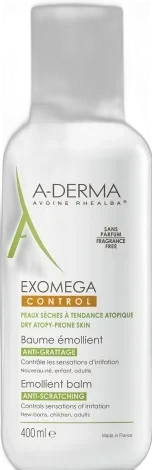
Exomega Control Emollient Balm
Atopic-Prone Staple
 Verified reviewer
Pros & cons.
- +Built around Pierre Fabre's evidence-backed Rhealba oat extract
- +Sunflower oil unsaponifiables address atopic skin's lipid deficiency directly
- +Niacinamide supports endogenous ceramide synthesis over time
- +Rich balm texture absorbs into a non-greasy, clothes-safe finish
- +Carries AFPADA recommendation for atopic-prone skin
- +Safe for infants, children, and adults across a wide age range
- +Fragrance-free, alcohol-free, and low-allergen base
- +Reduces flare frequency with consistent daily use
- −Too rich for non-atopic oily or combination body skin
- −Higher price than drugstore body lotions
- −Takes several minutes to fully absorb before dressing
- −Not a replacement for prescription treatment during active flares
- −200ml size is insufficient for heavy full-body users — larger size preferable
The full review.
The most boring pediatric dermatology advice is also the most clinically meaningful: if a child has eczema-prone skin, moisturize them head to toe every single day, likely twice. Whether they have fewer, milder flares over the next year depends on this habit. This recommendation lacks glamour, magazine covers, or TikTok virality. However, consistent evidence supports it—daily emollient use reduces eczema flare frequency and severity, and some studies show early use delays atopic dermatitis onset in high-risk infants. The problem is that daily emollient application requires consistency, and the biggest barrier is finding a product that parents or atopic-prone adults will actually use for months. A-Derma’s Exomega Control Emollient Balm addresses this.
The Exomega range is A-Derma’s dedicated atopic-prone skin line, distinct from its general sensitive-skin products. In France, where pediatric dermatology relies on pharmacy brands for OTC support of prescription eczema care, Exomega Control is a standard recommendation. It carries the AFPADA (Association Française pour la Prévention des Allergies) recommendation, a meaningful quality signal in the European atopic skin market. The formulation uses three evidence-backed actives: Rhealba oat extract (the brand’s proprietary anti-inflammatory juvenile oat), sunflower oil unsaponifiables (the lipid fraction of sunflower oil isolated for its barrier-replenishing effect in atopic-prone skin), and niacinamide (which supports ceramide synthesis and reduces TEWL). These sit in a thick emollient base of shea butter, mineral oil, and dimethicone, calibrated to be substantial yet light enough for daily use.
The texture supports daily use. It feels thicker than a standard body lotion—more like a light balm than a cream—but absorbs within minutes into a cushioned, non-greasy finish that leaves no residue on clothing. This is vital for realistic use. A genuine ointment like petrolatum seals compromised skin effectively, but applying it to a toddler twice daily without greasing all their clothing is a logistical nightmare. Balms like Exomega Control Emollient Balm are engineered to be effective and practical. In households and adult routines using it consistently, flares become less frequent and less severe, and the skin between flares becomes more resilient.
The ingredient strategy on the emollient base is thoughtful. Rhealba oat provides an anti-inflammatory baseline to quiet constant low-grade irritation. Sunflower oil unsaponifiables supply the linoleic acid and lipids often deficient in atopic skin, addressing a root metabolic problem in atopic dermatitis rather than just surface hydration. Niacinamide drives endogenous ceramide synthesis to help the skin rebuild its lipid matrix. Meadowsweet extract adds a subtle anti-inflammatory note via traditional salicylate-containing botanicals. No single ingredient works alone, but together they address multiple aspects of atopic-prone skin.
The limitations are expected. The balm is too thick for general-purpose use on non-atopic skin; oily or combination body skin will find it heavy. The price exceeds the cheapest drugstore body lotions, which impacts families with eczema-prone children who use product quickly. The 200ml size is standard, though a 400ml version in some markets offers better per-ml value for heavy users. This is not a treatment product; it cannot replace prescription steroids or calcineurin inhibitors during active flares. It is an adjunct and a daily-use foundation that complements prescription care.
For its specific purpose—daily application to atopic-prone skin to reduce flare frequency and severity—Exomega Control Emollient Balm is a well-formulated pharmacy option. It is not glamorous or viral, and it makes no miraculous promises. It is a boring, reliable, evidence-backed emollient for twice-daily application that delivers better long-term skin. That is what atopic-prone skin needs, and it is what the brand has built this line around for decades.
Ingredient analysis.
Full INCI list
Aqua, Paraffinum Liquidum, Glycerin, Butyrospermum Parkii Butter, Avena Rhealba Extract, Helianthus Annuus Seed Oil Unsaponifiables, Niacinamide, Filipendula Ulmaria Extract, Cera Alba, Cetyl Alcohol, Glyceryl Stearate, Dimethicone, Tocopherol, Pentylene Glycol, Xanthan Gum, Disodium EDTA, Sodium Hydroxide, Phenoxyethanol
Skin match.
The science.
The Science
Dermatology has robust evidence for daily emollient use on atopic-prone skin. A 2014 randomized controlled trial in the Journal of Allergy and Clinical Immunology followed high-risk infants for six months; daily emollient application from early infancy significantly reduced atopic dermatitis incidence compared to controls. A 2017 review in Pediatric Dermatology reinforced this and explained the mechanism: daily emollient use reduces transepidermal water loss, maintains a more intact barrier, and reduces the frequency and severity of inflammatory flares even in children who develop eczema. This science justifies Exomega Control as a preventative tool that changes the long-term trajectory of atopic-prone skin, rather than a treatment for active eczema.
The ingredient choices in this balm reflect recent research on atopic skin biology. Sunflower oil unsaponifiables contain high concentrations of linoleic acid and other essential fatty acids that atopic skin lacks metabolically. A 2018 paper in the International Journal of Molecular Sciences discussed how topical linoleic acid supports PPAR-alpha activation and enhances filaggrin expression in compromised skin models. This approach goes beyond simple occlusion. Niacinamide also increases endogenous ceramide synthesis; a 2005 paper in the British Journal of Dermatology documented improved barrier function and reduced transepidermal water loss after several weeks of topical niacinamide use. Rhealba oat provides anti-inflammatory effects, supported by Pierre Fabre's published research on its effect on inflammatory markers in reactive and compromised skin.
This formulation is clinically interesting because it combines barrier occlusion, lipid replenishment, ceramide synthesis support, and anti-inflammatory activity in one daily-use product. Most atopic body creams target one or two mechanisms; this one targets the full set. Whether the cumulative effect is meaningfully greater than a simpler formulation remains an open question, but the ingredient rationale is defensible and user clinical reports are consistent.
Dermatologist Perspective
Dermatologists, especially pediatric dermatologists in Europe, commonly recommend the Exomega Control range as a daily maintenance emollient for atopic-prone children and adults. Board-certified dermatologists note that the combination of Rhealba oat, sunflower oil unsaponifiables, and niacinamide is a comprehensive approach to atopic skin biology. The balm is typically recommended for daily application after bathing, alongside a gentle syndet cleanser and, when needed, prescription topical treatments for active flares. It is used alongside rather than instead of prescription eczema care, as the daily emollient role is distinct from acute treatment.
Where it fits in your routine.
Apply liberally to damp skin after bathing or showering, either head to toe or on specific affected areas. Use twice daily for atopic-prone skin; use more often during flares or when skin feels dry. Use with a gentle syndet cleanser or emollient bath oil to prevent stripping the skin during cleansing. The balm is safe to use with or over prescription topical treatments for eczema; apply the prescription product first, then layer the balm on top.
At roughly 28 US dollars for 200ml, the Exomega Control balm is priced in the upper-middle range of pharmacy-brand atopic body creams. For a family with multiple eczema-prone children, the cost adds up quickly with twice-daily application — a larger 400ml size is available in some markets and offers significantly better per-ml value, and is worth seeking out if you're a heavy user. For localized or adult-only use, the 200ml size lasts 4 to 6 weeks and offers reasonable cost-per-application. Compared to simpler drugstore options, the premium is justified by the specific Rhealba-oat-plus-unsaponifiables formulation and the AFPADA recommendation, but budget-conscious users can achieve some of the same basic emollient benefit with cheaper products — just without the full ingredient complexity.
This works for atopic-prone skin — eczema sufferers of any age, families with eczema-prone children, adults with chronic dry or sensitive body skin, and people in cold climates where the stratum corneum is chronically stressed. It is a good staple for anyone needing a daily-use balm they actually use.
Oily or combination body skin types who don't need the balm weight, users seeking a lightweight summer moisturizer, and anyone who already uses a ceramide-forward body cream they tolerate and love — the performance gap is small enough that switching is not typically worth it.
Product details.
Thick, cushiony balm that's denser than a standard body lotion but not greasy; forms a noticeable emollient layer that absorbs over a few minutes.
Genuinely fragrance-free.
An airless pump bottle uses A-Derma's white and green pharmacy livery; the standard size is 200ml, though some markets offer a 400ml option.
The first application comforts dry or atopic-prone skin immediately. The balm feels thick on contact and absorbs within minutes into a soft, cushioned finish. It has no tingling, no scent, and no surprises—it just holds the skin steadily. Consistent use drops flare frequency measurably over the first few weeks.
200ml lasts about 4-6 weeks for daily full-body use on adults; localized or pediatric use lasts longer.
12 months
All Year
The backstory.
A-Derma developed the Exomega range specifically in response to the rising prevalence of atopic dermatitis in European children and the need for a daily preventative emollient that could reduce flare frequency. The line was built around the brand's Rhealba oat research and evolved to include sunflower oil unsaponifiables and niacinamide as additional barrier-supporting actives.
About A-Derma
Legacy Brand (20+ years)A-Derma's Exomega Control range targets atopic-prone skin. European pediatric dermatologists use it, and it works for eczema-prone adults and children. It has the AFPADA (French Atopic Association) recommendation in France.
Common myths.
Atopic-prone skin requires a steroid for management; moisturizers have limited efficacy.
Dermatology literature shows that daily emollient use reduces eczema flare frequency and severity. Moisturizers do not substitute for prescription treatment during active flares, but they work as a preventative step between episodes.
Thicker is always better for eczema.
Up to a point. Extremely thick occlusives like petrolatum work well on the worst patches, but a balm like this one is more realistic for full-body daily application and more likely to actually get used consistently — which is what matters for long-term flare control.
FAQ.
How often should I apply the balm?
For atopic-prone skin, daily or twice-daily application is typically recommended as a preventative measure. During flares, more frequent application is appropriate. Apply to damp skin after bathing for maximum hydration retention.
What's the difference between the balm and the Exomega Control Cream?
The balm is thicker and more occlusive, which works better for severe dryness or cold weather. The cream is lighter and absorbs faster, making it better for summer or oily atopic-prone skin. Choose based on your skin's dryness and the current season.
Can it replace prescription eczema treatment?
No. This product prevents and supports skin to reduce flare frequency and maintain skin between episodes. Active flares typically require prescription treatments like topical steroids or calcineurin inhibitors. The balm complements those treatments instead of replacing them.
Is it fragrance-free?
This is fragrance-free and contains no essential oils or masking fragrances. This matters for atopic-prone skin, which often reacts to fragrance compounds found in standard body moisturizers.
Will it feel greasy under clothes?
The balm is thick but absorbs to a non-greasy finish within minutes. Let it sink in before dressing to avoid residue on clothing. Applying too much to wet skin increases residue time.
How does it compare to Eucerin Atopi Control?
Both are pharmacy-brand atopic-prone balms with similar positioning. Eucerin uses ceramide-3 and licochalcone; Exomega Control uses Rhealba oat, sunflower oil unsaponifiables, and niacinamide. Tolerance is similar — choose based on availability, texture, and whether you prefer the oat or ceramide angle.
What the community says.
"reduces eczema flare frequency with consistent use"
"gentle enough for infants and sensitive children"
"rich balm holds up in cold dry weather"
"fragrance-free with no irritation"
"too rich for combination or oily body skin"
"heavy texture takes a minute to absorb"
"price is higher than drugstore body balms"