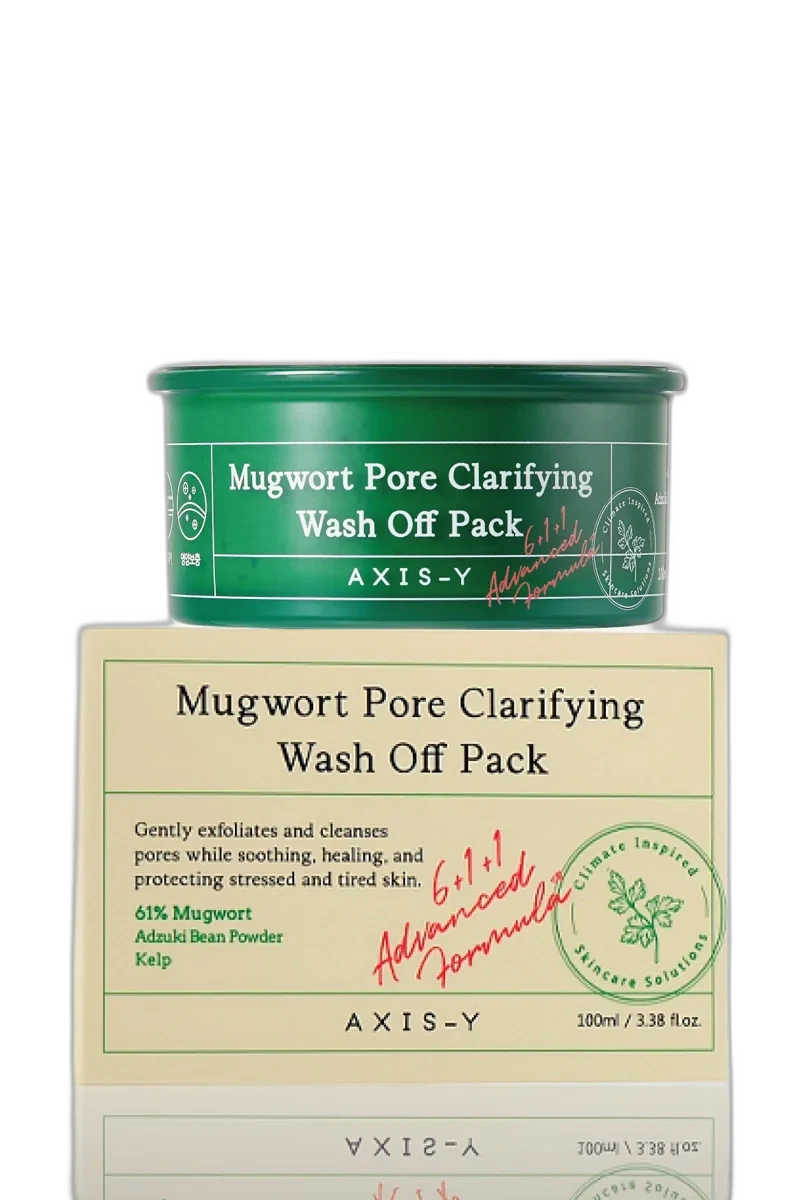
Mugwort Pore Clarifying Wash Off Pack
Mugwort-Buffered Clay Mask
 Verified reviewer
Pros & cons.
- +Mugwort placed high in the INCI as a structural calming active
- +Kaolin-bentonite combination balances absorbency and tolerability
- +Willow bark adds mild BHA-adjacent pore action
- +Fragrance-free formula
- +Soft spreadable texture without grit
- +Doesn't strip the skin the way harsher clay masks do
- −Not appropriate for dry or highly reactive skin
- −Jar packaging is a hygiene compromise
- −Can feel tight if left on past 15 minutes
- −Not fungal-acne safe due to triglyceride content
The full review.
Most clay masks treat calming ingredients as an afterthought. The core formula is built around maximum absorbency — bentonite or French green clay at high concentrations, often paired with charcoal for visual drama — and whatever centella or panthenol makes it in feels more like a garnish than a structural element. The practical result is that a lot of clay masks leave your skin looking cleaner and feeling flushed, tight, or irritated for a few hours afterward. Axis-Y made a different choice with this one. The clays are still doing the absorbent work — kaolin and bentonite sit in the top half of the INCI — but mugwort extract is placed above niacinamide and above the bentonite, which tells you the brand is treating calming as a structural priority rather than a garnish. Centella, heartleaf, panthenol, and allantoin fill in the soothing cast, and willow bark adds a mild BHA-adjacent effect at the surface during the wear time.
What that architecture produces in practice is a clay mask that feels different on the skin. The texture is soft, spreadable, and dark gray — closer to a firm cream than the gritty cement-like consistency of harsher clay products — and it goes on evenly without tugging. There’s an initial cooling sensation, then a mild tightening as the clay begins to work around the ten-minute mark, but the mask doesn’t crack or fully dry out on the skin if you remove it at the right time. When you rinse it off with lukewarm water, the skin immediately feels smoother and less oily, and crucially it usually doesn’t feel stripped or flushed the way post-clay skin often does. That’s the mugwort and centella earning their placement.
The willow bark is the ingredient doing the quiet pore-focused work underneath. Willow bark contains salicin, which converts to salicylic acid in some biological contexts and provides a mild BHA-adjacent surface effect. In a ten-to-fifteen-minute contact time it’s not a substitute for a dedicated BHA treatment, but it reinforces the clay action on congested pores and visible blackheads. Combined with niacinamide for sebum regulation and the clay’s direct absorbent effect on surface oil, the mask targets visible pore appearance through three parallel mechanisms. Regular weekly use produces a measurable improvement in pore appearance and texture over four to eight weeks, which is about what you’d expect from a good clay mask in this category.
Suitability is the honest limit on this product. For oily and combination skin with visible congestion, it’s a genuinely useful weekly tool. For normal skin it’s fine for occasional use. For dry skin the mask is too drying even with the calming cast, and for highly reactive or rosacea-prone skin the clay component is probably too much regardless of the supporting ingredients. The fragrance-free status helps, but clay is clay — it absorbs water from the skin during wear, and there’s a limit to how much you can buffer that effect. Spot-application on the T-zone only is a practical workaround for combination users who need the pore work but can’t tolerate full-face clay treatment.
Value is fair. Twenty-three dollars for 100ml is reasonable for a mid-tier K-beauty clay mask with this formulation quality, and the jar will last three to four months of weekly full-face application or substantially longer if you spot-treat. There’s no larger size for a better per-unit deal. The jar packaging is the one hygiene concern — using clean fingers or a small spatula is worth the minor effort to keep the formula uncontaminated. For readers in the suitability zone — combination or oily skin with visible pore concerns, looking for a weekly reset that doesn’t strip — this is a sensibly priced and well-formulated option that improves on the baseline clay mask by treating calming as a structural priority rather than a decorative one.
Ingredient analysis.
Full INCI list · pH 6
Water, Kaolin, Glycerin, Artemisia Princeps Leaf Extract, Bentonite, Butylene Glycol, 1,2-Hexanediol, Dipropylene Glycol, Cetearyl Alcohol, Niacinamide, Caprylic/Capric Triglyceride, Propanediol, Cetearyl Olivate, Sorbitan Olivate, Panthenol, Allantoin, Charcoal Powder, Centella Asiatica Extract, Houttuynia Cordata Extract, Salix Alba (Willow) Bark Extract, Ulmus Davidiana Root Extract, Sodium Hyaluronate, Carbomer, Tromethamine, Xanthan Gum, Disodium EDTA, Ethylhexylglycerin, Tocopherol
Skin match.
The science.
The Science
The absorbent action of kaolin and bentonite clays on skin is well-characterized in the cosmetic and dermatology literature. Kaolin is a milder aluminum silicate clay with moderate oil-absorbing capacity, while bentonite has higher swelling and absorbent properties through its smectite structure. Work in the International Journal of Cosmetic Science and related cosmetic chemistry literature describes the mechanism as physical adsorption of surface sebum and loose debris rather than any active pharmacological effect. Combining the two clays allows formulators to tune the absorbency to the target skin type without the extreme drying effect of pure bentonite. Willow bark's salicin content is supported by modest dermatology literature as a natural BHA-adjacent active, though it is generally less effective than synthetic salicylic acid at equivalent usage concentrations. Niacinamide's pore-appearance effect is backed by multiple clinical studies, including work from Draelos and colleagues demonstrating measurable reduction in sebum excretion rate at 2% topical concentrations. The mugwort contribution is consistent with the broader Artemisia princeps literature on anti-inflammatory plant actives, though its wash-off contact time in this format limits the ceiling of what the mugwort can contribute compared to a leave-on product.
References
- Niacinamide: A B vitamin that improves aging facial skin appearance — Dermatologic Surgery (2005)
Dermatologist Perspective
Dermatologists frequently recommend weekly clay masks for patients with oily, congested, and acne-prone skin as an adjunct to a complete routine. Board-certified dermatologists note that combining kaolin with bentonite allows better tolerability than pure bentonite masks, and that including calming botanical ingredients can reduce the post-mask flushing that patients often complain about. For patients with rosacea, eczema, or compromised barrier function, clinicians would typically advise against clay masks regardless of the supporting ingredients, since the absorbent action can aggravate the underlying condition. Dermatologists also commonly emphasize that clay masks should not be left on until fully dry and should be followed by a hydrating step to restore surface moisture.
Guidance
Where it fits in your routine.
Use once or twice weekly on cleansed, dry skin. Apply a thin, even layer to the face or T-zone using clean fingers or a spatula. Leave on for 10-15 minutes; do not let it dry fully. Rinse with lukewarm water and pat to lift the clay instead of rubbing. Follow with a hydrating toner, serum, and moisturizer to restore surface moisture. Sensitive skin should not use this on the same night as strong AHA or BHA treatments or retinol.
At twenty-three dollars for 100ml, this mask costs fairly for a mid-tier K-beauty clay formulation with these ingredients. Established brands often charge twenty-five to forty dollars for similar or smaller clay masks, making Axis-Y's pricing competitive. The jar lasts three to four months with weekly full-face use, or longer with T-zone spot application, providing a reasonable cost-per-use. No larger size exists, so you must watch retailer sales to lower per-unit cost. For readers in the suitability zone, this offers reasonable value — not a bargain, but priced correctly for what the formula does.
Combination and oily skin types with visible pores and mild to moderate congestion can use this weekly clay mask without stripping the skin. It works well for readers who react to harsher traditional clay products and want a more balanced formula.
Dry skin, rosacea-prone skin, anyone with a compromised barrier, and readers with confirmed fungal acne. If you already run a robust BHA routine throughout the week, this mask is redundant.
Product details.
No added fragrance; it has a faint clean clay scent and a subtle green note from the mugwort.
100ml jar with inner seal. The jar format requires clean fingers or a spatula to minimize contamination.
Apply a thin, even layer to clean skin. It feels cool for the first few minutes and tightens slightly as the clay dries at the 8-10 minute mark; do not let it dry completely. Rinse with lukewarm water. The skin feels smoother and less oily immediately.
Approximately 3-4 months of weekly use on the T-zone or full face.
12 months
All Year
The backstory.
Axis-Y released this mask in 2022 after the success of the Mugwort Sheet Mask, adapting the same plant lead to a wash-off format that could handle deeper surface congestion. The decision to keep the formula fragrance-free was deliberate — the brand wanted a clay mask that would be tolerable for the kind of combination-oily skin that still reacts to traditional clay products.
About Axis-Y
Emerging Brand (2–5 years)Axis-Y is a Korean-Singaporean indie brand that uses ingredient transparency. Since launching in 2018, it has gained credibility with K-beauty enthusiasts, though deep clinical validation for its specific products is still developing.
Common myths.
Clay masks should be left on until they fully dry.
A fully dry clay mask pulls moisture from the skin and damages the barrier. Rinse the mask off while it is still slightly tacky, usually after 10-15 minutes.
Clay masks draw out toxins.
'Toxins' is a marketing term. Clay masks absorb surface sebum and loose debris from pore openings. They do not detoxify the skin physiologically.
FAQ.
How often can I use this mask?
Most oily and combination skin can use this once or twice a week. Dry or sensitive skin should skip it or use it only on the T-zone.
Can I use it with a BHA treatment?
Don't use them on the same night. The willow bark in this mask provides a mild BHA-adjacent effect. Layering an additional acid treatment on top causes over-exfoliation. Space them out.
Why does it tingle slightly?
Willow bark salicin usually causes a light tingle on the surface. If stinging or persistent discomfort occurs, rinse off immediately and do not reuse the mask.
Does it work for blackheads?
Weekly use improves surface-level blackhead appearance and mild congestion within four to eight weeks. A clay mask won't resolve deep sebaceous filaments or severe comedones alone.
Can I spot-treat a breakout with this mask?
Yes — many users apply it only to the T-zone or individual breakouts instead of the full face. This works for combination skin where only specific areas need the clay action.
Is this formula fungal-acne safe?
No — it contains caprylic/capric triglyceride. If you have confirmed fungal acne, choose a different clay mask with a stricter ingredient profile.
What the community says.
"Doesn't dry out skin as harshly as traditional clay masks"
"Noticeably smoother texture after rinsing"
"Fragrance-free"
"Easy to wash off"
"Not for very dry skin"
"Can feel tight near the end of wear"
"Jar packaging means contamination risk"
"Small amount needed per application but still finishes fast with regular use"
People also looked at.